Grace in a Small Ceramic Cup
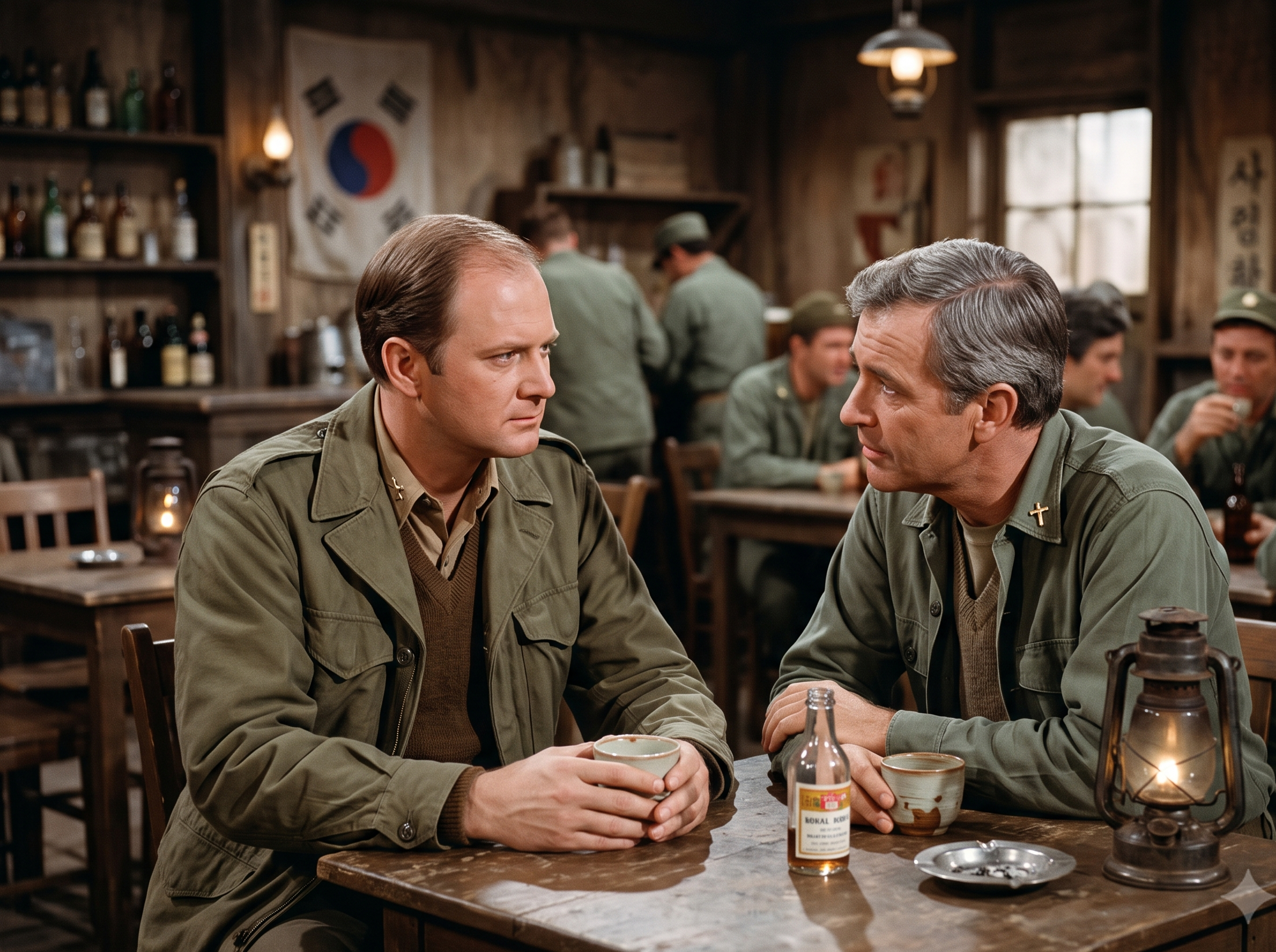
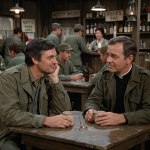
The air in Rosie’s Bar was always thick with a familiar, comforting grime. It smelled faintly of cheap garlic, stale beer, and the pungent sting of a local liquor that could easily strip the paint off a transport jeep.
For the men and women of the 4077th, it was the closest thing to a sanctuary they had on this side of the Pacific. It was a rustic, dimly lit social room with wooden walls where the war was supposed to wait outside the door.
Tonight, however, the war had followed Charles Emerson Winchester III right to his table.
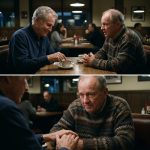
He sat perfectly upright on his wooden chair, his posture precise and relentlessly controlled. Even wrapped in worn olive drab and a heavy green wool sweater, Charles somehow wore his clothing like fine tailored suits.
But the deep shadows cast by the warm, flickering oil lantern on the table betrayed him. His face held a complex, painful mix of wounded pride and reluctant compassion.
His large hands were wrapped around a tiny, chipped ceramic cup, holding it as if it were the last piece of fine china left in the world.
Across the small, scarred table sat Father John Patrick Mulcahy. The chaplain leaned in slightly, his shoulders relaxed beneath his faded fatigue shirt.
The silver cross on his collar caught the amber light of the lantern. Mulcahy wasn’t speaking. He was simply offering quiet sadness and the gentle, moral warmth that made him the beating heart of the camp.
Behind them, the bar was a blur of tired soldiers in green, finding temporary escape in hazy conversation. A faded Korean flag hung on the worn wooden wall, a silent reminder of exactly where they were.
“I assure you, Father,” Charles finally said. His voice was laced with its usual aristocratic velvet, but the edges were audibly frayed. “I am merely enjoying a moment of solitary, quiet reflection. I do not require spiritual triage.”
Mulcahy smiled a small, knowing smile. He didn’t push. He just rested his forearms on the sticky table, looking at the proud surgeon with unshakeable kindness.
“I’m off the clock, Charles,” the priest replied, his voice barely above a whisper in the noisy room. “I just thought a man shouldn’t have to drink Rosie’s finest alone. It’s dangerous without a spotter.”
Charles huffed softly, dropping his gaze back down to the small cup in his hands.
They had just survived an agonizing, eighteen-hour marathon in the operating room. The wounded had poured in like a relentless gray tide. It was a nightmare of meatball surgery, noise, and bone-deep exhaustion.
But it was the very last patient that had managed to crack the thick ice around Winchester’s heart. It was a young, terrified corporal. A nineteen-year-old boy from a small town just outside of Boston.
A boy who had held onto Charles’s bloody sleeve and talked about the rowing crews on the Charles River, right before the anesthesia took him under.
A boy who, despite Charles’s most brilliant, desperate efforts, had not made it off the table.
Charles gripped his small cup tighter. His knuckles turned white under the strain. The ambient noise of the bar seemed to fade away, leaving only the heavy silence between the two men.
“He was practically a neighbor, John,” Charles whispered.
His voice was suddenly stripped of all its bluster, revealing the raw, terrified humanity he tried so hard to hide. The Boston armor was cracking, right down the middle, and Charles looked entirely unsure of how to stop it.
Father Mulcahy didn’t flinch. He didn’t reach out to pat Charles on the arm, knowing the proud surgeon would recoil from such an overt display of pity.
Instead, the priest simply nodded, his eyes locked onto Charles with deep, unwavering empathy. He understood that Charles didn’t want a sermon. He wanted an anchor.
“Cambridge,” Mulcahy said softly, letting the word hang in the warm, smoky air between them. “I remember you telling me once about the autumns there. You said the trees turn a color of gold that you can’t find anywhere else in the world.”
Charles stared at the table, his jaw tightening. He took a slow, uneven breath.
“Yes,” Charles murmured, the word catching slightly in his throat. “The maples. They catch the afternoon light just so. It makes the whole river look as though it’s been set on fire.”
He paused, his eyes closing for a fraction of a second.
“That boy,” Charles continued, his voice tight and heavy. “That corporal. He asked me if I thought the leaves had turned yet. I told him they had. I promised him I would personally ensure he was sent to a hospital near the river so he could see them from his window.”
Charles looked up, meeting the chaplain’s eyes. The wounded pride in Winchester’s expression was agonizing. It was the look of a man who believed his hands were meant to fix everything, faced with the brutal reality that they couldn’t.
“I lied to him, Father,” Charles said bitterly. “I gave him false hope. And then I let him slip away.”
Mulcahy leaned closer, the amber light warming the gentle lines of his tired face. Between them, an opened bottle of local rice liquor stood like a silent witness to their shared grief.
“You didn’t lie, Charles,” Mulcahy said gently. “You gave him comfort. In his last moments, he wasn’t in a dirty, freezing tent in Korea. Because of you, he was home. He was back in Massachusetts, looking at the gold leaves.”
Charles let out a short, cynical breath, shaking his head. He looked away, staring toward the dark bottles lined up behind Rosie’s counter.
“A charming sentiment, Father,” Charles replied, attempting to wrap himself back in his usual sarcasm. “But sentiment does not restart a stopped heart. It is a poor substitute for surgical success.”
“Perhaps,” Mulcahy conceded quietly. “But we are not always called to perform miracles of the flesh, Charles. Sometimes, the only miracle we can offer is a moment of peace before the end. You gave him that.”
The bar around them carried on. A soldier laughed loudly in the corner. Someone ordered another round of ribs. The war kept spinning outside the wooden walls, indifferent to the quiet tragedies playing out within it.
Charles looked back down at the modest ceramic cup in his hands. The tension in his shoulders slowly began to ease, just a fraction.
The desperate need to hold himself perfectly together at all times seemed to melt slightly under the priest’s quiet grace.
It was a bittersweet realization. Charles Emerson Winchester III, a man who prided himself on his total self-reliance, had found himself utterly reliant on the quiet strength of a modest army chaplain.
He didn’t hate the feeling as much as he thought he would.
With a slow, deliberate motion, Charles raised the cup to his lips and tossed back the clear liquid. He grimaced instantly, his eyes watering as the terrible, fiery brew burned its way down his throat.
“Good Lord,” Charles gasped, coughing slightly into his fist. “I am convinced this establishment distills its beverages from discarded jeep tires and medical alcohol.”
Mulcahy let out a soft, genuine laugh. The tension at the table broke, replaced by a warm, familiar comfort. The heavy ghost of the operating room finally stepped back, giving them room to breathe.
“It certainly builds character,” Mulcahy smiled, reaching out to pour another small measure into Charles’s cup from the bottle on the table.
“I have entirely enough character, thank you,” Charles grumbled, though he made no move to pull his cup away.
He adjusted his heavy wool sweater, sitting up a little straighter. The aristocratic mask was sliding back into place, but it was softer now. Less like armor, and more like a comfortable old coat.
Charles looked across the table at the priest. He took in the faded green of Mulcahy’s uniform, the tired lines around his eyes, and the relentless, quiet bravery that kept this entire camp from falling completely apart.
“John,” Charles said, his voice quiet, stripped entirely of sarcasm.
Mulcahy looked up from the bottle. “Yes, Charles?”
Charles held his gaze for a long moment. There were a thousand things he could say. He could complain about the dust, the food, or the sheer indignity of being stationed three thousand miles from civilization.
Instead, he just gave a short, stiff nod.
“Thank you,” Charles said softly. “For the… spotter’s assistance.”
Mulcahy smiled, raising his own empty cup in a silent toast.
“Anytime, Charles,” the priest replied warmly. “Anytime at all.”
They sat together in the flickering amber light of Rosie’s Bar, two very different men from very different worlds, anchored to each other in a place that made no sense.
They didn’t speak again for a long while, simply sharing the quiet, the warmth, and the rare, beautiful gift of temporary peace.
Some wounds can’t be stitched in the O.R., but they can be bandaged with a little time, a terrible drink, and the quiet presence of a friend.