The Midnight Library of the 4077th
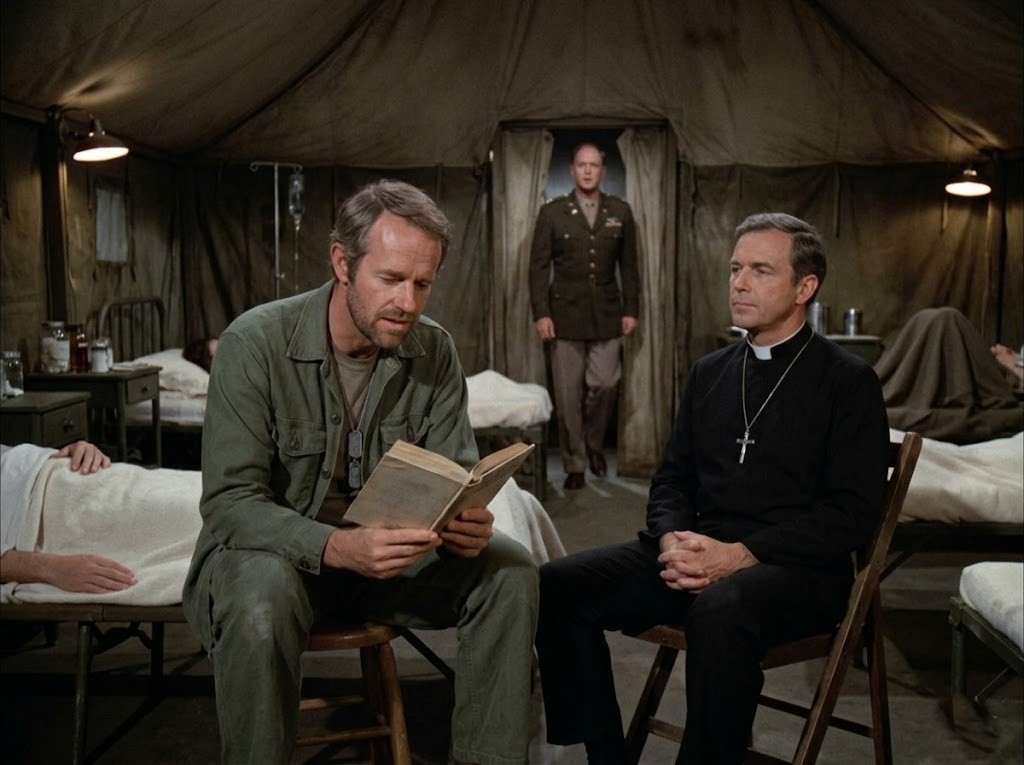
Post-Op at three in the morning possessed a very specific, heavy kind of silence.
It was never truly quiet, of course. There was always the rhythmic, ragged breathing of wounded men, the hollow drip of IV lines, and the low hum of the generator fighting a losing battle against the Korean night.
But after a forty-eight-hour marathon in the operating room, the silence felt thick enough to lean against.
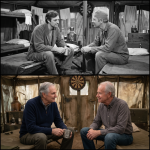
Captain B.J. Hunnicutt sat slumped on a rickety wooden stool between two rows of cots. He wore his rumpled green fatigues, his dog tags dangling freely over a plain olive t-shirt. He hadn’t shaved in two days, and his eyes burned with a dry, scratching ache that made blinking feel like a chore.
Beside him, sitting on a folding wooden chair, was Father Mulcahy.
The priest was a picture of quiet endurance. Dressed in his black clerical shirt, the silver cross catching the dim light of the bare bulbs overhead, Mulcahy sat with his hands loosely clasped in his lap. He wasn’t preaching. He wasn’t offering last rites. He was simply doing what he did best: holding the space, anchoring the room with his presence.
In the cot before them lay Private First Class Thomas Miller. The kid was nineteen, though he looked closer to fifteen beneath the bandages wrapping his shoulder and chest.
For the past twenty minutes, Miller had been fighting the morphine. He was caught in that terrible, restless twilight between waking and sleeping, his uninjured hand twitching, his breath coming in shallow, panicked hitches.
Every time he closed his eyes, the memory of the artillery barrage seemed to snap them open again.
B.J. knew the kid needed sleep more than he needed plasma. So, he had reached into his back pocket and pulled out a battered, dog-eared paperback he’d been carrying around for a week.
It was a copy of Robert Louis Stevenson’s *Treasure Island*, left behind in the mess tent by some passing journalist. B.J. had opened it to a random page in the middle, leaned forward resting his elbows on his knees, and simply started reading aloud.
He kept his voice low, steady, and entirely devoid of his usual sarcastic bite. He was just a father, thousands of miles from his own child, using the only tool he had left to chase away the monsters under a young boy’s bed.
Father Mulcahy watched B.J. with a soft, appreciative smile, entirely captivated by the strange, gentle rhythm of the moment.
“‘…we were now close in,’” B.J. read, his voice raspy from exhaustion. “‘And the new island lay before us, catching the first glint of the morning sun. The trees were tall, the sand a blinding white…’”
Private Miller’s restless shifting began to slow. The cadence of B.J.’s voice, deep and resonant, was doing what the medication couldn’t quite manage.
Then, the heavy canvas flaps at the end of the tent parted.
Major Charles Emerson Winchester III stepped into the doorway. Even after two days of non-stop surgery, Charles looked remarkably composed. He wore his tailored wool shirt, his posture entirely rigid.
Charles surveyed the dim tent. His eyes swept over the cots, landing immediately on the small gathering in the center aisle.
B.J. caught the movement out of the corner of his eye. His heart sank.
Charles was notoriously intolerant of anything he deemed “unprofessional nonsense” in the medical wards. A bedtime story hour at three in the morning was exactly the sort of thing that usually provoked a booming, pompous lecture about proper military hospital protocol.
B.J. stopped reading, his throat dry.
Private Miller immediately whined in the sudden silence, his good hand gripping the edge of his thin blanket as the panic began to return.
Charles puffed out his chest, his jaw setting as he took a deliberate step forward into the ward. He took a deep, unmistakable breath, ready to speak.
B.J. gripped the small book, bracing himself for the inevitable explosion.
“Hunnicutt,” Charles’s voice carried through the quiet tent.
It wasn’t a shout, but it possessed that unmistakable Bostonian authority that commanded absolute attention. Father Mulcahy shifted slightly in his chair, a flicker of polite concern crossing his gentle features.
“Yes, Charles?” B.J. sighed, too bone-tired to muster up a decent defense. “Look, the kid is just having a hard time settling down. Give me five minutes.”
Charles walked slowly down the center aisle, his hands clasped behind his back. He stopped just a few feet away, standing near the foot of the kid’s cot. He looked down at the young, bandaged soldier, then looked at the worn paperback in B.J.’s hands.
“Captain,” Charles said, his tone surprisingly even. “If you are going to attempt to soothe a patient with classic literature, I must insist you do it with at least a modicum of respect for the author’s intended rhythm.”
B.J. blinked, staring up at the Major. “Excuse me?”
“Your pacing,” Charles said, gesturing vaguely with one hand. “It is entirely too pedestrian. You are reading Stevenson as if you are reciting a list of surgical supplies. It requires a certain… theatricality. A sense of grand adventure.”
Father Mulcahy let out a very small, muffled sound that might have been a chuckle, quickly disguised as a cough behind his hand.
B.J. looked down at the book, then back up at Charles. A slow, tired smile crept onto his face.
“Well, Major,” B.J. said softly. “I’m just a simple country doctor. I don’t suppose a man of your refined breeding knows the proper way to read about pirates?”
Charles drew himself up to his full height. “My grandfather, Charles Emerson Winchester the First, considered Stevenson to be essential reading for any young man of substance. I knew the entire text of *Treasure Island* by heart before my tenth birthday.”
“Is that a fact?” B.J. asked, his tone softening into genuine warmth.
“It is,” Charles replied softly. He looked down at Private Miller, whose eyes were fluttering, caught between pain and the distraction of the quiet conversation.
Charles did not reach for the book. He simply stood tall, placed his hands gently on the iron railing at the foot of the bed, and cleared his throat.
When he spoke again, his voice had dropped an octave. It was rich, resonant, and filled with a surprising, quiet tenderness that he rarely let slip past his polished armor.
“‘…we were now close in,’” Charles recited from memory, picking up exactly where B.J. had left off. His voice washed over the ward like a warm blanket. “‘And the new island lay before us, catching the first glint of the morning sun. The trees were tall, the sand a blinding white, and the surf crashed against the rocks with a sound like rolling thunder.’”
B.J. leaned back on his stool, letting his shoulders drop. He closed the paperback, keeping his thumb holding the page, and just listened.
Father Mulcahy closed his eyes, a look of profound peace settling over his features.
Charles continued reciting for another five minutes. He didn’t do voices or act out the scenes, but he spoke with a steady, hypnotic gravity. He painted a picture of open oceans, brave sailors, and hidden shores—a world so far removed from the blood and mud of Korea that it felt like magic.
Slowly, the tension drained out of Private Miller’s body. His gripped fingers relaxed. His breathing deepened, matching the slow, steady cadence of the Major’s voice.
Finally, the young soldier’s eyes drifted shut, and he fell into a deep, merciful sleep.
Charles let the sentence trail off into a whisper. He stood in silence for a moment, watching the boy’s chest rise and fall steadily.
“Thank you, Charles,” B.J. said quietly, his voice barely above a whisper.
Charles cleared his throat softly, instantly retreating behind his usual mask of dignified professionalism. He adjusted the cuffs of his shirt.
“Think nothing of it, Hunnicutt,” Charles murmured. “I simply cannot abide the butchering of the English language. Now, if you gentlemen will excuse me, I have a post-operative abdominal case in bed four that requires my actual medical expertise.”
“Of course, Major,” Father Mulcahy whispered warmly. “Bless you.”
Charles gave a sharp, incredibly brief nod. He turned and walked quietly down the aisle toward the back of the tent, his dark silhouette disappearing among the cots.
B.J. looked over at Mulcahy. The priest opened his eyes and met B.J.’s gaze. They didn’t need to say anything. They had both survived long enough in this place to know a miracle when they saw one, even if it came wrapped in a pompous Boston accent.
B.J. carefully tucked the worn paperback back into his pocket. He looked at the sleeping kid, then up at the canvas ceiling of the tent.
The war was still waiting outside. The choppers would eventually return. The OR would fill up again.
But for tonight, in the quiet dimness of Post-Op, the pirates had chased the war away, and that was enough.
In the worst of places, they somehow always managed to find the very best parts of each other.