A Small Miracle in the Supply Tent
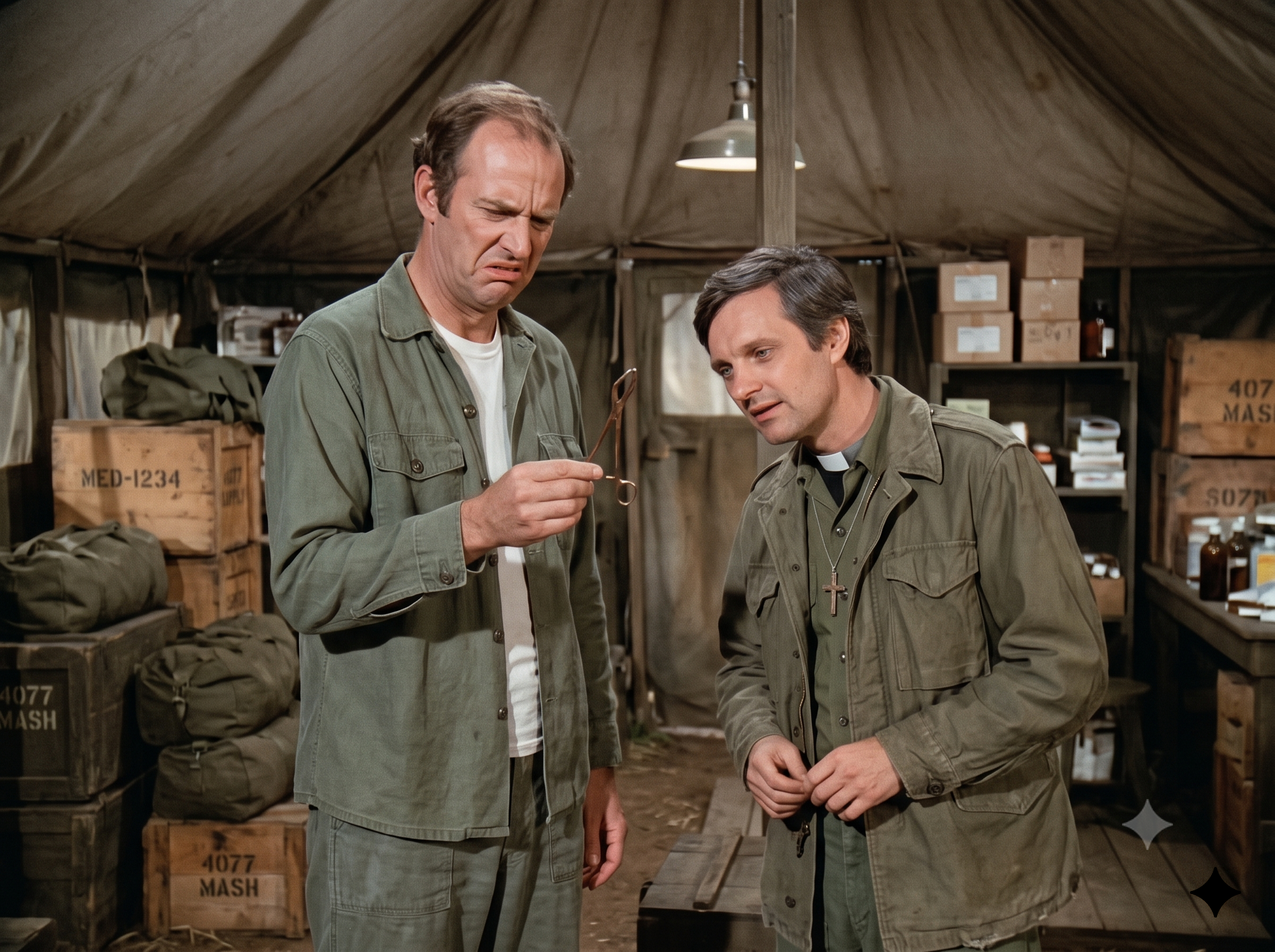
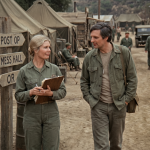
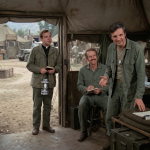
The afternoon sun was doing its best to turn the 4077th supply tent into an oven, but the stifling heat was the least of their worries. Hawkeye stood near a stack of crates, his expression a masterpiece of weary skepticism as he held a pair of rusted, peculiar-looking medical forceps between his thumb and forefinger.
He lifted the instrument, squinting at it as if trying to determine if it was a surgical tool or an antique nutcracker found in an attic. Beside him, Father Mulcahy leaned in, his brow furrowed in quiet, intense concentration. He wasn’t looking at the rust or the age of the metal; he was looking at it with the same gentle curiosity he might apply to a complicated theological question.
They had been searching for something entirely different—some elusive piece of equipment that had gone missing during the morning’s rush—but this strange object had surfaced instead. Hawkeye wrinkled his nose, his lip curling in a familiar, playful grimace of distaste, as if the very sight of the tool was an affront to his sensibilities.
“Father,” Hawkeye drawled, his voice tight with the exhaustion that usually set in after a long shift, “I’ve seen some prehistoric contraptions in my time, but I think this might predate the wheel. It looks like it was designed to extract stubborn wisdom teeth from a particularly grumpy T-Rex.”
Mulcahy didn’t laugh. Instead, he reached out, his fingers hovering just inches from the metal, his eyes reflecting a soft, unshakeable kindness. “It’s old, certainly, Hawkeye. But perhaps it served someone well once. Perhaps it held together a life that was falling apart, even if the edges were a bit jagged.”
Hawkeye looked down at the priest, his witty retort dying on his lips as he noticed the genuine solemnity in Mulcahy’s expression. The air in the tent grew suddenly heavy, the sound of a distant helicopter hovering over the base fading into a dull, rhythmic thrumming that seemed to vibrate against their ribs.
Hawkeye felt a sudden, sharp ache in his chest, a reminder of the dozens of patients who had passed through their hands that day. He turned the forceps over again, the metal cold against his skin, and felt the weight of all the things they couldn’t fix. He looked at the Father, his eyes searching for an answer, and felt the precarious balance of their fragile world begin to tilt.
“It’s not just a tool, is it?” Hawkeye asked, his voice barely a whisper now, the sarcasm finally stripped away.
Father Mulcahy looked up, his gaze steady and clear. “No. I suppose it’s a reminder. We spend our days trying to mend the broken, hoping that the work we do—however imperfect, however rusted—is enough to let someone go home to the people they love. Maybe that’s the miracle, Hawkeye. Not the instrument, but the hands that refuse to put it down.”
Hawkeye took a long breath, the kind that starts deep in the lungs and clears out the dust of the day. He looked down at the forceps again. In the dim light of the tent, the rust didn’t look so much like decay anymore; it looked like experience. It looked like survival.
He realized then that he wasn’t just tired because of the surgery or the heat. He was tired because he cared so deeply that it felt like he was carrying the weight of the entire war on his shoulders, one stitch at a time. And he realized, looking at the gentle, quiet man beside him, that he wasn’t carrying it alone.
“I suppose you’re right,” Hawkeye said, his voice softer, grounded by the priest’s quiet strength. He carefully placed the forceps back onto the crate, his movements deliberate and respectful. It was just a piece of metal, yet for a fleeting moment, it had acted as a bridge between the exhaustion of a surgeon and the quiet faith of a chaplain.
They stood there for a moment longer, two friends in the middle of a war, surrounded by crates and supplies, sharing the kind of silence that only exists between people who have seen too much and refused to let it harden them. The tension had evaporated, replaced by a profound, shared understanding. They would go back out there in a moment—back to the noise, the orders, and the inevitable cycle of the wounded—but they would do it differently.
As they walked toward the tent flap, the late afternoon light spilling in to meet them, Hawkeye clapped a hand briefly on the Father’s shoulder. There was no need for grand speeches or heroic declarations. In the world of the 4077th, kindness was often found in the quiet moments between the chaos, in the way a friend understood your silence, and in the shared knowledge that they were all doing their best to keep the light on in a dark time.
They stepped out into the camp, the hum of the 4077th continuing around them, a chorus of misfits and heroes just trying to make it to tomorrow. The forceps remained on the crate, a small, forgotten relic of a long day, but the comfort of the interaction stayed with them, a quiet armor against the world.
Sometimes, it’s not the tools we use, but the people we stand beside that help us make it through the day.