The List of Things We Carry
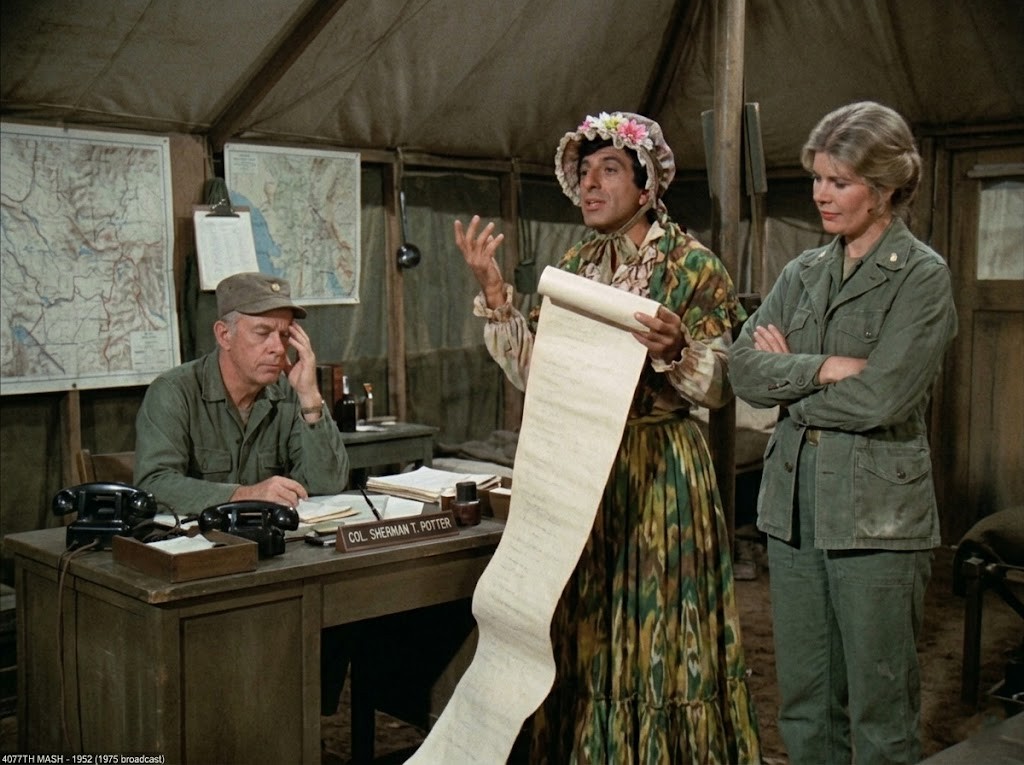
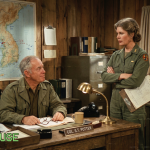
The air in Colonel Potter’s office that afternoon was thick, and it wasn’t just the dampness from the canvas.
It was the quiet after a 36-hour O.R. session that had left everyone’s souls feeling bruised and battered.
Colonel Potter sat behind his desk, hand pressed to his temple, staring blankly at the map of Korea on the wall, the same wall that held that neat clipboard with the roster of patients. His desk, normally immaculate, was a controlled battlefield of papers, double phones, and the reassuring bronze gleam of his nameplate.
Next to him, Radar was just… *there*. The company clerk, a fixture of the office, but his gaze was fixed somewhere past the wooden phones, perhaps back toward Iowa, with that look of observant weariness unique to someone forced to grow up too quickly.
Then, there was Klinger.
In a scene that could only be found in the 4077th, he was standing at the edge of the desk, dressed in full floral splendor.
He wore a patterned green camouflage dress and a matching bonnet adorned with delicate pink and white flowers, looking like a strangely elegant jungle hothouse plant.
But it was what he held that really mattered: a roll of paper so long it uncoiled down past his knees, pooling on the floorboards.
He held it out with one hand raised dramatically, his face a canvas of earnest pleading. He wasn’t performing; this was the genuine, desperate hope of a man trying, and failing, to escape insanity by proving his own.
Watching him, with her arms crossed tightly, was Major Houlihan. Margaret didn’t say a word, but her face—a mask of tired professionalism, concern, and a tiny, almost invisible sliver of understanding—said everything.
“Sir,” Klinger began, his voice breaking the stillness, “this isn’t just about my Uncle Leo’s pigeon training manual. This is evidence. Hard, undeniable physical proof.”
He unrolled another foot of paper with a dramatic flourish. Potter didn’t look up from his hand. Radar didn’t move.
Klinger’s eyes darted between them all. “This list, Colonel… it’s every time I’ve been overlooked. Every time my section 8 was unjustly denied when *clearly*…” he gestured to his outfit, “this isn’t standard issue.”
The tension in the tiny tent rose. It wasn’t anger; it was the heavy, collective weight of a unit that had given everything and was still being asked to give more.
“Every single time, Sir. Documented. Dated. And signed, usually by you, Sir, when you weren’t looking.”
Potter’s other hand moved from the desk to join the first, his face now completely covered, a silent admission of defeat against the sheer, theatrical force of Klinger’s persistence.
“It’s about the fairness of it all,” Klinger said, his voice rising, “When does the paperwork just end? When does the paper… just… stop?”
Klinger’s voice trailed off, leaving a silence that felt heavier than the O.R. air.
For a long moment, the only sound was the generator’s distant hum and the soft rustle of the list as a slight breeze stirred the canvas.
Finally, Colonel Potter slowly took his hands away from his face. His eyes were tired, yes, but they were clear.
He looked at the list unspooled across his floor, and then he looked at Klinger. Not at the dress, not at the bonnet, but at the man.
“You really kept track, didn’t you, Klinger?” Potter’s voice was surprisingly soft, devoid of its usual parade-ground rasp.
Klinger, still holding his dramatic pose, hesitated. “Yes, Sir. Every single one.”
Potter looked over at Major Houlihan. “Major, how many hours since we got into O.R.?”
“We just passed thirty-six, Sir,” Margaret replied instantly, her posture softening slightly as her arms uncrossed.
“And how many since the last chopper?”
“Nearly four, Colonel.”
Potter turned back to Klinger. “You know what else that paper reminds me of, son?”
Klinger lowered his hand. He hadn’t expected this.
“It reminds me of the supply lists we send out. The laundry lists. The personnel charts. The casualty lists we have to write up. More paper. More lists. More numbers.”
He reached out and picked up the end of the long roll on his desk.
“You’re right, Klinger. The paper doesn’t stop. And neither do we.”
The humor that often buffered Klinger’s performance evaporated, leaving something raw and true in its place. He realized Potter wasn’t talking *to* him; he was sharing a load *with* him.
“This is how we keep track, right?” Klinger said, his voice quiet. “This is how we don’t forget… that there’s a system somewhere, even if it’s crazy.”
Potter gave a small nod. “Sometimes, the system is crazy, son. But if we lose the paper, we lose the thread. And we all need to hold onto that thread.”
He didn’t make Klinger roll it up. He didn’t order him to get back into uniform.
Margaret walked over to Klinger and placed a hand gently on his arm. She didn’t speak, just a look that was both an order to fall back and a sign of respect.
Klinger, in his bonnet and heels, seemed to grow a little taller. He gathered his endless, meaningless list, carefully rolling it back up.
“Thank you, Sir,” Klinger whispered, and for the first time in memory, he wasn’t begging.
Radar finally looked up. He didn’t say anything either, but his eyes were wide, taking in the scene—the defeated commander, the theatrical soldier, the steadfast nurse—and processing it with that deep, observant understanding.
Klinger stepped out of the tent into the Korean sunset, the bonnet strings fluttering. Inside, Potter sighed, his hand returning to his temple, but this time, he wasn’t just hiding. He was remembering.
They would never leave this tent, the list makers, the paper chasers, and the ones too tired to list anything at all.
But for one small moment, in the warmth of shared absurdity and quiet care, the weight of the list was just a little easier to bear, a paper trail that proved, even in this godforsaken swamp, they were all in this together.
Sometimes the craziest people are the only ones holding the thread.