The Late-Night Anatomy of a Truce
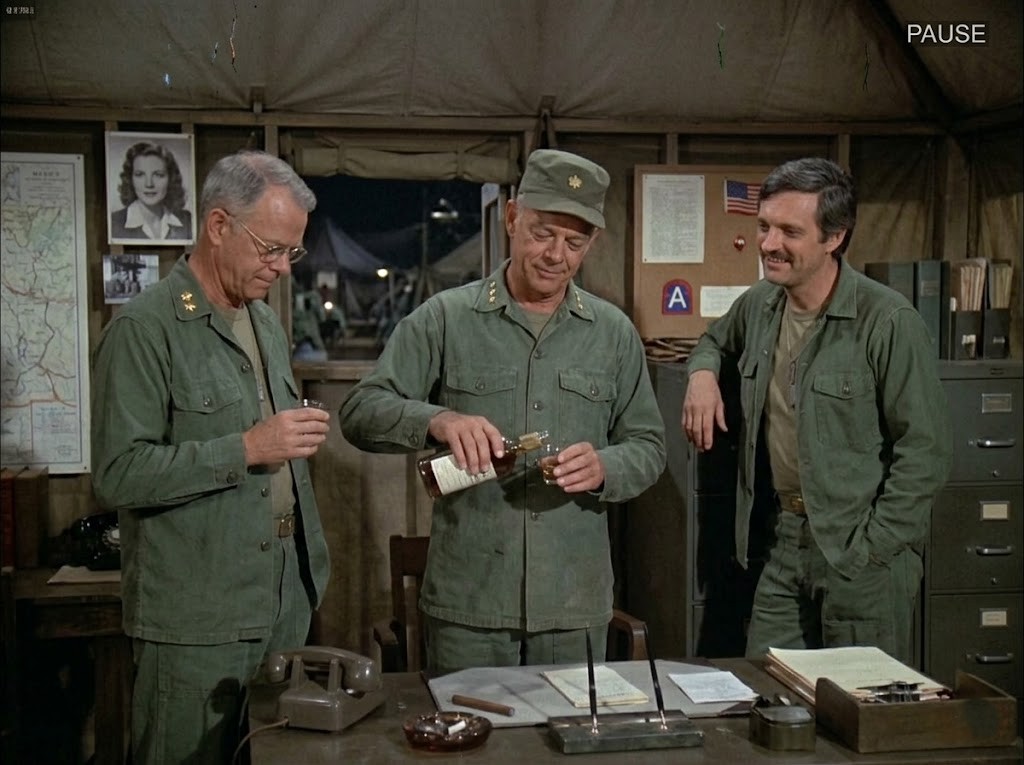
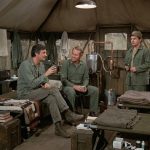
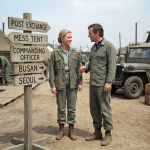
The mud outside Colonel Potter’s tent always had a way of creeping into a man’s boots, but tonight, it felt like it was creeping directly into our souls. The OR had finally gone quiet after a brutal thirty-six-hour marathon, leaving nothing behind but the faint, metallic smell of ether and the heavy, ringing silence of the Korean night.
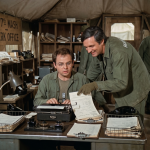
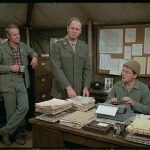
Inside the office, the overhead bulb flickered slightly, casting long shadows across the wooden desks, the olive-drab filing cabinets, and the framed map pinned to the wall. It was that specific hour of the night where tomorrow felt too exhausting to face, and today felt too heavy to put down.
Hawkeye leaned against a metal filing cabinet near the door, his hands thrust deep into the pockets of his fatigue jacket. His trademark grin was there, but it didn’t quite reach his eyes, which were framed by dark, bruised circles of pure exhaustion. Beside him stood General Brandon, a visiting brass hat from Seoul who had spent the last two days observing our little circus, looking for inefficiencies in our operating procedures.
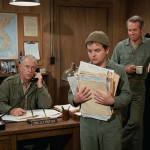
Between them sat Colonel Potter’s desk, cluttered with an overflowing ashtray, a stray cigar, and a pair of fountain pens standing at attention in their base. Potter himself stood behind it, his cap pulled down low over his brow, carefully tilting a half-empty bottle of amber whiskey over a small, clear shot glass.
“The regulations clearly state, Colonel, that official command spaces are to remain dry at all times,” General Brandon said, his voice flat, his posture rigid. He held his own small glass with a delicate, hesitant grip, looking down at it as if it were a tiny explosive device.
Potter didn’t stop pouring. His hand was remarkably steady for a man who had just spent a day and a half stitching human beings back together under a canvas roof. “General, with all due respect, the regulations were written by men sitting in rooms with central heating and indoor plumbing.”
Hawkeye shifted his weight, a slow, dry smirk spreading across his face as he watched the liquid rise in the General’s glass. “Besides, General, think of it less as a beverage and more as a topical antiseptic applied internally. It cleanses the spirit after a very dusty afternoon.”
Brandon didn’t smile; he looked between the two men, his brow furrowed with the weight of a decision that had nothing to do with the war, and everything to do with the strange, fragile rules of the 4077th. The silence stretched out, thick and tense, as the last drop of whiskey left the neck of the bottle.
The General looked down at the filled glass in his hand, then up at Potter, whose fatherly, unyielding gaze never wavered. For a second, it felt like the whole room was holding its breath, waiting to see if a court-martial was about to be served along with the drinks.
Then, Brandon took a slow, deep breath, his shoulders dropping just a fraction of an inch. The rigid spine of the Seoul staff officer seemed to soften under the warm, dim light of the tent. He raised the glass to his lips and took a neat, quiet sip.
“My God,” Brandon muttered, his eyes watering slightly as the cheap whiskey hit the back of his throat. “What is this stuff, Sherman? It tastes like aviation fuel mixed with battery acid.”
“Local vintage, General,” Hawkeye chimed in, his posture relaxing as he leaned further against the cabinet, his hands still tucked away. “We call it ‘Swamp Water ’53.’ A very cheeky year. It pairs beautifully with powdered eggs and absolute despair.”
Potter set the bottle down on the desk with a satisfying, solid thud. “It’s a special blend, General. It keeps the heart pumping when the brain wants to quit. I find it’s the only thing that dissolves the knots in my shoulders after a long shift in the swamp.”
Brandon looked around the room, taking in the scuffed desks, the faded pin-up picture on the wall, the old rotary telephone, and the tired, mud-splattered men standing before him. The administrative coldness he had brought with him from headquarters seemed to evaporate, replaced by the heavy, shared realization of where they actually were.
“I watched you out there today, Pierce,” the General said quietly, turning his gaze toward Hawkeye. “You were moving so fast I thought you were going to trip over your own gown. You didn’t lose a single one on your table.”
Hawkeye looked down at the floor, his humored expression slipping away for a brief, vulnerable second to reveal the raw fatigue underneath. “We got lucky today, General. The green ones usually break a little faster. Tomorrow, the wind might blow a different way.”
“It wasn’t luck,” Potter said firmly, stepping around the desk to stand closer to his men. “It’s what we do here. We patch them up, we hold them together, and sometimes, we have a drink in the middle of the night so we can wake up and do it all over again.”
The General nodded slowly, looking at his glass, then raised it slightly toward the two doctors. “To the 4077th,” he said, his voice dropping its formal edge entirely. “The finest, most undisciplined, miracle-working madhouse in the whole damn Army.”
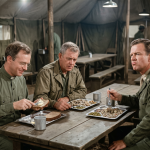
They drank in a quiet, synchronized rhythm, three tired men sharing a fleeting moment of peace in a corner of the world that knew very little of it. Outside, the distant, low rumble of artillery echoed through the hills, a reminders of the world waiting for them at dawn, but inside the tent, the warmth of the whiskey and the quiet bond of survival held the darkness at bay just a little longer.
Because in the end, it wasn’t the rank or the regulations that kept them sane—it was the quiet, shared understanding that as long as they had each other, the mud couldn’t win.