The Smallest Envelope in Korea
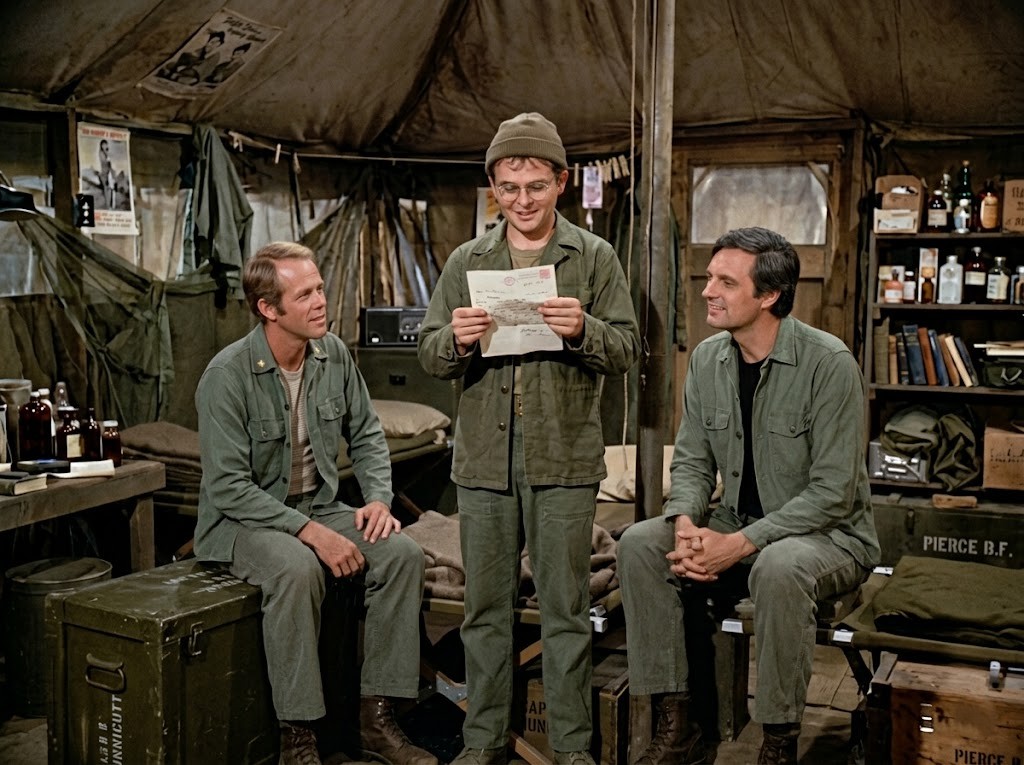
We called it The Swamp, and mostly it was just a canvas tomb for our exhaustion.
But sometimes, in between the shifts that stripped your soul, it became the only real living room we had.
Take this specific Tuesday. The silence in the tent was heavy. Not peaceful—just empty. We were all running on fumes.
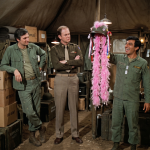
B.J. was sitting on his footlocker, looking at nothing. Hawkeye, eyes shadowed with a fatigue that no martini could fix, was on a cot, his hands clasped as if trying to hold himself together.
Even the endless sound of the generators seemed to have a tired edge.
Then, the canvas flap parted, and a beam of light cut through the gloom. It was Radar.
He didn’t just walk in; he drifted. He looked paler than usual, which is saying something for Walter O’Reilly. He was gripping his brown woolen beanie tight in one hand.
In the other hand, held out as if it might explode, was a single, tiny, airmail letter. It wasn’t a standard manila brown envelope. It was delicate, pale pink, and looked like it had been handled with extreme care.
“A-A package just arrived from Iowa,” Radar stammered, his voice cracking slightly in the quiet. He was usually so precise with his notifications, but now his words were stuck. “It’s… for everyone. For the whole outfit.”
Hawkeye finally looked up, his eyebrows arching in weary curiosity. B.J. leaned forward, his hands unfolding.
“For everyone?” B.J. asked, his voice unexpectedly gentle. “What is it, Radar? A communal fruitcake?”
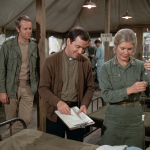
Radar didn’t answer right away. He looked terrified. His glasses caught the low light as he raised the small, frail envelope and began to open it. It was so small, he could barely fit his fingers around the seal.
The anticipation in the Swamp suddenly became electric. What could be so important, so small, and yet addressed to the whole 4077th? We held our breath as Walter took the final small item out, holding it up like a priceless gem…
… It wasn’t a communal fruitcake. It wasn’t money. It wasn’t even a full letter.
It was a tiny, rectangular piece of construction paper, and stuck meticulously to the center of it, with perhaps slightly too much glue, was a single crayon drawing of a purple daisy with wobbly green leaves.
Below it, in large, shaky, blocky letters, was a simple message: “STAY SAFE. WE WAITING.”
“I-It’s from my sister’s second-grade class,” Radar said, his voice trembling so much the little daisy was vibrating. He was holding the paper with both hands, staring at it. “She… she organized them all to draw pictures and write messages. She said… she wanted to make sure everyone knew someone remembered them.”
A profound, absolute silence fell over the Swamp. The kind of silence that usually only came after a helicopter left.
Hawkeye didn’t make a crack. He didn’t deflect with wit. He didn’t even look cynical. He looked… wrecked.
His dark hair was messy, and he just sat there, his mouth opening slightly but no words coming out. He saw the crayon daisy. He saw the unsteady writing. And he saw something else: a world of small hands and innocence that felt like a billion miles away from the smell of ether and mud.
A single tear rolled down Radar’s cheek. He blinked quickly, trying to stop it, but he couldn’t. This was the same kid who sorted mail for hundreds of soldiers every week, but this… this tiny piece of paper with its purple flower and messy letters had bypassed every defense he had.
Slowly, almost unconsciously, B.J. reached out and rested his hand firmly on the edge of Radar’s forearm. He didn’t say anything. He didn’t need to. The simple pressure of his hand said everything that words would fail to convey. It said: *We see it, son. We feel it. We’re here with you.*
Hawkeye watched the exchange, his face softening with a tenderness that was rare to see outside of the OR.
“Is that the purple of hope,” Hawkeye finally murmured, his dry wit returning, but softened by a deep affection, “or just the last crayon she had in the box?”
B.J. let out a quiet, genuine chuckle that was just loud enough to cut the tension. “I think the purple means she didn’t know how to draw a heart,” he smiled.
Radar sniffed, managed a wobbly smile in return, and quickly wiped his eyes with the back of his hand, his beanie still in his grip. He looked down at the tiny drawing, and you could see the pride washing over his face, replacing the fear.
“It is hope, Captain,” Radar said softly, his voice stronger now. “She said second grade believes in purple more than any other color.”
That night, in the Swamp, we weren’t just three tired soldiers in a dirty tent. We were friends. We were a family, reminded, by a wobbly purple daisy, that someone, somewhere, still saw our humanity through the mud. It was the smallest envelope that ever arrived in Korea, and it felt like the heaviest.
We hung the drawing right above Radar’s cot. We couldn’t take home with us, but Walter O’Reilly ensured that, for a few precious moments, second grade came to us.
Sometimes, the best medicine was sent in a crayon envelope.