A STROKE OF PINK IN A CANVAS WORLD
The war had a way of bleeding the color out of everything it touched, turning the world into an endless, muddy sea of olive drab and washed-out canvas.
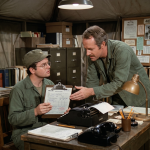
Inside the 4077th supply tent, the air always smelled faintly of damp wool, iodine, and old cardboard. It was a practical, dusty purgatory where the sheer exhaustion of the Korean conflict was stacked high in wooden crates and metal tins.
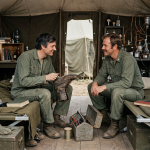
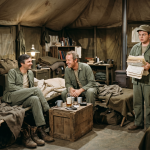
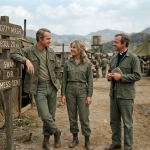
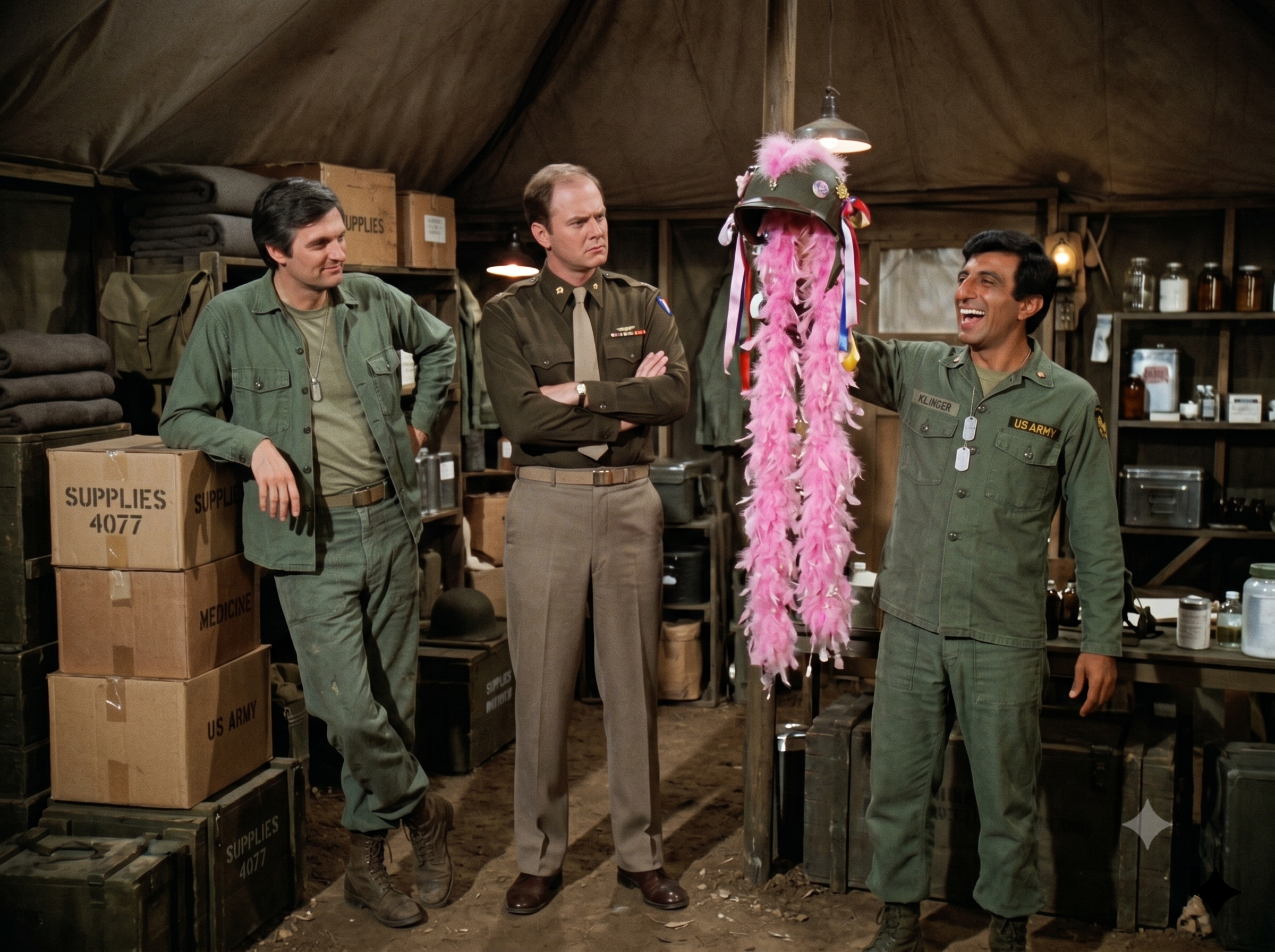
Hawkeye Pierce had retreated here simply to hide. He was leaning casually against a stack of thick cardboard boxes stenciled with “SUPPLIES 4077,” trying to steal five minutes of peace after a grueling twenty-hour session in the OR.
His green fatigue shirt hung unbuttoned over his t-shirt, his dog tags resting against his chest. He was exhausted down to his marrow, waiting for the inevitable sound of choppers to call him back to the blood and the noise.
Major Charles Emerson Winchester III had arrived a few moments later, immaculate as ever. Despite the dirt floor and the dim, warm light of the practical camp lamp swinging above, Charles stood rigid, his arms folded tightly across his chest.
He was wearing his Class B uniform shirt and a perfectly knotted tie, looking for a pristine bar of French milled soap that he was convinced the supply clerk was hoarding.
Neither surgeon had the energy to bicker. They simply existed in the quiet, dull beige textures of the tent, two men worn down by the sheer weight of saving lives in a place that specialized in ending them.
And then, Corporal Maxwell Q. Klinger walked in.
He wasn’t wearing one of his famous floral dresses or a velvet evening gown. He was dressed in standard-issue green fatigues, his own dog tags glinting in the dim light.
But what he held in his hands was nothing short of a theatrical miracle.
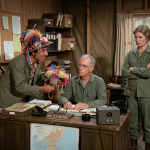
With a triumphant, ear-to-ear grin that could have lit up the entire compound, Klinger hoisted his creation into the air for the two officers to witness. It was a standard, heavy steel M-1 army helmet.
But cascading down from the drab metal dome was a massive, vibrant, utterly ridiculous explosion of hot pink feathers.
It was a feather boa of magnificent proportions, adorned with bright ribbons and completely impractical shiny trinkets. Klinger held it up like a holy relic, a monument to defiance, his face radiating an unmistakable, comic pride.
Hawkeye let out a soft breath, a sharp, teasing smirk instantly breaking across his tired face. He didn’t move from his casual slouch against the boxes, but his quick attention locked onto Klinger.
It was exactly the kind of improvised, resourceful absurdity that kept Hawkeye tethered to his sanity.
Charles, however, looked as though he had just been physically struck.
The Major stood frozen, his hands still tightly folded over his chest, his face fixed in a state of wounded pride and reluctant participation. He stared at the pink feathers with the profound disgust of a man judging a profound insult to human dignity.
“Gentlemen,” Klinger announced, his voice echoing in the quiet tent. “I present to you the ultimate weapon against the North Korean army. They see this coming over the hill, they drop their rifles and surrender out of sheer respect for high fashion.”
Hawkeye chuckled, a dry, raspy sound. “It’s beautiful, Klinger. I think it really captures the existential dread of a Tuesday in Uijeongbu.”
But the tension in the room suddenly shifted. Charles slowly lowered his chin, his eyes narrowing at the flamboyant helmet.
The Major drew in a deep, dangerous breath, preparing to unleash a devastating barrage of aristocratic insults that would undoubtedly shatter Klinger’s triumphant moment.
“Corporal,” Charles began, his voice a low, rumbling baritone of absolute disdain. “I have witnessed many atrocities since the army, in its infinite lack of wisdom, sent me to this forsaken sandbox.”
Charles took a half-step forward, his gaze locked entirely on the hot pink feathers gently swaying in the drafty tent.
“I have eaten powdered eggs that tasted of despair. I have endured the agonizing, ceaseless prattle of this camp. But that…” Charles pointed a trembling finger at the helmet. “…that is a monument to your own unparalleled, catastrophic tastelessness. It is an affront to everything that is decent and symmetrical in this world.”
Klinger’s wide grin didn’t falter, though he lowered the helmet just a fraction. “Major, you’re missing the artistic vision. It’s not just a helmet. It’s a morale booster. A beacon of hope in a dark, dark place.”
“It is a diseased flamingo sitting on a soup bowl,” Charles countered sharply, though his arms remained tightly crossed, as if to physically protect himself from the sheer absurdity of the object.
Hawkeye finally pushed himself off the stack of cardboard boxes. He shoved his hands into his pockets, walking slowly over to Klinger to inspect the ridiculous headgear.
“Take it easy on him, Charles,” Hawkeye said, his smirk softening into something quietly appreciative. “The kid is a visionary. A misunderstood genius of the supply depot. Where did you even get this, Max? Did a Las Vegas showgirl get drafted?”
Klinger sighed, the theatrical energy dropping away for just a fleeting second. He looked down at the pink feathers, gently brushing one with his thumb.
“I traded two jars of Radar’s homemade grape jam and a slightly used spark plug to a guy in the 8063rd,” Klinger explained quietly. “His sister sent it to him for Halloween. He didn’t want it.”
Klinger looked back up, his dark eyes suddenly very earnest. “You guys were in post-op for twenty hours straight. We lost three kids on the table. The whole camp feels like a graveyard today, Cap’n.”
Hawkeye stopped smiling. The memory of the OR washed over him, the smell of copper, the slippery feeling of gloves, the faces of boys who should have been at high school dances instead of dying on canvas stretchers.
“I figured,” Klinger continued, his voice modest and steady, “if I put this on and walk through the mess tent… maybe, just maybe, somebody laughs. Maybe some kid with his arm in a sling sees it and thinks the world hasn’t gone completely crazy.”
The silence in the supply tent stretched out, heavy and thick.
Hawkeye swallowed hard. He looked at Klinger, really looked at him. Beneath the jokes, beneath the dresses and the Section 8 schemes, Klinger was just a guy from Toledo desperately trying to keep the ghosts away from his friends.
Hawkeye reached out and gave the pink boa a gentle tug.
“It’s the most beautiful, ugly thing I’ve ever seen in my life, Klinger,” Hawkeye said softly. His voice was laced with a tired, profound affection. “You wear it to the mess tent. You wear it with pride. If the Colonel says anything, tell him I prescribed it for camp-wide depression.”
Klinger beamed, his chest puffing out again in that unmistakably resilient way.
Hawkeye turned his head to look at Charles. The Major was still standing rigidly in the center of the tent.
But the disdain on Winchester’s face had cracked.
Charles possessed a deeply buried, fiercely guarded compassion that he hated to let anyone see. He understood the crushing weight of the war just as much as Hawkeye did. He felt the losses just as deeply, even if he hid behind classical music and Boston bravado.
Charles looked from the tired, haunted eyes of Hawkeye Pierce to the earnest, hopeful face of Corporal Klinger. He looked at the ridiculous pink feathers resting against the cold, drab military steel.
Slowly, almost imperceptibly, Charles let out a long, quiet sigh.
He uncrossed his arms and adjusted the cuffs of his pristine shirt. He raised his chin, adopting his usual air of haughty superiority, but his eyes were entirely gentle.
“While I maintain that the aesthetic value of that… thing… is roughly equivalent to a severe head cold,” Charles said, his voice quiet, “I must concede that, in the realm of primitive psychological warfare, it may have a certain… tragic utility.”
Hawkeye raised an eyebrow, a genuine smile finally touching his eyes. “Was that a compliment, Major?”
“It was a reluctant observation of medical necessity, Pierce. Do not flatter yourself,” Charles replied stiffly. He turned on his heel, preparing to leave the tent. “Now, if you will excuse me, I am going to return to my quarters and attempt to erase the color pink from my memory.”
Charles stopped at the flap of the tent. He didn’t turn around, but he paused for just a second.
“Corporal,” Charles added softly over his shoulder.
“Yes, sir?” Klinger asked, standing a little taller.
“Ensure you walk past the post-op ward,” Charles murmured. “The boys in bed four and six… they could use a distraction.”
With that, Major Winchester pushed through the canvas flap and disappeared into the gray compound.
Hawkeye and Klinger stood alone in the dim, warm light of the supply tent. The shelves of medicine, the folded blankets, the endless crates of beige and olive drab surrounded them. But right there, in the middle of it all, was a vibrant, undeniable splash of color.
Hawkeye clapped a hand heavily onto Klinger’s shoulder, giving it a firm, grateful squeeze.
“Come on, Corporal,” Hawkeye said, his voice thick with a bittersweet warmth. “Let’s go show the war what Toledo is made of.”
Klinger placed the heavy steel pot on his head. The pink feathers cascaded down around his face, utterly absurd, deeply inappropriate, and entirely perfect.
Together, they walked out into the mud, ready to fight the darkness with the only weapons they had left.
In a place where everything was painted the color of war, the greatest act of survival was simply finding a way to make someone smile.