The Bureaucracy of Keeping Warm
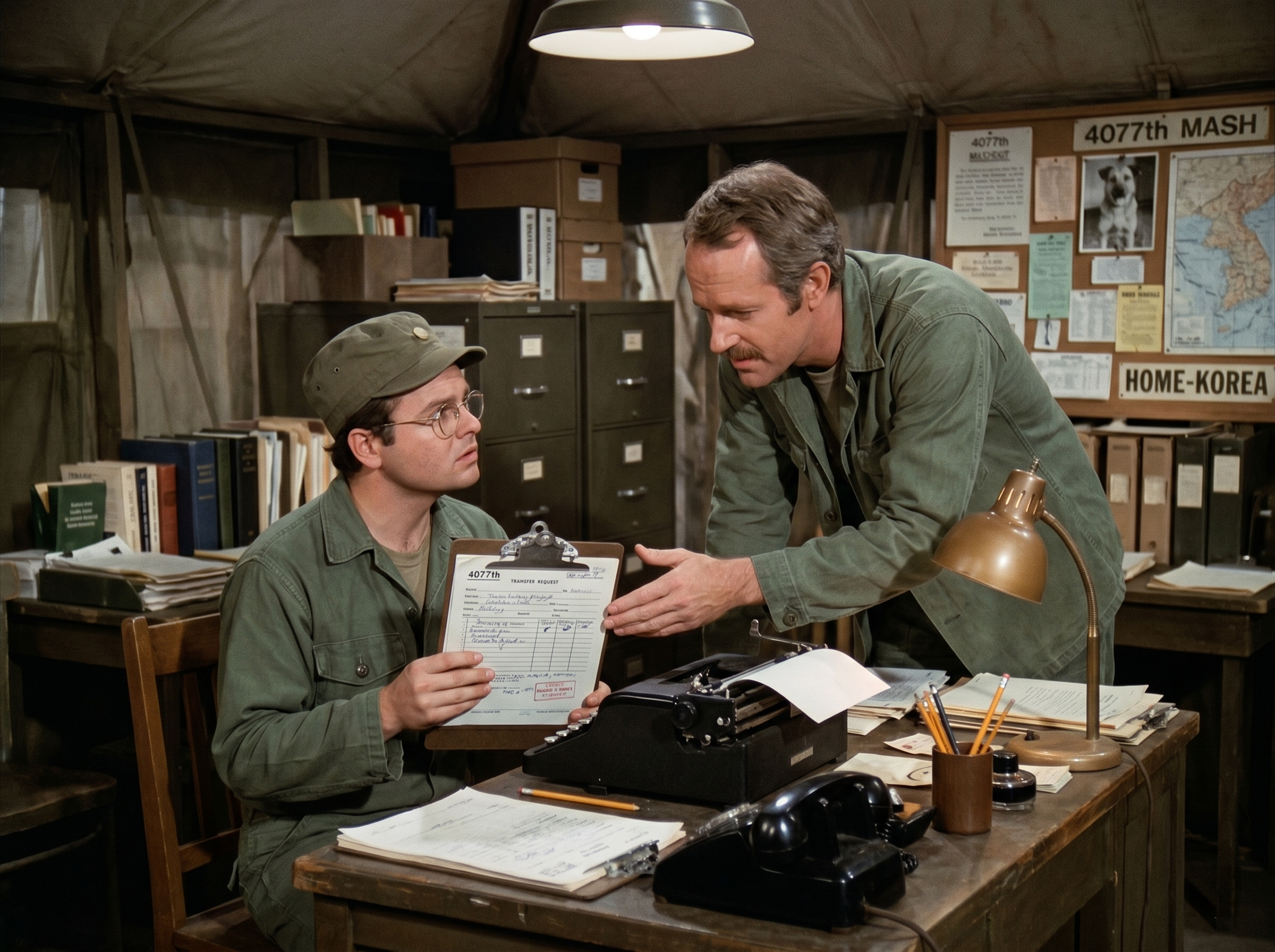
In a place where the loudest sounds were usually the screaming of chopper blades and the chaotic shouting of the triage pad, the quietest moments often carried their own strange, heavy weight. It was nearly two in the morning at the 4077th Mobile Army Surgical Hospital. The night was cold, the kind of deep, biting Korean cold that seemed to seep through the canvas tents and settle directly into a man’s bones. Inside the clerk’s office, the rhythmic, frantic clack of the black manual typewriter had finally ceased. Now, the only sounds were the soft hum of the wind outside and the nervous tapping of a pencil against a wooden desk.
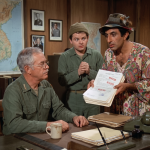
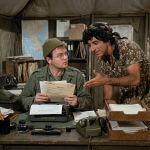
Corporal Walter “Radar” O’Reilly sat frozen in his chair. He was hunched beneath the soft, even glow of the overhead lamp, looking entirely defeated by a single piece of paper. He wore his standard green fatigue shirt and his olive-drab cap, pulled low over his forehead. Behind his round, thick-lensed glasses, his eyes were wide with a very specific, pure kind of panic. It wasn’t the panic of incoming wounded or a visit from a cranky general. It was administrative panic. The worst kind. Radar clutched a standard-issue Army clipboard against his chest like a makeshift shield, staring down at the document clipped to it. The form had “4077th” typed neatly across the top, followed by a series of serial numbers that were currently threatening to ruin his entire life.
The screen door whined on its hinges, and Captain B.J. Hunnicutt quietly slipped into the office. B.J. looked exhausted. He wore a faded green fatigue shirt unbuttoned over a standard olive tee, his shoulders slumped with the heavy fatigue of a man who had spent the last twelve hours standing over an operating table. He had come to the office looking for a fresh cup of coffee, or perhaps just a sanctuary where the air didn’t smell like ether and iodine. He stopped, noticing the small corporal trembling behind the desk. B.J. didn’t crack a joke. He didn’t offer a sarcastic quip. He saw the genuine, earnest distress radiating from the kid from Ottumwa.
B.J. walked slowly to the edge of the desk, stepping past the green metal filing cabinets and the crowded bulletin board with its maps, pinned notices, and the hand-painted “HOME-KOREA” sign. He leaned his tall frame forward, resting his right hand gently near the typewriter.
“Hey, Radar,” B.J. said softly, his voice a low, steady rumble in the quiet room. “You look like you just found out the Army banned comic books. What’s going on in the world of high finance and paperclips?”
Radar swallowed hard, his Adam’s apple bobbing nervously. He didn’t lower the clipboard. “It’s worse, sir. It’s much worse. It’s Form 409-J. Requisitions and Supply Logistics.”
“Alright,” B.J. said gently, stepping just a little closer. “I’ll bite. What did 409-J do to you?”
“It’s not what it did to me, Captain,” Radar squeaked, his voice cracking slightly. “It’s what I did to us. I was just trying to get ahead of the winter freeze. I was trying to order the new heavy-duty thermal long johns for the camp. The ones with the double-stitched seams that keep your knees from freezing together.”
“A noble pursuit,” B.J. nodded, his mustache twitching just slightly with a suppressed, fond smile. “God knows my knees could use the help. So, what’s the problem? I Corps denied the request?”
“No, sir,” Radar whispered, finally lowering the clipboard to the desk. He looked up at B.J., his face a mask of tragic guilt. “They approved it. But I didn’t type the code for thermal underwear, Captain. I misread the catalog. I typed the code for surplus WAC nylon hosiery. Six hundred pairs. And they’re arriving on the morning convoy. Colonel Potter is going to have me shot, sir. Right here in front of my filing cabinets.”
The silence in the small clerk’s office stretched out for a long, heavy moment. B.J. stood perfectly still, leaning over the wooden desk. The soft, warm light from the lamp illuminated the deep lines of exhaustion around his eyes, but his expression remained remarkably calm. He didn’t laugh, though the image of the entire 4077th medical staff trudging through the mud in sheer nylon stockings was fighting a fierce battle in his mind. He knew that to Radar, the United States Army was a massive, unforgiving machine, and a mistake on official paperwork was a sin that could never be washed away.
B.J. shifted his weight, his left hand reaching out to gently touch the edge of the clipboard. He looked down at the paper, his eyes scanning the neatly typed rows of numbers and bureaucratic nonsense. He offered a look of thoughtful concern, providing a quiet, anchoring empathy to the terrified young man in front of him.
“Radar,” B.J. said, his tone entirely serious, entirely grounded. “Take a breath. Nobody is going to shoot you. Not even Frank, and he actually enjoys shooting things.”
“But the supply budget, sir!” Radar protested, pushing his glasses up his nose with a trembling finger. “It’s completely drained! We own six hundred pairs of sheer nylons. The camp is going to freeze to death, and they’ll be wearing lovely, seamless hosiery when they do!”
B.J. leaned closer, his eyes narrowing as he studied the form. He knew the Army. He knew that for every rigid rule, there was an equally ridiculous loophole created by another bored clerk in a basement somewhere in Seoul. He rested his arm on the desk, right next to the black rotary phone and the brown cup full of freshly sharpened pencils.
“Let me look at this,” B.J. murmured. He traced his finger along the line Radar had pointed out. “Okay. Yes. I see the mistake. The code for the thermals is 8-Alpha-2. You typed 8-Alpha-3. It’s an easy slip of the finger. Your typewriter probably just has a sticky key.”
“My keys never stick, sir,” Radar said defensively, before his shoulders slumped again. “It was me. I was tired. I was thinking about my Uncle Ed’s tractor back home, and my finger just… slipped. I ruined winter.”
“You didn’t ruin winter, Walter,” B.J. said softly, using Radar’s given name to break through the panic. It worked. Radar blinked, taking a small, shuddering breath. B.J. tapped the paper. “Look here. See this little box at the bottom? The one marked ‘Unit Disposition Status’?”
Radar leaned in, squinting. “Yes, sir.”
“Right now, you have us listed as a ‘Static Medical Facility,'” B.J. explained, his voice taking on the patient, methodical tone of a teacher. “If we’re static, we keep whatever we order. But what happens if we change that box to ‘Mobile Transit Hub’?”
Radar frowned, his encyclopedic knowledge of Army regulations slowly overriding his fear. “Well… if we’re a transit hub, we aren’t the final destination for the supplies. We’re just a waystation. But sir, we aren’t a transit hub.”
“We are today,” B.J. smiled warmly. “If you re-type this form, check the transit box, and issue a forwarding order to the 8th Army Quartermaster Depot in Tokyo, those stockings never technically belong to us. They just pass through. And according to Section 4 of the Supply Code—which I learned strictly by accidentally reading Hawkeye’s mail—any supplies misrouted through a transit hub must be instantly replaced by the local supply depot with the originally intended items, to prevent operational collapse.”
Radar’s eyes widened. The panic began to recede, replaced by a slow, dawning awe. “You mean… we bounce the nylons back to Tokyo, and I Corps legally has to send us the thermals anyway?”
“Exactly,” B.J. said, giving the clipboard a gentle tap. “It’s not a mistake, Radar. It’s a logistical detour. All you need to do is roll a fresh sheet of paper into that beautiful black machine of yours, change one little checkbox, and file this original copy in the circular file under your desk.”
Radar looked at the typewriter, then up at B.J. The visible tension melted out of his small frame. He wasn’t going to the stockade. Colonel Potter wasn’t going to yell. The camp was going to be warm. “Captain,” Radar said, his voice thick with earnest gratitude, “you’re a genius. A genuine, certified genius.”
“I’m just a guy who knows how to survive a paper cut,” B.J. replied modestly, standing up straight and stretching his tired back. “You take care of the camp, Radar. It’s only fair somebody helps you take care of the paperwork.”
Radar immediately grabbed a fresh piece of carbon paper, his movements quick and precise once again. The heavy weight of the war felt just a little bit lighter in the small office. B.J. watched him for a moment, a warm, quiet affection settling in his chest. He turned toward the door, ready to finally get that cup of coffee.
“Oh, and Radar?” B.J. paused at the screen door, looking back over his shoulder.
“Yes, sir?”
“When those nylons do arrive tomorrow morning… see if you can snag one pair before you ship them off to Tokyo. I think Margaret’s been using surgical gauze to tie her hair back, and she could use a break.”
Radar grinned, the soft desk lamp reflecting in his glasses. “Yes, sir. Mobile Transit Hub, sir.”
In the heart of a senseless war, salvation rarely came from a general’s orders, but rather from a friend leaning over your desk in the middle of the night.