The Weight of the Cup at Rosie’s Bar
Sometimes, the mud of Korea didn’t just stick to your boots; it settled deep inside your bones. After a grueling thirty-six-hour shift in the Operating Room, the smell of ether and the ringing of metal surgical instruments could drive a man right out of his mind.
For Hawkeye Pierce and B.J. Hunnicutt, the only antidote to the madness was a slow walk across the dirt road to Rosie’s Bar.
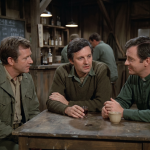
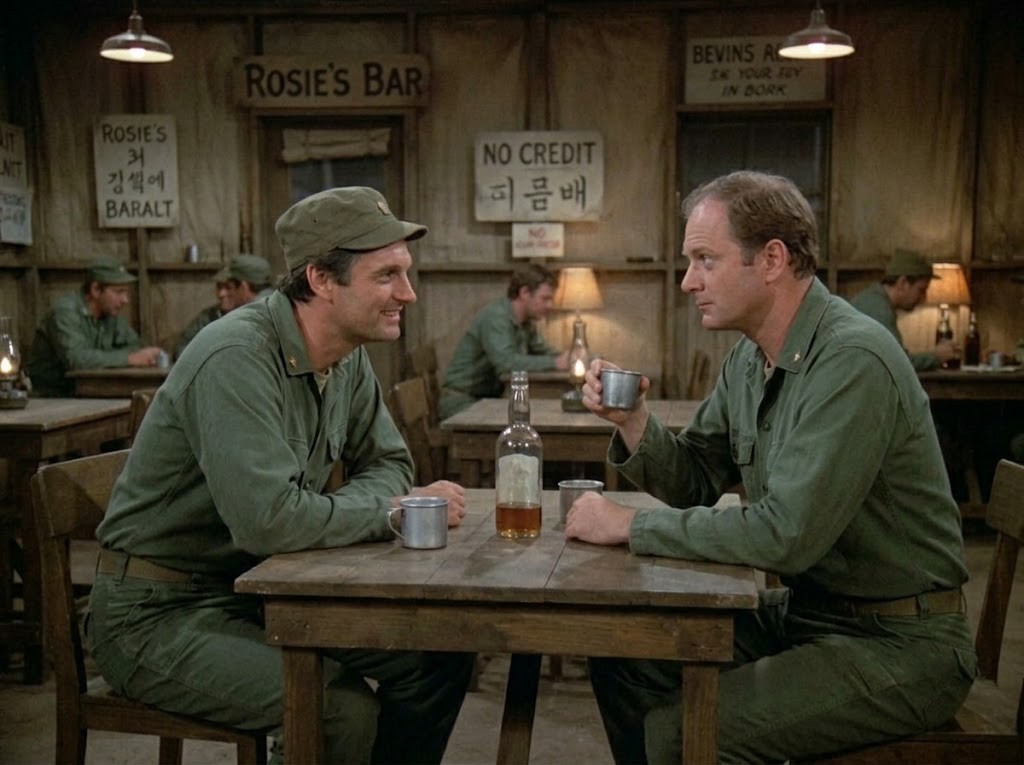
The bar was dim, cast in the familiar amber glow of low-hanging electric lamps and the soft flicker of kerosene lanterns on wooden tables. The weathered signs on the wall—”Rosie’s Bar” and the blunt “NO CREDIT”—offered a strange, comforting permanence in a world where everything else was temporary. In the background, a few other exhausted soldiers sat in the shadows, nursing their own drinks, trying to wash away the memory of the front lines.
Hawkeye sat hunched over the rough wooden table, still wearing his faded green fatigue cap, a tired but genuine smile finally breaking through his exhaustion. Across from him sat B.J., his face etched with the quiet gravity of a man who had spent the last day and a half holding human lives together with stitches and sheer willpower.
Between them sat a single, half-empty bottle of amber liquor and two battered metal cups.
“You know, Beej,” Hawkeye said, his voice a low, gravelly rasp from hours of shouting over the roar of incoming choppers. “If we stay here long enough, I think the wood grain on this table might actually start to make sense.”
B.J. didn’t answer right away. He slowly raised his metal cup, holding it level with his chin, his eyes locked onto Hawkeye with an intensity that made the laughter die down in Hawkeye’s throat.
The silence between them stretched, heavy and thick with the unspoken weight of the patients they had saved, and the ones they couldn’t.
Hawkeye’s smile faltered just a fraction as he looked at his best friend. He could see the faint tremor in B.J.’s hand—the subtle, telltale sign of a surgeon who had given absolutely everything he had left to give, only to wonder if it was enough.
“Hawkeye,” B.J. said quietly, his voice tight, holding the metal cup perfectly still. “I need you to tell me a joke. Right now. Because if you don’t, I think I’m going to start thinking about home, and I don’t know if I’ll be able to stop.”
Hawkeye looked at the metal cup in B.J.’s hand, then up into the eyes of the man who had become his brother in this God-forsaken corner of the world. The dry wit that usually flowed so effortlessly from Hawkeye’s lips suddenly felt heavy, like lead. He knew that look; it was the look of a man staring across an ocean at a wife and a daughter who were growing up without him, wondering if the person he was becoming here would even be recognizable to them when he finally got back.
“A joke?” Hawkeye murmured, leaning forward, resting his forearms on the scarred wood of the table. He forced his smile back into place, though it softened into something much more tender. “Alright. Two surgeons walk into a tent in the middle of a monsoon…”
He kept talking, spinning a ridiculous, convoluted story about a fictional general, a wandering goat, and a missing bottle of scotch. He used his hands, he changed his voice, and he threw in every bit of old-fashioned sarcasm he could muster. He did it because he knew B.J. needed the noise. In the 4077th, humor wasn’t just entertainment; it was a tourniquet for the soul.
As Hawkeye spoke, the tension in B.J.’s shoulders began to crack. A small, reluctant smirk tugged at the corner of B.J.’s mouth, and the tremor in his hand subsided. He finally took a sip from the metal cup, the cheap whiskey burning its way down, anchoring him back to the room, back to the reality of Rosie’s Bar.
“You’re terrible, Pierce,” B.J. muttered, setting the cup down with a soft *clink* against the wood. “That joke didn’t even have a punchline.”
“The punchline is that we’re still here to tell it, Beej,” Hawkeye said softly, his voice dropping the theatrical edge. He reached out and tapped his own metal cup against B.J.’s.
Just then, the door to Rosie’s creaked open, letting in a gust of damp night air. Colonel Potter walked in, his shoulders slightly hunched but his posture still holding that unmistakable old cavalry stiffness. He took one look at the two surgeons, sighed a deep, fatherly sigh, and walked over to their table.
“You two look like a pair of discarded shoes,” Potter said, pulling up a stray wooden chair and sitting down heavily. He didn’t ask for a glass. He just reached over, took the bottle, took a modest swig straight from the neck, and wiped his mouth with the back of his hand. “Good work today, boys. It was a hell of a mess out there.”
“Just trying to keep the customer satisfied, Colonel,” Hawkeye said, nodding toward the door as Radar O’Reilly peeked his head in, holding a clipboard and looking characteristically nervous.
“Sir? Colonel Potter?” Radar called out softly, his eyes darting around the dim bar. “Corporal Klinger says the generator is acting up again, and Major Winchester is threatening to write a letter to the Secretary of War if his electric blanket doesn’t get full power.”
Potter groaned, rubbing his temples. “Tell Klinger to fix it with a bobby pin and tell Winchester I’ll personally use his electric blanket to wrap a side of beef if he doesn’t pipe down.”
“Yes, sir,” Radar said with a small, comforting smile, entirely used to the routine, before ducking back out into the night.
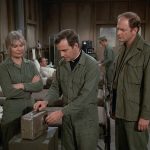
Inside the bar, the warmth returned. Major Houlihan stepped in a moment later, her uniform immaculate despite the grueling shift they had all shared. She didn’t say a word, but she walked past their table and placed a gentle, lingering hand on B.J.’s shoulder for just a second—a quiet acknowledgment of the lives they had pulled through together—before moving to sit with Father Mulcahy near the corner lantern.
B.J. looked around the dim room, watching the makeshift family that the war had thrust upon them. He looked back at Hawkeye, who was already pouring another splash of liquor into their metal cups. The deep, aching loneliness that had threatened to swallow B.J. whole just minutes before began to recede, replaced by the profound, quiet comfort of shared survival.
They were thousands of miles from home, surrounded by mud, misery, and the constant echo of artillery in the distance. But sitting at that rough wooden table under the signs of Rosie’s Bar, looking at the tired, smiling face of his friend, B.J. realized that home wasn’t just a place on a map anymore. It was the people who held you together when everything else was falling apart.
Hawkeye raised his cup one more time, his smile warm and completely devoid of mockery.
“To the next chopper, Beej,” Hawkeye said quietly.
B.J. raised his own cup, his hand perfectly steady now. “To the next chopper, Hawk.”
—
Amidst the dust and shadows of Korea, they found that the strongest medicine didn’t come from a bottle, but from the quiet loyalty of a friend who refused to let you face the darkness alone.