The Weight of a Piece of Paper
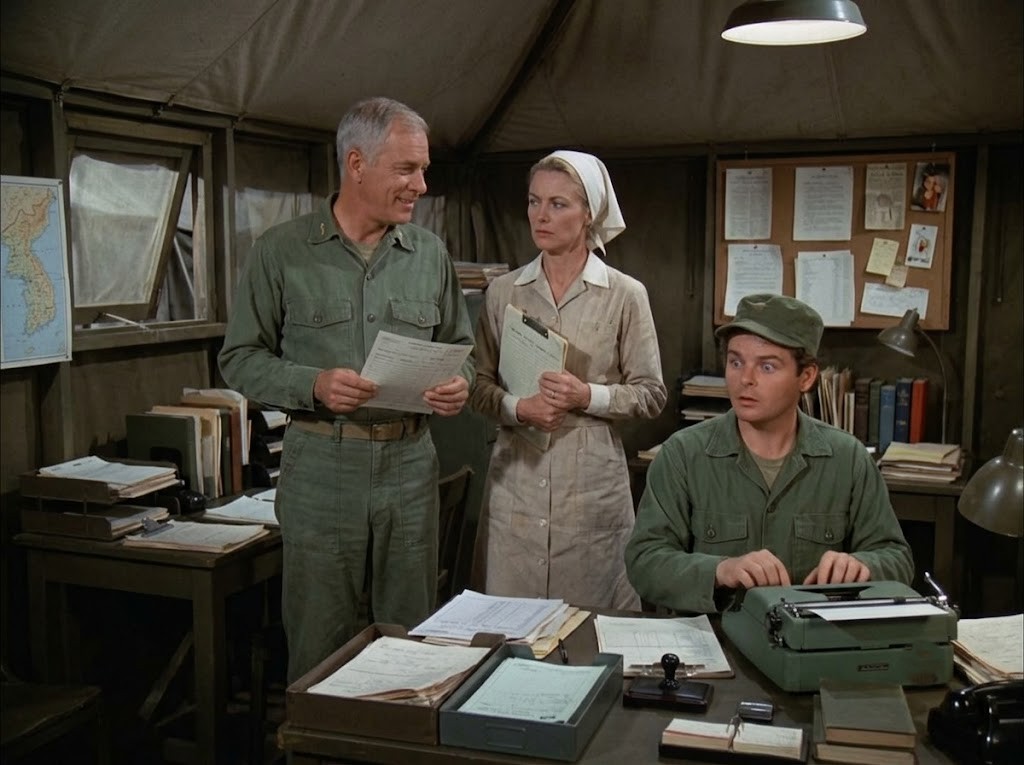
The rhythmic, metallic clack of Radar’s typewriter was usually the heartbeat of the 4077th. Today, however, it sounded more like a countdown, each keystroke echoing off the canvas walls of the administrative tent.
Outside, the Korean sun was baking the mud into a cracked, pale crust, and the heavy smell of dust and diesel hung thick in the air. Inside, the air was perfectly still, save for the sudden, sharp silence that fell when Colonel Potter cleared his throat.
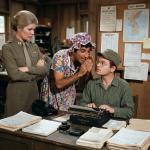
Colonel Potter stood by the desk, a sheaf of papers held loosely in his hand, his eyes scanning the lines with a familiarity that only decades of service could breed. His expression was unreadable—a mask of seasoned military discipline tempered by the deep, fatherly weariness that always seemed to settle in his eyes after a long casualty shift.
Beside him, Margaret stood rigid, her posture a perfect line of military decorum, yet her hand gripped her clipboard just a fraction too tightly. Her eyes weren’t on the papers; they were fixed entirely on the side of the Colonel’s face, watching for the slightest twitch of his jaw.
“Radar,” Colonel Potter said, his voice dropping into that quiet, gravelly register he used when the news wasn’t about supply lines or broken generators. “Take a look at this routing slip again.”
Radar’s fingers froze instantly over the keys, his head snapping up with wide, startled eyes. His round face, usually a mirror of innocent compliance, went entirely blank with a sudden, suffocating panic.
He didn’t just look at the Colonel; he looked through him, his internal radar already screaming that something in the fragile ecosystem of their camp was about to shatter. The typewriter sat between them like an unexploded shell, the white paper rolled halfway out of the carriage, waiting for a final sentence that nobody in the room wanted to dictate.
“Sir?” Radar squeaked, his voice cracking slightly as he shifted his gaze between the Colonel and Major Houlihan. “Is… is it the discharge orders for the sergeant in Ward Three? Because I swear I routed those through Seoul exactly like you said.”
Margaret stepped forward, her professional facade softening by a mere fraction, just enough to show the deep, protective ache she carried for every nurse and patient under her command. “It’s not the sergeant, Corporal. It’s the personnel reassignment list from headquarters. The one we’ve been waiting on for three weeks.”
Potter sighed, a sound that seemed to carry the weight of the entire war, and tapped the paper against his palm. “They’re shifting the boundaries again, Radar. Which means our intake numbers are about to double, and they’re freezing all standard rotations. Nobody goes home. Not this month.”
The silence returned, heavier this time, settling into the corners of the tent among the stacked crates and the pin-up calendars. It was the kind of news that broke men out here—not the shells, but the endless, stretching horizon of time that never seemed to get any closer to an end.
Radar looked down at his typewriter, his small hands resting on the cold metal frame. He thought of Hawkeye’s cynical jokes that were wearing thin, of B.J.’s quiet sighs when he looked at the drawing of his daughter, and of the sheer, bone-deep fatigue that lived in the O.R.
“Double, sir?” Radar whispered, looking up again, his eyes searching Potter’s face for some sign of a joke, some hint of the dry humor the Colonel used to shield them from the worst of it. “We’re already running out of penicillin. And Father Mulcahy just used the last of the communion wine to toast a kid who didn’t make it through the night.”
Potter walked around the desk, his hand coming down firmly on Radar’s shoulder, a solid, grounding presence in the small, canvas room. “We’ll manage, son. We always do. Because the people out there in those tents don’t care about headquarters’ maps. They just care that we’re here.”
Margaret nodded slowly, her chin lifting with that fierce, stubborn pride that made her the backbone of the nursing staff. “I’ll have Nurse Kelly inventory the surplus supplies immediately. If Seoul thinks they can overwhelm this unit, they don’t know the 4077th.”
A faint, bittersweet smile finally touched Radar’s face, the tension leaving his shoulders as he looked at the two leaders standing over him—not just officers, but the makeshift parents of a very large, very broken family. He rolled the paper in his typewriter up by one notch, his fingers finding their rhythm once again.
In the heart of the 4077th, the papers changed, the numbers grew, but the love that held them together never wavered.