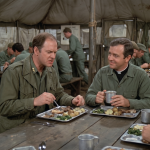
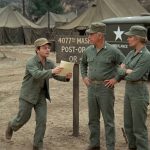
The Boston Requisition
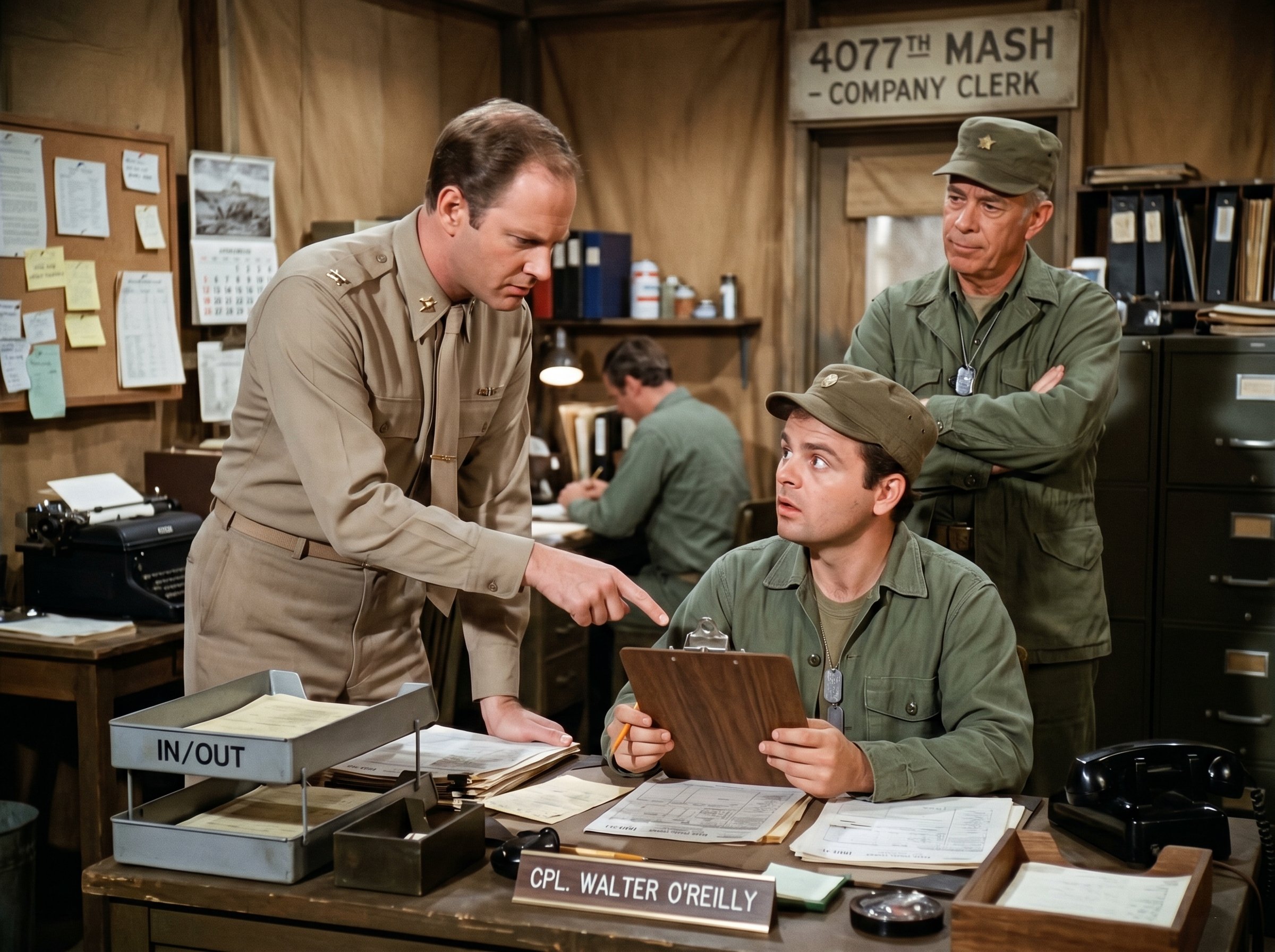
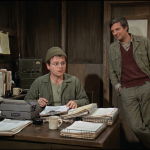
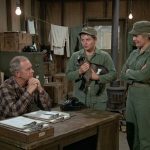
The 4077th MAS*H clerk’s office usually hummed with a quiet, chaotic rhythm. It smelled of stale coffee, mimeograph ink, and the faint, dusty scent of canvas baking in the Korean sun. The modest room was a clutter of filing trays, stacked beige paperwork, and a heavy black typewriter that had seen better days.
Today, however, the normal hum was completely silenced, replaced by the distinct, palpable aura of Bostonian outrage.
Major Charles Emerson Winchester III leaned heavily over the simple wooden desk. His posture was rigidly upright, his khaki uniform immaculate despite the everyday grime of the camp.
He looked exactly like a judge preparing to pass a very long, very uncomfortable sentence.
His elegant, manicured index finger jabbed aggressively at a standard-issue clipboard.
The clipboard was held tightly in the trembling hands of Corporal Walter “Radar” O’Reilly.
Radar sat frozen behind his desk, his wide-eyed concern and nervous confusion on full display. He wore his standard green fatigues and cap, looking very small and incredibly guilty beneath the Major’s towering shadow.
“Explain this to me, Corporal,” Charles demanded.
His voice dropped into that smooth, dangerous baritone that usually preceded a full-scale, operatic meltdown in the Swamp.
“Use small, easily digestible words. Because my admittedly superior intellect is completely failing to grasp the sheer, breathtaking magnitude of your administrative incompetence.”
Radar shrank back into his wooden chair. He pulled the clipboard closer to his chest, trying to use it as a makeshift canvas shield against the verbal assault.
His round eyes darted frantically from the form on the clipboard to the Major’s furious face, and then pleadingly over Charles’s shoulder toward the back of the room.
Standing quietly in the background, near the door frame, was Colonel Sherman T. Potter.
Potter had his hands planted firmly on his hips, his weathered face set in a mask of fatherly, dry amusement mixed with quiet exasperation.
He was perfectly content to watch the show for a moment, letting the theater of the absurd play out under the soft, practical office light.
“Well, sir,” Radar squeaked, his voice cracking slightly as he adjusted his glasses. “It’s just that… well, you see, the requisition form… Form 47-B…”
“I am intimately aware of the form’s designation, you diminutive bureaucrat!” Charles boomed, slapping the edge of the desk with his free hand.
“I spent three agonizing hours filling it out in triplicate. It was a request for a very specific, highly delicate diamond stylus for my phonograph.”
Charles leaned in closer, invading Radar’s personal space.
“Mozart, Corporal. Bach. Brahms. The only thin, fragile thread tethering my sanity to the civilized world in this godforsaken dust bowl of a country.”
Radar swallowed hard, his Adam’s apple bobbing nervously. “Yes, sir. I know, Major. But see, the supply depot in Seoul… well, the guys down there don’t always read things too good.”
“They are the United States Army, O’Reilly! They are ostensibly required to read before they issue supplies!”
“Right, but see, on line 14, where you wrote ‘Stylus, Diamond, one each’… well, Sparky at I Corps said the mimeograph ink smudged in transit.”
Charles froze. His jaw tightened, and his eyes narrowed to dangerous slits.
“The ink… smudged?”
Radar nodded miserably, looking like a puppy who had just chewed up a favorite slipper. “Yes, sir. And they, um… they misread the supply code.”
Charles straightened up slowly. He drew a deep, trembling breath, his chest expanding as if he were preparing to scream the roof off the tent.
Colonel Potter’s eyebrows shot up. He finally shifted his weight, taking a single step forward. He realized the comedic fuse had just burned down to the powder keg.
“Corporal,” Charles whispered, a terrifyingly calm and icy edge to his voice. “What exactly did you order me?”
Radar looked up, his face a picture of pure, tragic innocence framed by his oversized cap.
“Well, Major,” Radar mumbled, his finger tracing the dented metal edge of the clipboard. “Sparky thought the smudged word said ‘Baseballs, Diamond-brand.’ So… there’s a wooden crate of seventy-two baseballs sitting on the helipad right now. With your name stenciled on the side.”
Charles stared at him.
The silence in the small clerk’s office was absolute, save for the distant, rhythmic thumping of a helicopter miles away, and the wind rustling the tan canvas walls.
Charles’s mouth opened, but no sound came out.
He pointed a trembling finger at Radar, then at the offending clipboard, and finally out the small screen window toward the dust-blown helipad.
“Baseballs,” Charles finally breathed. He said the word as if it tasted like spoiled milk.
“Yes, sir,” Radar said softly, wincing in anticipation.
“Seventy-two of them.”
“Yes, sir. Regulation weight.”
“I ask for the means to listen to the greatest musical genius of the eighteenth century,” Charles began, closing his eyes and pinching the bridge of his aristocratic nose.
“And you provide me with the tools for a sweaty, boorish peasant pastime involving a wooden stick and running aimlessly in circles.”
“They’re very high quality, sir,” Radar offered helpfully, trying to find a silver lining. “Real horsehide. Sparky says they’re the same ones the Brooklyn Dodgers use.”
In the background, Colonel Potter couldn’t hold it in any longer.
A short, gruff bark of laughter escaped the Colonel’s lips, echoing loudly in the cramped office.
Charles snapped his eyes open and spun around on his heel, his posture stiffening even further.
“You find this amusing, Colonel?” Charles asked, his voice dripping with wounded dignity. “My utter cultural starvation is a source of levity for the commanding officer?”
Potter walked slowly forward, dropping his hands from his hips.
He moved with the slow, deliberate grace of a man who had seen a thousand real tragedies, and therefore knew exactly when to appreciate a harmless, ridiculous moment.
“Settle down, Winchester,” Potter said, his voice a low, comforting rumble that filled the room.
“Nobody’s laughing at your cultural starvation. We all know how much that phonograph means to you.”
Potter stepped up beside Charles, looking down at Radar’s desk.
“But you have to admit, Charles, seventy-two baseballs instead of a phonograph needle is a pretty spectacular Army foul-up. Even for this man’s army, that takes a special kind of administrative blindness.”
Charles deflated slightly. The rigid anger in his shoulders softened, though he kept his chin jutted out in stubborn defiance.
“It is a tragedy, Colonel,” Charles muttered, looking away. “A Shakespearean tragedy playing out in dirty khaki.”
Radar looked absolutely miserable.
He genuinely hated upsetting people. Despite the Major’s pompous exterior, Radar knew Charles worked just as hard in the O.R. as Hawkeye and B.J., and he knew the music was the only thing that helped the Major sleep.
“I’m really sorry, Major,” Radar said, his voice small and sincere.
“I tried to call Sparky back to fix it, but the lines to Seoul were blown down again this morning. I’ll fill out a new Form 47-B right now. Priority shipping. I promise I’ll get it right.”
Charles looked down at the young corporal.
For a fleeting second, the haughty Boston Brahmin mask slipped completely. Beneath the bluster and the sarcasm, a deeply tired, incredibly homesick doctor stood in his place.
Charles looked at Radar’s earnest, guilty face, and the sharp edge of his irritation finally dissolved into a heavy, weary sigh.
“Never mind, Corporal,” Charles said softly, waving a dismissive hand. “The damage is done. A new requisition will take six weeks. By then, I shall have surely perished from a severe lack of Mozart.”
Potter stepped up to the desk, resting a steady, weathered hand on Charles’s shoulder.
“Tell you what, Charles,” Potter said gently, his eyes twinkling with quiet kindness.
“Why don’t we take a walk down to my tent? I believe I have a bottle of something vaguely resembling single malt scotch hidden in my footlocker. It’s not a diamond stylus, but it does wonders for taking the edge off the silence.”
Charles looked at Potter, recognizing the olive branch for what it was—a lifeline of camaraderie from one career man to another.
He gave a short, stiff, but appreciative nod.
“That is… highly acceptable, Colonel. Thank you.”
As Charles turned to leave the office, he paused at the doorway. He glanced back at the stack of beige paperwork cluttering Radar’s desk.
“And O’Reilly?”
Radar jumped slightly in his chair. “Yes, sir?”
“Since I am now the proud, unwilling owner of seventy-two regulation baseballs,” Charles said, a hint of his dry wit returning to his voice, “I expect you to organize a camp game.”
Radar blinked. “A game, sir?”
“Yes, a game,” Charles sighed. “I may not lower myself to participate, but I fully expect to be thoroughly entertained from a safe distance, seated in a very comfortable canvas chair.”
Radar’s face lit up. A massive, genuine smile broke through his nervous expression.
“Really, Major? A game? Wow! I’ll go tell Hawkeye and B.J. right now! They’ve been dying to play!”
Charles rolled his eyes dramatically toward the ceiling, though the corners of his mouth twitched in the faintest hint of a smile.
“Lord help us all,” Charles muttered.
He swept out of the office, his dignity wrapped tightly around him like a tailored cloak, leaving the small room feeling suddenly much lighter.
Potter chuckled warmly, giving Radar’s shoulder a final, reassuring squeeze.
“Good work, son,” Potter said softly, looking toward the door. “You just bought the 4077th a little bit of home.”
Radar beamed. He looked down at the disastrous requisition form on his clipboard with a sudden surge of affection.
The Army messed up the paperwork all the time. But sometimes, when you were five thousand miles from home, the Army messed things up exactly right.
Sometimes the biggest mistakes on paper end up being exactly what the heart ordered.