The Cost of a Quiet Morning
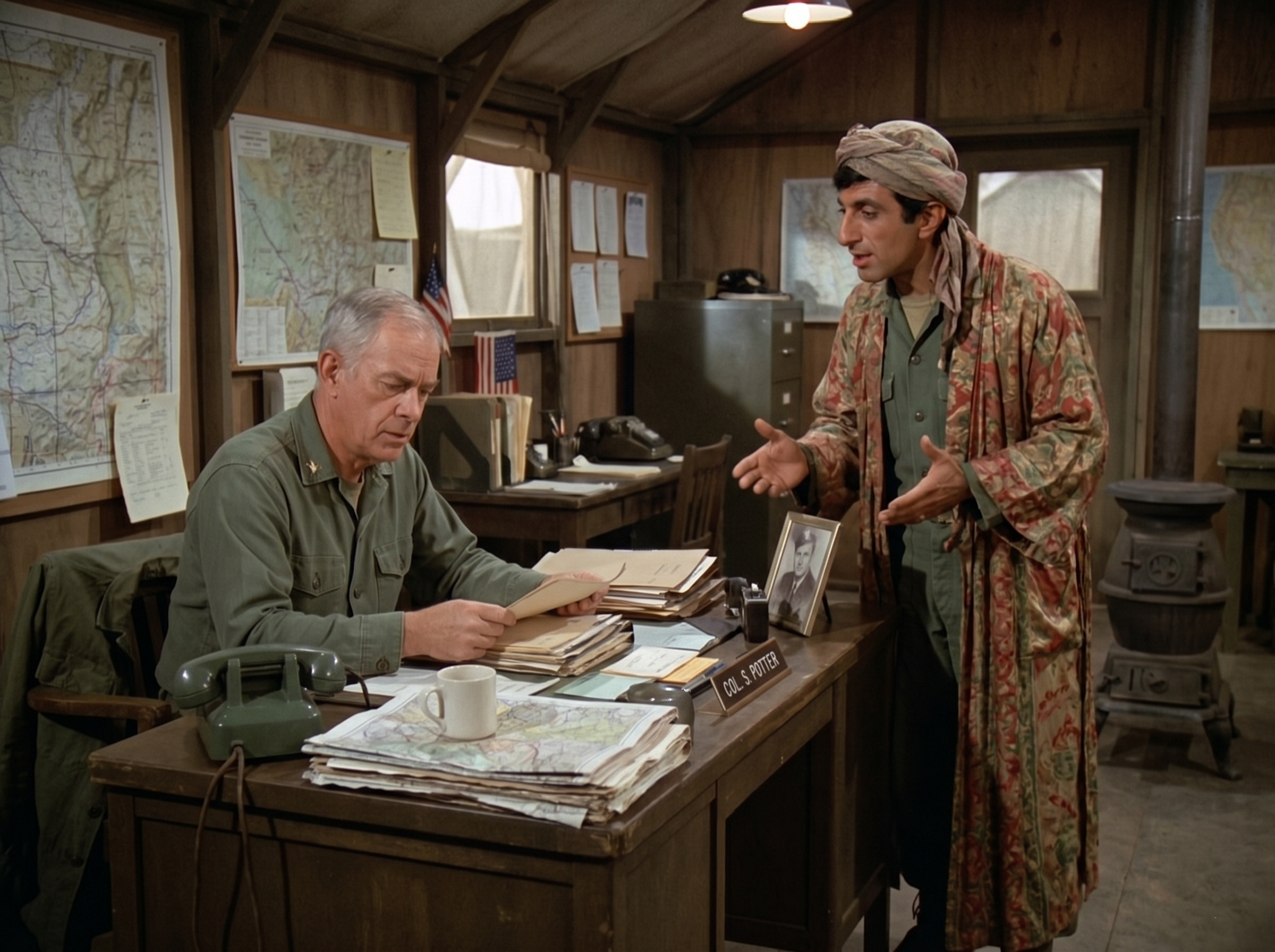
The coffee in Colonel Potter’s mug had long since gone cold, a stagnant little pool reflecting the harsh light of the Korea sun straining against the canvas walls. It was one of those mornings at the 4077th where the air felt thick with the weight of the previous night’s work.
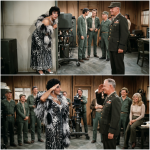
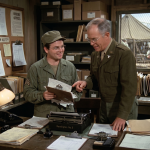
Colonel Potter sat behind his desk, hunched over a stack of requisitions that seemed to mock him with their sheer volume. Across from him, Corporal Klinger was in full performance mode. He was draped in a sprawling, floral-patterned dressing gown that looked like it had been salvaged from a lost luggage claim at a Parisian hotel, topped with a makeshift headwrap that defied both fashion and physics.
Klinger was gesturing wildly, his hands dancing in the air as he pleaded his case—likely another elaborate attempt to secure his section eight discharge or perhaps just a very creative way to request more supplies for the day. Potter didn’t even look up at first, his eyes scanning a document with the weariness of a man who had seen too many wars.
But then, Klinger stopped mid-sentence. His theatrical flair vanished, replaced by a sudden, jarring stillness. He leaned forward, his voice dropping from a frantic pitch to a shaky, genuine whisper.
“Colonel, look at me,” Klinger said, gesturing toward his own reflection in the small framed photo on the desk. “You think this is just a game? You think I wear this silk just to make people laugh? Look at the dates on those forms you’re holding, sir. I’m not just trying to go home. I’m trying to remember what it feels like to be human before I forget how to walk on two legs without someone shooting at me.”
Potter’s pen stopped dead on the paper. The silence in the office became deafening, pressing in on them like the mountain air. Potter finally looked up, his brow furrowed, his eyes searching Klinger’s face for the mask, but finding only a young man who was tired of being far away from his own life.
Potter sat back, the springs of his chair groaning under the shifting weight. He took a slow, deliberate breath, pushing the stacks of paper aside. For a long moment, the only sound was the distant hum of a generator outside and the steady ticking of a clock that didn’t seem to care about the war.
“Klinger,” Potter started, his voice gravelly but devoid of its usual sharp edge. “I’ve spent most of my life looking at men through a gunsight or a surgical mask. I know the look of a man who’s running out of road. You think this robe is a costume, but to me, it’s just another uniform—it’s just the one you chose to keep yourself from breaking.”
Klinger blinked, his bravado completely washed away. He slowly lowered his arms, the heavy fabric of the robe bunching at his elbows. The theatricality was gone, and for a second, he looked smaller, younger, and profoundly lost.
Potter didn’t scold him. He didn’t tell him to go change, and he didn’t bark about discipline. Instead, he reached into his desk drawer and pulled out a small, battered tin of ginger snaps. He pushed it across the desk, a quiet peace offering in a place where peace was often hard to come by.
“You want out, Corporal? We all want out,” Potter said softly, leaning into the desk. “But while we’re stuck here in the middle of nowhere, the least we can do is make sure we don’t lose ourselves entirely. If you want to wear that ridiculous curtain, wear it. But don’t you ever think I don’t see the man underneath it.”
Klinger took a breath, his shoulders finally dropping as the tension drained out of the room. He reached out, his fingers brushing the edge of the desk, and managed a weak, lopsided grin—not the performative kind, but a genuine, tired smile of acknowledgment. It was a silent pact made over cold coffee and stale cookies, the kind of quiet, fleeting moment that held the entire 4077th together when the world outside tried to tear it apart.
They didn’t solve the war that morning. They didn’t even solve the requisition forms. But as Klinger turned to leave, the floral gown trailing behind him like a strange, colorful cape, the office felt a little less like a bunker and a little more like a home. They were just people, trying to navigate the madness one day at a time, finding grace in the most unlikely of places.
In the heart of the madness, kindness is the only uniform that truly fits.