The Long Silence in the Korea Sun
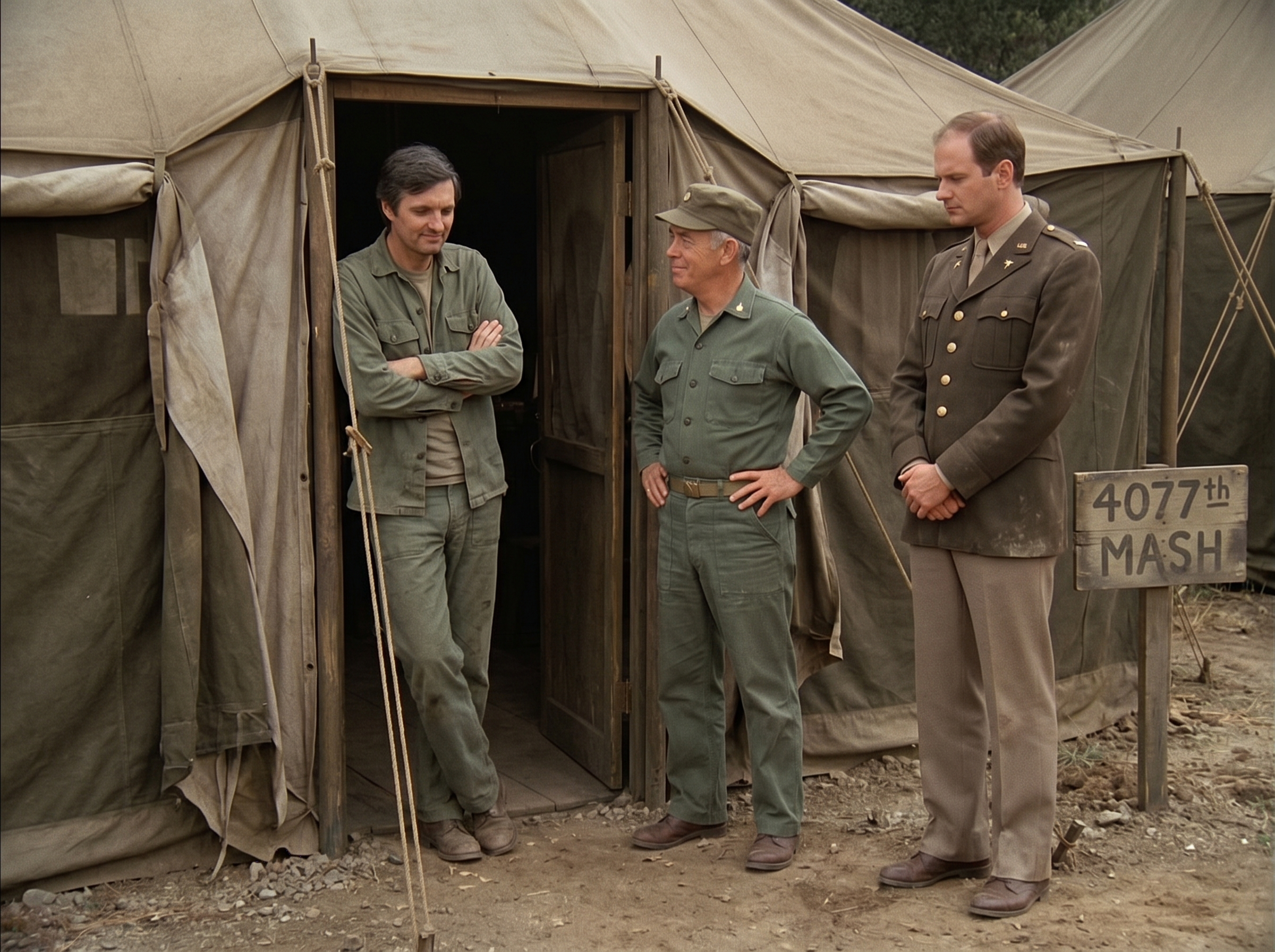
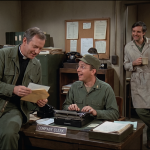
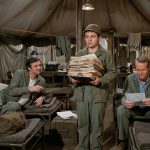
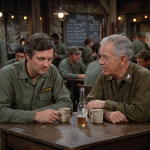
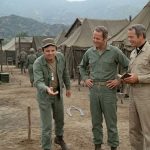
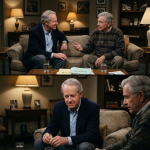
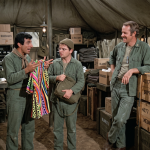
The late afternoon sun is just starting to slant across the compound, casting those long, deep shadows that usually signal the approach of dusk and, if luck was with them, the last surgical shift. You can feel the fatigue radiating from the ground up, a fine layer of dust coating everything: the tents, the vehicles, and especially the spirits of the people trying to stay upright. In front of the officers’ tent, three men have carved out a moment, not of conversation, but of quiet resignation, as if even words are too heavy to lift. The small wooden sign, ‘4077th MASH,’ leans tiredly against its post, a humble confirmation that yes, they were all still here.
Captain Benjamin Franklin Pierce, known to everyone who needed him or needed a drink as Hawkeye, is draped against the dark wooden frame of the doorway. He looks exactly how he feels: slightly unraveled and completely worn out. His green fatigues are rumpled and dusty, his arms crossed over his chest in that protective, defensive posture that says, ‘I am not talking, do not ask.’ His head is tilted down, his gaze fixed somewhere on the rough wooden floorboards, or perhaps just at the idea of a solid night’s sleep. He isn’t making jokes. He isn’t winding anyone up. The silence around him is heavy. He looks like he’s holding his breath, waiting for the other shoe to drop, even if it’s just the silence itself breaking.
A few steps away, Colonel Potter stands, solid as a weathered post. He’s in full uniform, including his cap, hands planted firmly on his hips in a stance that is part authority and part bone-deep weariness. He is looking directly at Hawkeye, and his expression isn’t his usual wry smile. It’s grave. Serious. Deeply concerned. In that face, etched with decades of military life and now the grim reality of this war, there’s a fatherly sort of worry that can only be seen when his guard is slightly down. He’s seen this look in men before. He knows that when the witty captain stops talking, the danger is inside. He’s watching, waiting for something, for the moment to intervene.
Then there’s Major Charles Emerson Winchester III. Standing a little apart, hands clasped together in front of him, he looks like a refined bird that has accidentally landed in a muddy barnyard. His uniform is impeccable compared to the others, a stark contrast to Hawkeye’s casual fatigues. He looks utterly miserable and profoundly self-contained. He is looking down at his clasped hands, his expression a mix of distaste and a tightly controlled, almost painful internal process. Charles is in his own private exile. He isn’t part of this unit in his mind; he is merely an observer, a visitor trapped in a very unpleasant dream, and this silence is his cocoon of dignity. He doesn’t want to engage, and his solitude is a weapon and a shield.
The air between them is so thick it feels like you could carve it with a surgical knife. Hawkeye hasn’t said a single word in nearly twenty-four hours. Not a bad joke, not a sarcastic remark to the nurses, not even a comment about the heat. His silence has slowly grown from a strange quietness to an oppressive, frightening void in the camp’s atmosphere. Everyone, from Klinger to Radar to Margaret, has felt it, and it has set the entire 4077th on edge. They all knew him to be the center of noise, of life, and this complete absence is like seeing a machine stop running. Colonel Potter has just told him that they have incoming casualties expected within the hour. The silence from Hawkeye in response has just stretched into its most alarming, heartbreaking minute.
Colonel Potter steps one inch closer to Hawkeye, his voice quiet but carrying the full weight of authority and affection. “Pierce. I need to hear you, son.”
Hawkeye slowly looks up, just enough to lock eyes with the Colonel. His face is blank. There’s nothing there but a deep, unreadable exhaustion. For the first time, not even a glimmer of wit.
Charles shifts his weight, the first movement he’s made, and he looks from his hands directly at Hawkeye, his gaze filled with a sudden, unsettling clarity, as if his own mask was beginning to slip.
The silence has become a scream.
The silence was so profound that you could almost hear the dust settling back onto the canvas. The entire camp seemed to hold its breath. Hawkeye’s lack of response was not defiance; it was an echo of total depletion. He just stared, that uncharacteristic blankness on his face. He’d seen too much that month. Not just in surgery, but everything. The constant push and pull of hope and despair had finally emptied him. There were no words left to keep the sadness at bay.
Colonel Potter didn’t move a muscle. His hands stayed on his hips, his posture commanding but his gaze remained gentle. He knew that pushing Hawkeye right now would be like hitting a fine porcelain teacup with a sledgehammer. He just waited. The moment stretched, full of silent questions. What had broken him this time? When would he come back? Could he come back? Potter’s concern wasn’t about the casualties; it was about the man standing in the doorway who had given so much of himself.
Winchester, typically the most verbose of them, remained perfectly still, hands still clasped, but his eyes were now locked onto Hawkeye. His habitual mask of intellectual superiority had given way to a raw, empathetic look. For all his claims of distance, Charles was acutely aware of his colleagues. He could see the toll. The sight of Hawkeye Pierce, of all people, completely silent was more disturbing to him than any number of casualties. His own refined isolation felt suddenly fragile. In Hawkeye’s silence, he saw a mirror of the despair he himself felt but would never, ever articulate.
Just then, the faint but unmistakable sound of a bell ringing broke through the quiet from across the compound. Radar’s bugle was still tucked away, but the camp was waking up to a new rhythm. People started moving toward the mess tent. A few corpsmen jogged toward the triage area. The world of the 4077th was starting to turn again, demanding their presence, forcing them to continue. The sound of life returning served to deepen the stillness between the three men in front of the tent. It was as if time had split into two layers: the busy world and the suspended breath of their conversation.
Finally, the tension was too much for Charles. He cleared his throat. It was a small, practical sound, but it cut through the oppressive air. Hawkeye’s gaze, which had been fixed on the Colonel, flickered to Winchester. The Colonel’s eyes followed. For that one second, they were all present, and the burden of the moment had been slightly distributed.
Winchester, without looking at either of them, raised his hand and rubbed his forehead with an elegant, weary gesture. “Well,” he murmured, the word carrying more weight than a speech, “I believe I will find some water. It is a profoundly… tedious… afternoon.”
It was the most human thing anyone had said all day. The sarcasm was there, but it was thin, and the underlying exhaustion was palpable. Charles wasn’t making light; he was just acknowledging, in his own way, that they were all tired. He wasn’t connecting, but he was at least participating. He wasn’t talking, but he was speaking.
Colonel Potter let out a long, slow sigh through his nose. His hands dropped to his sides, his shoulders slumped ever so slightly. The official demand was gone; now it was just an old soldier and his friend. “Yes,” he said, his voice softer now. “Tedious seems about right.” He looked at Hawkeye again, the concern still there, but mixed with a gentle, patient nod. He didn’t ask again. He just gave permission. Permission to feel it, and permission to be quiet.
Hawkeye looked at Potter. Then he looked at Winchester, who was still rubbing his forehead. And then, he did something incredibly small but profoundly significant. He shifted his weight from one foot to the other. Just that simple, normal movement. It broke the spell. It was the signal. I’m here. I’m moving.
Then, the final, faint, but powerful break came. Hawkeye let out a single breath that was half a cough, half a sigh. It was quiet, but in that silence, it sounded monumental. The muscles in his crossed arms relaxed a fraction. He didn’t smile. He didn’t say a witty comeback about Tedium. He just dropped his arms and stepped away from the tent frame.
“Tedious,” Hawkeye whispered. Just the one word. His voice was hoarse from disuse.
Potter didn’t say anything. He just looked at him, gave a tiny nod, and started to walk toward the hospital entrance. “Come on,” he called over his shoulder, his voice back to its practical tone. “There’s work to do.” He didn’t push, and he didn’t hug, because that wasn’t their way. He just gave order and structure to a moment that was threatening to fracture.
Hawkeye watched the Colonel walk away, then looked at Winchester again. The two men stood for a long moment, locked in a mutual, silent understanding. In that pause, the rivalry, the banter, and the differences in rank and ego faded away. They were just two tired men, caught in a madness they didn’t understand, sharing a moment of vulnerability they would never speak of again.
Charles straightened his jacket, his composure restored. He gave a single, almost imperceptible nod of acknowledgment to Hawkeye, and then turned and walked away with a measured, deliberate pace, heading toward his own tent, but with a slight spring in his step that hadn’t been there a few minutes ago.
Hawkeye stood alone in front of the tent for one last minute. The afternoon sun was turning a deeper orange. He took another breath. It was full of dust and despair, but it was also full of air. He ran a hand through his hair, shook his head as if trying to clear it of cobwebs, and then started to walk toward the hospital. The silence wasn’t gone. He still felt the weight. But the oppressive void had been cracked open by a single, shared, human moment. He wasn’t back to being Hawkeye, but he was, finally, back. The 4077th could still run. And so could he. For now.
The small sign, ‘4077th MASH,’ was still leaning against the post, a humble, enduring presence in the dust. The sun continued to set, the shadows continued to grow, and the people of the 4077th continued to move, one weary, human step at a time. It wasn’t an official ceremony, it was just life in a place that required a lot of heart, and that day, three men had helped each other find a tiny bit more.
They had survived another day, not with grand gestures, but with the quiet resilience that only found-family can provide.