The Fragile Weight of Quiet Afternoons
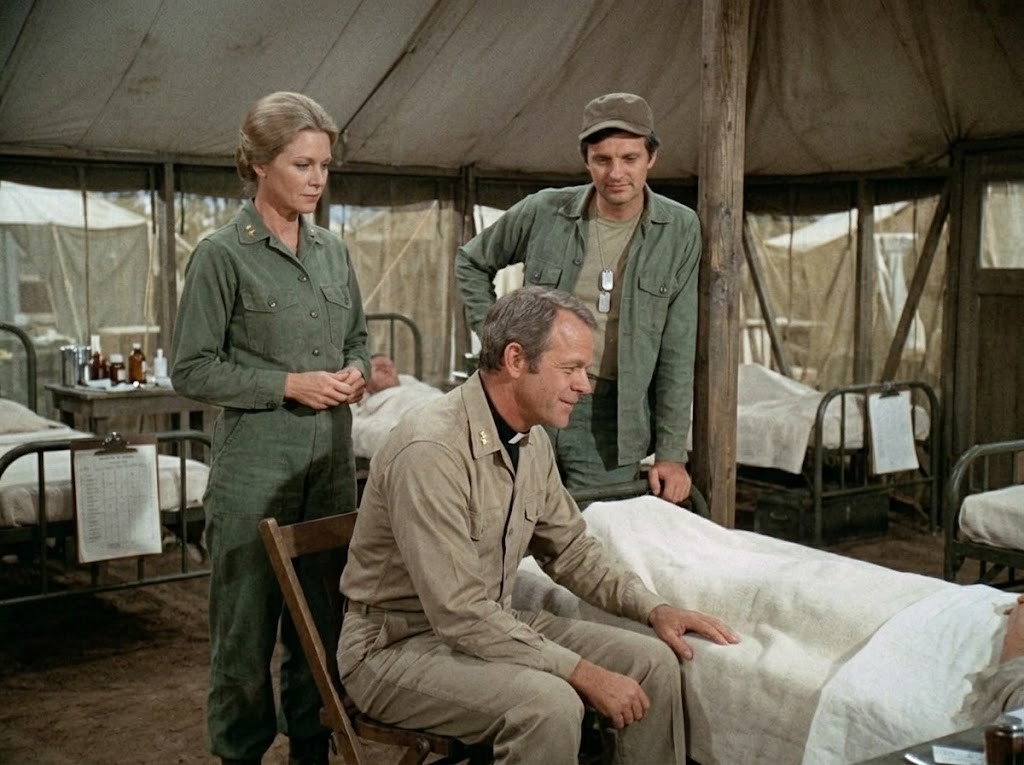
The Post-Op tent always smelled of damp canvas, old wool, and the sharp, antiseptic sting of rubbing alcohol.
On an afternoon like this, when the chopper blades had finally stopped thumping against the Uijeongbu sky, the silence felt heavier than the noise. It was the kind of quiet that made your bones ache, a reminder of how much exhaustion you’d been running on for the last seventy-two hours.
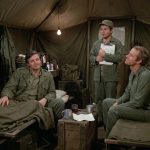
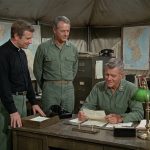
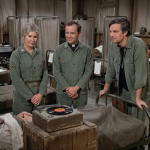
Hawkeye Pierce stood near the center pole of the tent, his hands resting loosely on his hips, his dog tags dangling outside his olive-drab shirt. He looked down at the cot, his face an uncharacteristic mask of guarded stillness, the quick-witted banter temporarily drained from his eyes.
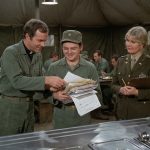
Beside him, Major Margaret Houlihan stood with her hands clasped tightly in front of her crisp uniform. Her blonde hair was pinned back neatly, but the tight set of her jaw spoke of a fatigue that no amount of military discipline could entirely hide.
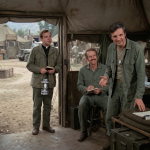
Between them sat Father Mulcahy, perched on a squeaking wooden folding chair. His tan jacket looked dusty, and the collar of his shirt peeked out beneath his civilian neck-piece, marking him as a man caught between two completely different worlds.
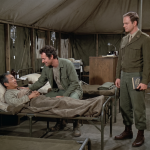
He was looking down at Private Thomas Miller, a nineteen-year-old kid from Iowa who had spent the last twelve hours drifting in and out of a feverish sleep.
The kid wasn’t in immediate danger anymore—Hawkeye’s surgical hands had seen to that—but his spirit seemed to be stuck somewhere in the muddy ridges of the front lines.
For the past hour, Miller had been tossing, muttering fragmented sentences about a silver pocket watch his grandfather had given him before he boarded the troop transport in San Francisco. He was convinced he’d dropped it in the mud during the retreat, and the loss was consuming what little strength he had left.
Father Mulcahy gently reached out, placing his hand over the boy’s trembling fingers on the white cotton blanket. The warmth of the gesture seemed to anchor the private for a brief second, his breathing slowing down as he blinked up at the priest with glassy, unseeing eyes.
“It’s gone, Father,” the boy whispered, his voice cracking with the fragile desperation of a child who had lost his only connection to home. “Everything’s just… swallowed up by the mud.”
Margaret shifted her weight, her eyes softening as she watched the boy’s face, her professional armor cracking just enough to let a flicker of deep, maternal sorrow show through.
Hawkeye swallowed hard, looking from the patient to the priest, the air in the tent suddenly feeling thick enough to choke on.
Then, the private’s hand went entirely limp under Mulcahy’s palm, his eyelids fluttering closed as a long, ragged sigh escaped his lips, leaving the tent in a terrifying, absolute stillness.
For one heart-stopping second, nobody moved.
Hawkeye instinctively stepped forward, his fingers instantly seeking the pulse point on the boy’s wrist, his medical instincts overriding his exhaustion.
But within three beats, Hawkeye relaxed, letting out a breath he didn’t realize he’d been holding. He looked across the bed at Margaret and gave a very small, reassuring nod.
“He’s just asleep, Father,” Hawkeye said, his voice dropping its usual theatrical edge, replaced by a quiet, gravelly tenderness. “The fever’s breaking. The kid’s just plumb exhausted from fighting the war in his sleep.”
Margaret let out a long, slow breath, her shoulders dropping an inch. She reached out and smoothed the corner of the chart clipped to the foot of the bed, her fingers tracing the metal frame just to give her hands something practical to do.
“He was talking about his grandfather’s farm right before you walked in, Father,” Margaret murmured, her voice gentle, devoid of the command-toggle tone she used outside these canvas walls. “He said the corn in Iowa gets so tall you can hide a whole childhood in it.”
Father Mulcahy didn’t take his hand away from the blanket. He smiled down at the sleeping boy, a look of profound, quiet gratitude washing over his weathered features.
“The things they hold onto,” Mulcahy said softly, looking up at Hawkeye and Margaret. “A pocket watch, a patch of dirt, a memory of a Sunday dinner. It’s the only armor they have against a place like this.”
Hawkeye leaned his back against the wooden support pole, a faint, wry smile touching the corners of his mouth as he looked at the priest.
“Well, Father, if he wakes up looking for that watch again, tell him I traded it to a local merchant for three bottles of terrible gin and a pair of dry socks,” Hawkeye joked quietly, though his eyes remained warm and completely devoid of malice. “That way, he can blame the doctors instead of the mud. We’re much better targets.”
Margaret offered a tiny, genuine laugh—the kind she only shared when the rest of the camp was asleep or too tired to notice. “For once, Pierce, your terrible reputation might actually be useful.”
The three of them stayed like that for a few minutes, a makeshift family bound together by green canvas, shared trauma, and an unspoken oath to keep the world from breaking these boys completely.
Outside, the distant, dull thud of artillery echoed against the mountains, a reminder that the world was still spinning out of control just a few miles away. But inside the Post-Op, under the soft, filtered light of the afternoon sun hitting the tent roof, there was peace.
Mulcahy patted the boy’s blanket one last time, then slowly stood up from the folding chair, his joints popping slightly from the damp air.
“I think he’ll be just fine now,” the Father said, adjusting his cap. “He has a good doctors, and the best nurses this side of the Pacific.”
“Don’t let it get around, Father,” Hawkeye grinned, finally stretching his arms above his head. “If people find out we actually care, they’ll expect us to start wearing clean shirts.”
Margaret shook her head, turning back toward the medicine cabinet to prep for the evening rounds, but the softness lingered in her stride.
Hawkeye watched the priest walk slowly toward the tent exit, his shadow lengthening across the dirt floor. It was just another ordinary afternoon at the 4077th—a tiny victory won not with scalpel blades or grand speeches, but with a quiet hand held in the dark.
Sometimes, the greatest medicine the 4077th had to offer wasn’t found in a bottle, but in the quiet, fierce devotion of the people who refused to let each other fade away.