The Ink-Stained Sanity of the 4077th
Sometimes, the only way to keep from crying in the middle of a war is to laugh at something completely ridiculous.
The Uijeongbu wind was howling outside, rattling the windows of the administrative tent and bringing with it the familiar, heavy scent of diesel and damp earth. Inside, the air was thick with the smell of stale coffee, old ink ribbons, and the quiet, bone-deep exhaustion that only a thirty-six-hour shift in the operating room could bring.
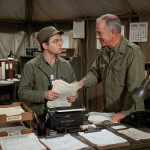
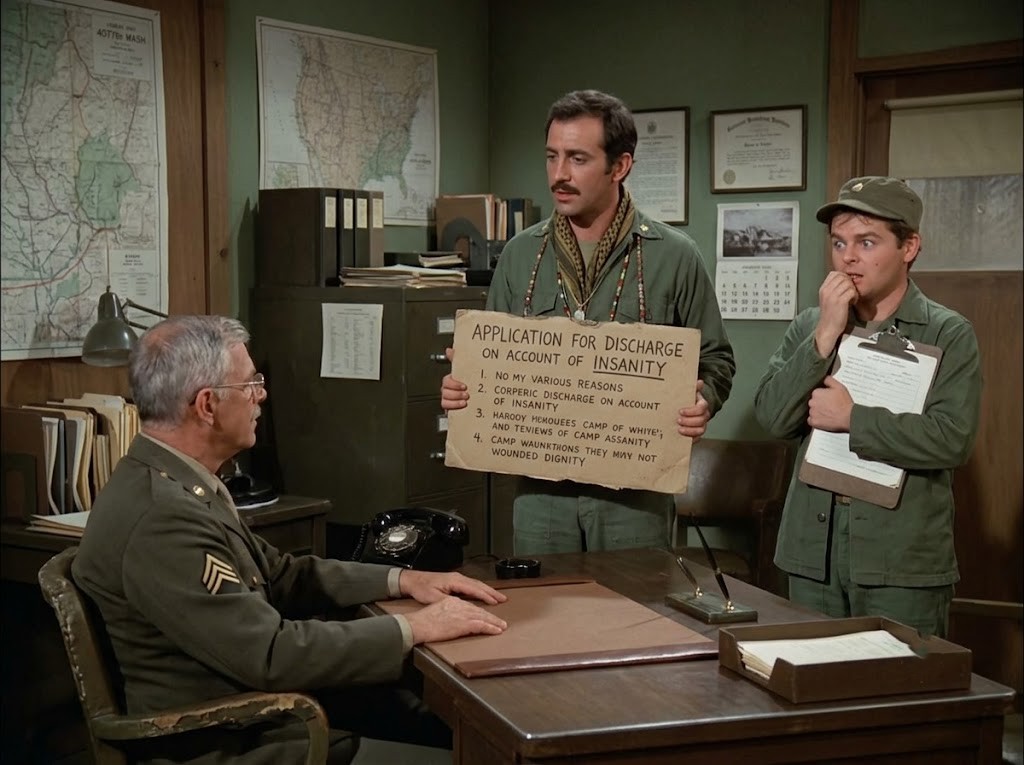
Sergeant Frank Harrison sat behind his cluttered wooden desk, his silver hair catching the dim overhead light, his back straight despite the ache in his spine. He had seen two world wars and a depression, and he usually possessed the patience of a saint, but today his regular calm was being thoroughly tested.
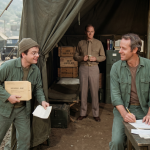
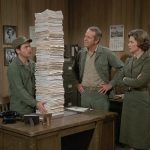
Standing across from him was Captain Jerry ‘Mac’ McIntyre, a surgeon whose humor was normally as sharp as his scalpel, but who currently looked like a man who hadn’t slept since Tuesday. Mac was holding a makeshift cardboard sign, propping it up with a look of deadpan seriousness that belonged in a courtroom rather than a drafty tent in Korea.
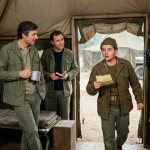
Beside Mac stood young Corporal Billy ‘Penny’ Pennington, the company clerk, clutching a clipboard tightly against his chest like a shield, his eyes wide and anxious as he nervously bit his thumbnail.
The sign Mac held was hand-painted in crude, bold letters, reading: ‘APPLICATION FOR DISCHARGE ON ACCOUNT OF INSANITY.’ Underneath the title were four numbered points, written in a strange, fractured jargon that looked like a typewriter had lost its mind.
“Just read the terms, Sarge,” Mac said, his voice entirely flat, though a faint, tired glint danced in his eyes. “It’s all there in black and white. Clear as mud.”
Harrison adjusted his glasses, leaning forward to squint at the cardboard. “Mac, I’ve read a lot of army regulations in my thirty years of service, but I have never seen the word ‘Corperic’ used in a sentence. What the hell is a ‘Corperic discharge’?”
“It’s a deeply medical term, Frank,” Mac explained smoothly, adjusting the scarf wrapped around his neck. “Very exclusive. It means my sanity has officially packed its bags, checked out of the compound, and caught the last ferry back to San Francisco.”
Penny shifted from one foot to the other, his boots squeaking on the floorboards. “Sir, I told Captain Mac that the manual doesn’t have a form for… whatever point number three says. ‘Harooy memouees camp of white’ isn’t in the standard filing system.”
“It’s an ancient Celtic plea for mercy, Penny,” Mac shot back without missing a beat, keeping his gaze fixed on the sergeant. “And point four is the most crucial. ‘They may not wounded dignity.’ If the army can’t protect my dignity, Harrison, I am legally allowed to go home and open a hardware store.”
Harrison sighed, a sound that came from the very bottom of his boots. He looked at the sign, then at Mac’s bloodshot eyes, and finally at the trembling clipboard in the young corporal’s hands.
The humor was there, familiar and sharp, the kind of defensive shielding they all used to keep the reality of the wounded-flow from breaking their spirits. But underneath Mac’s theatrical presentation, Harrison could see the tremor in the captain’s hands.
This wasn’t just a prank; it was the manifestation of a breaking point, a quiet cry for a moment of breathing room disguised as a piece of absolute nonsense.
“You’ve been in the swamp too long, Mac,” Harrison said quietly, his voice softening just a fraction.
“We all have, Sarge,” Mac replied, the playful edge in his voice suddenly thinning out, leaving behind a raw, heavy silence that filled the small room.
Penny looked between the two older men, his own breath catching as he realized the joking had suddenly veered into dangerous, fragile territory.
The silence stretched tightly across the tent, punctuated only by the distant, rhythmic thud of artillery echoing through the hills.
Harrison didn’t look away from Mac’s tired face. He knew that look; he had seen it on dozens of young doctors and soldiers who had given everything they had until there was nothing left but a shell held together by sarcasm.
“Penny,” Harrison said softly, keeping his eyes on the doctor. “Set the clipboard down.”
The young corporal blinked, hesitated for a second, and then carefully slid his clipboard onto the corner of the desk, stepping back a couple of inches.
Harrison stood up from his chair, his old joints popping in the quiet room. He walked around the desk until he was standing directly in front of Mac, looking down at the ridiculous sign.
“Point number one,” Harrison read aloud, his voice deep and steady. “‘No my various reasons.’ You want to tell me about those reasons, Mac?”
Mac’s jaw tightened, and for a second, the comedic mask threatened to slip entirely. He swallowed hard, looking down at the cardboard text. “Just the usual, Frank. Too many kids on the tables. Too many nights where the red phone rings before we’ve even washed the blood off our aprons.”
He looked up, his eyes shining slightly under the tent’s single bulb. “I think my brain just needed to see something that didn’t make any sense, because nothing out there makes sense either.”
Harrison nodded slowly, reaching out and placing a heavy, warm hand on Mac’s shoulder. “The army doesn’t give discharges for sanity or insanity, Mac. If they did, this whole valley would be empty by sundown.”
A tiny, breathless laugh escaped Penny from the background, breaking the heavy tension just a little.
“But what the army can do,” Harrison continued, squeezing Mac’s shoulder gently, “is recognize when a damn good surgeon needs to step away from the canvas for an hour.”
He reached out and gently took the sign from Mac’s hands. The doctor let it go without a fight, his shoulders slumping as the weight of his exhaustion finally caught up with him.
Harrison laid the sign flat across his desk, right over his official paperwork.
“Penny,” the sergeant commanded, turning to the clerk. “Go down to the mess tent. Tell the cook I ordered a fresh pot of coffee, and tell him to find that tin of real butter biscuits we hid behind the flour sacks.”
“Yes, Sarge!” Penny said, a look of immense relief washing over his youthful face. He turned and practically bolted out of the tent, eager to help.
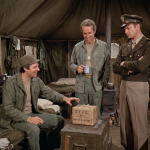
Harrison walked over to a small wooden cabinet in the corner, unlocked it, and pulled out a dusty bottle of amber liquid that definitely hadn’t been issued by the supply depot. He poured two modest measures into a pair of mismatched tin cups.
He walked back and handed one to Mac.
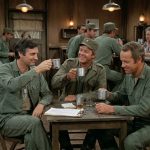
“To wounded dignity,” Harrison said, raising his cup slightly.
Mac looked at the cup, then at the older sergeant, a genuine, tired smile finally breaking through his mustache. “To wounded dignity. May it survive the winter.”
They clinked the tin cups together, a small, metallic sound that felt incredibly grounded in the middle of the chaotic world outside.
They sat down together in the quiet tent, not as officers and enlisted men, but as two tired souls sharing a moment of shelter from the storm, waiting for the coffee to arrive, and finding a strange kind of sanity in each other’s company.
Because in the heart of the 4077th, when the world lost its mind, friendship was the only form of sanity that mattered.