The Thing in the Tray
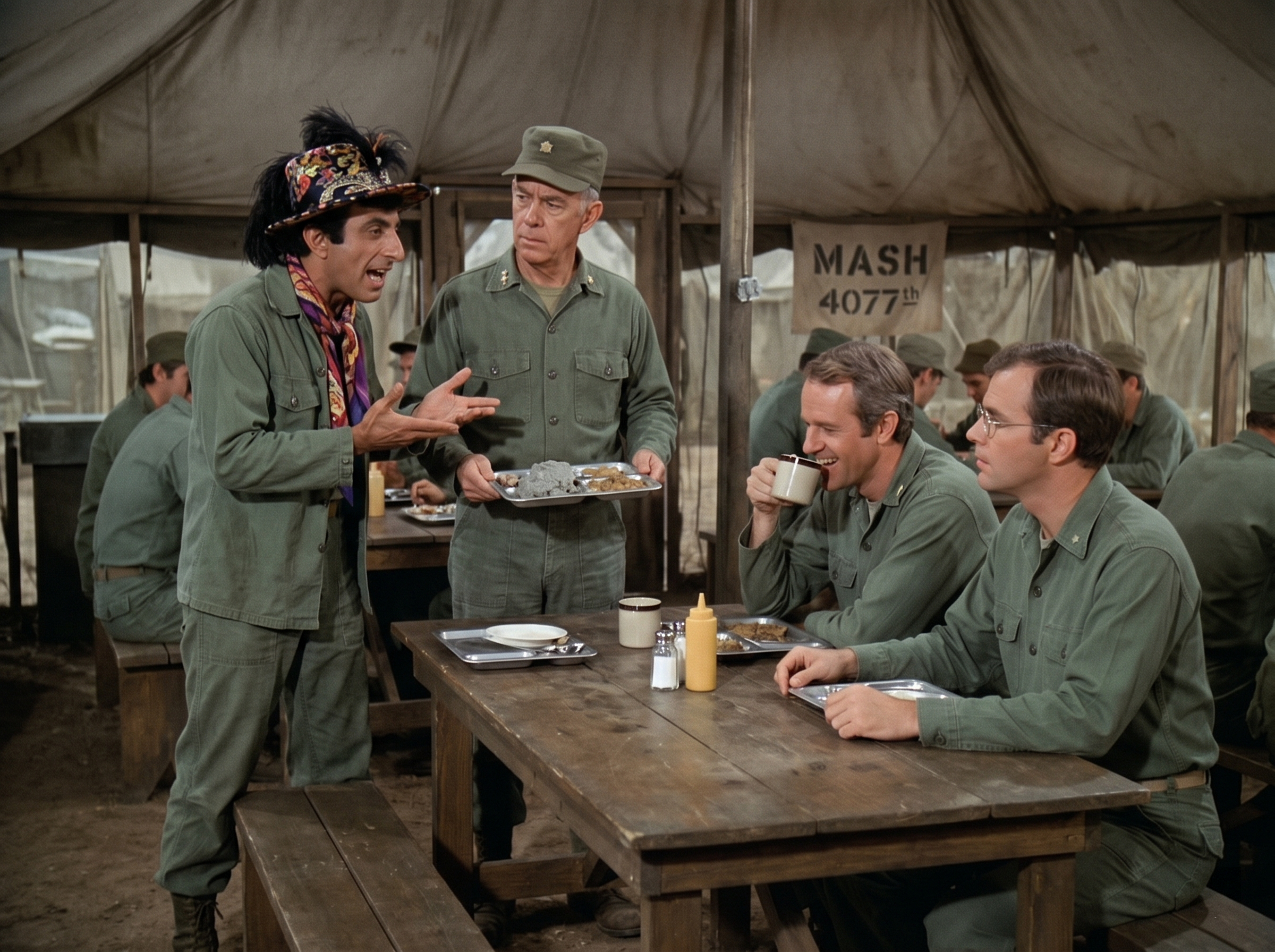
In the 4077th, some days you fight the war, and some days you just fight the food.
The Mess Tent felt particularly oppressive that afternoon, the dust clinging to everything like a second skin.
Hawkeye Pierce had always maintained that the cooks weren’t making food; they were making statements. Very loud, confusing, and usually gray statements.
Today was a classic statement.
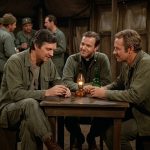
Hawkeye stared at the tray in front of him, or rather, at what was *on* it.
He nudged B.J. Hunnicutt, who was calmly sipping his third cup of lukewarm coffee.
“Beej, look at this. It’s got a texture somewhere between a crumpled sponge and despair.”
B.J. lowered his cup and squinted. “Huh. It is… complex. Sort of a geometric disaster.”
Captain Hunnicutt, the quiet anchor of Swamp morality, could find humor in a bag of wet laundry, but even he looked slightly worried about this specific lump.
Hawkeye continued, finding the words like he was diagnosing a particularly intricate spleen. “And the smell? It’s not food. It’s not chemical. It’s more… existentially challenged.”
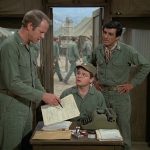
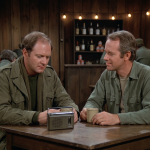
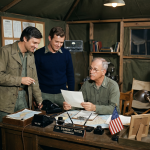
At the head of the table, Colonel Sherman T. Potter sat with that precise blend of authority and fatherly patience he used to keep the whole, crazy circus running. He was currently holding his own loaded tray, listening with a look that suggested he’d already fought through worse things in three different conflicts, and this was just today’s small skirmish.
Corporal Radar O’Reilly, the camp’s nervous conscience, was trying not to hear it. He was carefully ignoring Hawkeye, probably mentally reviewing the supply list for Teddy Bears or trying to pick up distant helicopter signals.
He had that “I am not here” look, a defense mechanism against Hawkeye’s theatrical rants. He was hoping if he ignored it hard enough, the food might become less offensive.
And then there was Max Klinger.
Klinger was doing what Klinger does best: standing by, looking ready for anything, especially if it involved a questionable fashion accessory and some questionable authority. Today’s hat was a particularly elaborate piece with what looked like black ostrich feathers and red fabric scraps, a desperate cry for civilian sanity in a sea of fatigue green.
“But Pierce!” Klinger began, spreading his arms with all the dramatic flair of a Shakespearean actor in a muddy field. “It’s a delicacy from the… the… whole other continent. My mother made a variation that could cure gout.”
“Max,” B.J. said, still holding his coffee cup, “your mother also claimed to have met a spirit that taught her to knit using only spaghetti and a prayer.”
“Exactly!” Klinger snapped, gesturing toward the plate. “Creative! Resourceful! What’s so wrong with a little gray? It’s neutral. It’s calming.”
Klinger leaned over, his feathered hat casting a long shadow, and speared the unidentifiable gray object. He lifted it slowly, examining it with a seriousness usually reserved for inspecting incoming wounded.
His hand shook slightly as he did it. Maybe it *was* complex. Or maybe he just really needed to get that Section 8 and this was all part of the theatre.
Hawkeye and B.J. stopped talking and just watched him. Radar finally looked up, his eyes wide. Colonel Potter looked on, his expression unchanging, but the air in the mess tent grew thick.
This was the quiet center of the storm. The moment of commitment. The point where the crazy logic of the camp truly came alive, making even a lump of gray food seem momentous.
Everyone waited.
“You know, Pierce,” Klinger murmured, still holding the gray morsel on the tip of the fork. “It has a distinct… aromatic signature. A bouquet, almost.”
Hawkeye couldn’t help himself. He was always one to feed the crazy. “Ah yes. Notes of… burnt rubber and… old library books?”
“Precisely!” Klinger was beaming. He liked when other people joined in. “Like a fine, sophisticated rubbery book.”
B.J. finally put his coffee down. “You two are going to make us all sick, just discussing it.”
“Nonsense, Hunnicutt,” Hawkeye said, gesturing wildly with his own empty fork. “This is a profound medical study in… resilience.”
They all watched Klinger. The theatrical tension was real. It was better than the radio, better than the gin. It was the human game of ‘will he, won’t he.’
Colonel Potter finally spoke, his voice dry and steady. “Klinger, if you’re quite finished interrogating the carbohydrate, may I suggest we let the man eat it?”
The camp commander was patient, but even his patience had borders. Borders that didn’t include food being debated on a fork for ten minutes.
This broke the spell. Klinger looked down at his fork, then to Hawkeye, then to B.J., and finally back to the gray lump.
His face softened. For all the theatre, he was a tired soldier in a tent in Korea. Sometimes, he just missed home, and maybe this thing reminded him of something that was actually edible.
“Alright,” Klinger said softly, the drama fading from his voice. “For the morale of the 4077th.”
He took a bite. A big one.
Everyone stared. A silent count to ten began in everyone’s head.
Klinger’s expression was a masterpiece. First, confusion. Then, shock. Finally, a weird, forced resolve. He started chewing, which was apparently no easy task, his whole feathered hat nodding with the effort.
Hawkeye watched, riveted. “Well? Tell us, Corporal. Does it have soul?”
Klinger chewed and swallowed with great effort, wiping his mouth. He looked Hawkeye right in the eye.
“Pierce,” Klinger said, a little misty-eyed and a lot less theatrical, “it tastes… exactly like my aunt’s petrified sponge cake. A little bit dusty, totally confusing, but full of heart.”
A collective sigh went through the group. The danger was over. The weird food was weird, but it wasn’t poisonous.
Hawkeye let out a genuine, exhausted laugh. “Spoken like a man on the edge, Corporal. I salute your bravery.”
Radar whispered, “Is he going to be okay, Colonel?”
“He’ll survive, Radar,” Potter said, starting to eat his own meal. “Klinger has a stomach of steel. Now if only the same could be said for this coffee.”
B.J. smiled, picking up his mug again. “Well, that settles it. Another medical mystery solved. We can add ‘Gray Thing, Klinger Style’ to the official treatment manual.”
The humor was dry, but the tenderness was there. It was found family. They had nothing else to offer but these moments, these shared laughs over a terrible plate of food, keeping each other sane in a crazy world.
The tension broke, the banter returned, and for a few minutes, the war outside was just background noise, and they were just friends sitting at a table, making it work, day after day, in their own messy, resilient way.
They knew how lucky they were. To have this. Even the terrible food.
Sometimes, you find family in the wildest, grayest places, and somehow, you all make it through together.