The Weight of a Canvas Doorway
The war had a terrible habit of stealing your breath, but every now and then, if you were lucky, it gave a little piece of it back.
It was late afternoon at the 4077th, that rare, golden hour when the brutal Korean sun finally decided to apologize for the day. The frantic, bloody marathon in the Operating Room had ended two hours ago. The scrubbing was done. The floors were mopped. The heavy smell of ether and iodine was slowly being replaced by the familiar, dusty scent of the camp and the distant, tragic aroma of whatever Igor was boiling in the mess tent.
For a brief, miraculous moment, the helicopters were silent.
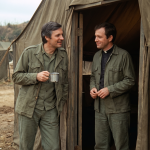
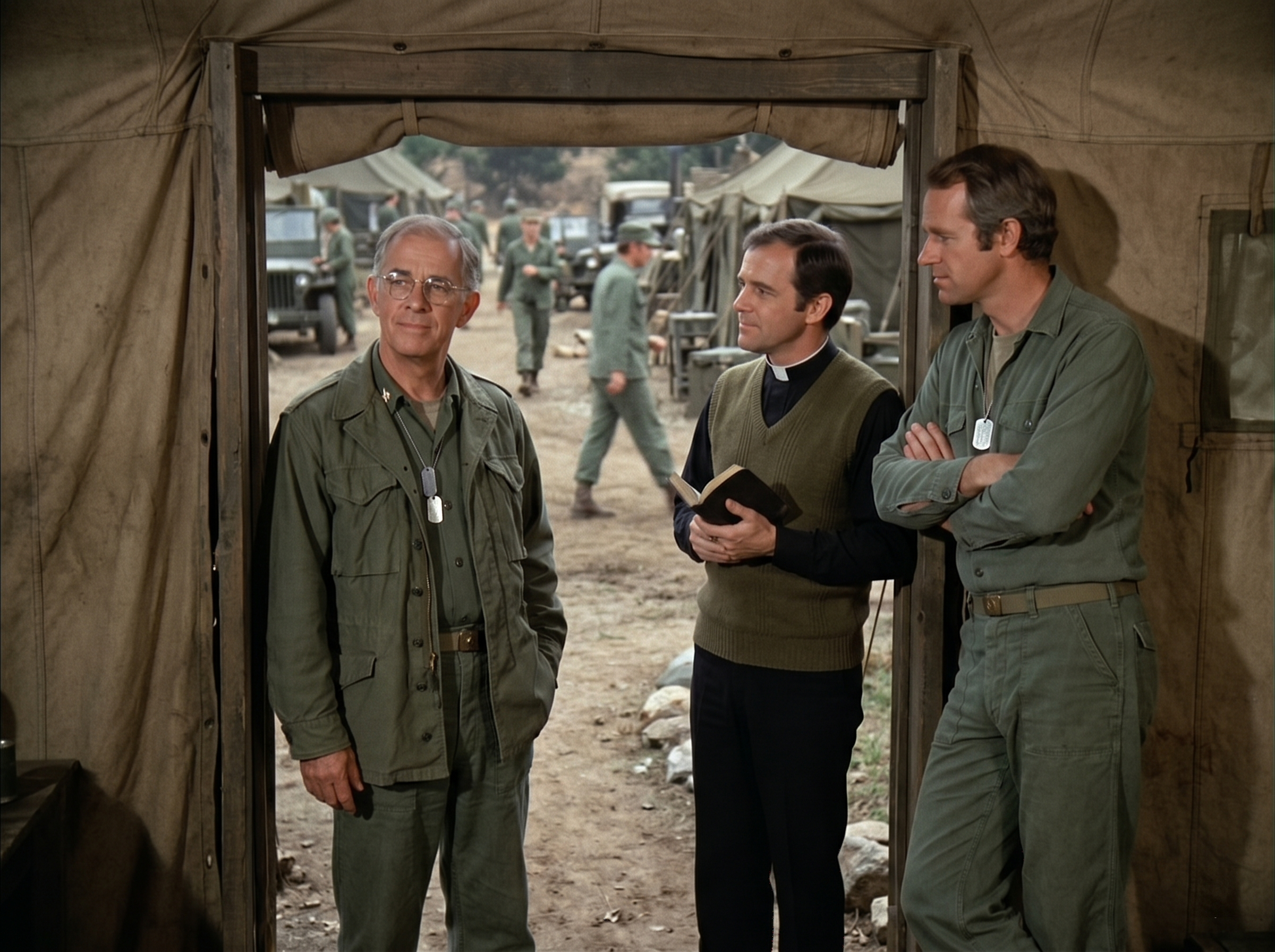
At the edge of the compound, just outside the post-op ward, a quiet scene was unfolding. The doorway of the canvas tent opened out onto the main dirt path, framing a casual, transitional space between the agonizing reality of the hospital beds and the chaotic life of the camp.
Captain B.J. Hunnicutt was the first to step into the doorway. He was still wearing his rumpled green fatigues, his dog tags resting against his chest. He didn’t step all the way outside. Instead, he simply leaned his shoulder against the heavy canvas wall, letting the wooden frame support a weariness that went straight down to his bones. He crossed his arms loosely, his eyes tracking something down by the motor pool.
A moment later, Colonel Sherman T. Potter stepped up beside him. Potter didn’t lean. He stood squarely in the shadow of the doorway, his worn fatigue jacket hanging comfortably on his frame. He had the quiet, steady posture of a man who had seen three wars and knew exactly how to stand in the eye of a storm.
Just outside the shadow, stepping lightly into the soft daylight, was Father Francis Mulcahy. He wore his familiar green sweater vest over his clerical collar, his hands gently holding a small, black prayer book.
All three men were looking toward a dusty two-and-a-half-ton truck idling near the supply depot.
Beside the truck stood Private First Class Thomas Miller. He was nineteen years old, a farm kid from Ohio who had arrived at the 4077th six days ago with a shattered femur and a chest full of shrapnel. B.J. had spent five hours putting his leg back together. Potter had repaired his lung. Mulcahy had sat by his cot for three sleepless nights, reading to him while the boy fought off a raging fever.
Today, Miller was going home.
But as the three men watched from the canvas doorway, something was going wrong.
Miller wasn’t getting on the truck. He was standing in the dirt, leaning heavily on a wooden cane, staring at the ground. His canvas duffel bag lay in the dust at his feet. The truck driver, a tired corporal smoking a cigarette, tapped the side of the vehicle, gesturing for the kid to load up.
Miller shook his head. He took a clumsy step backward. Even from fifty yards away, B.J. could see the panic rising in the boy’s shoulders. The sudden, overwhelming terror of leaving the only place that had kept him alive, the fear of going back to the world as a broken, changed man, was paralyzing him.
Miller dropped his cane. He looked like he was about to collapse, not from physical weakness, but from the invisible, crushing weight of surviving.
B.J.’s jaw tightened. The quiet empathy in his eyes hardened into a fierce, protective instinct. He uncrossed his arms, pushing his weight off the canvas frame, his boots shifting in the dirt as he prepared to sprint down the path to help the boy.
Before B.J. could take a full step, Potter’s hand moved. He didn’t grab B.J., he simply raised a single, steady finger in the periphery of B.J.’s vision.
“Hold your ground, Captain,” Potter said, his voice barely above a whisper, rough with fatigue but carrying an iron authority.
B.J. froze, his chest heaving with a sudden, frustrated breath. “Colonel, he’s panicking. He’s going to tear those sutures if he falls.”
“He’s not going to fall,” Potter replied, his eyes never leaving the boy.
“He needs help, Father,” B.J. pleaded quietly, looking to Mulcahy.
Mulcahy gripped his small black book a little tighter, his knuckles pale. He looked at B.J. with a heartbreaking mix of sorrow and deep, unshakable faith. “He has had our help, B.J.,” the priest said softly. “Now, he needs his courage.”
Down by the truck, the driver tossed his cigarette away and took a step toward the terrified Private. Miller backed up again, his hands trembling as he reached for a cane that was no longer there. The engine of the truck idled loudly, a heavy, mechanical heartbeat echoing across the quiet compound.
B.J. clenched his fists, his heart hammering against his ribs as the boy began to sink toward the dirt.
The heavy canvas of the tent flapped lazily in the warm afternoon breeze, entirely indifferent to the silent drama unfolding in the dirt.
B.J. shifted his weight back against the wooden frame of the doorway, but his body remained entirely coiled. His arms were crossed again, but tightly this time, his fingers digging into his own green sleeves. It went against everything inside him—as a doctor, as a father, as a human being—to watch someone suffer and not immediately run to fix it.
“Colonel,” B.J. whispered, the word hanging heavy with a plea.
“Give him a minute, son,” Potter said gently from the shadows of the doorway. The old cavalryman’s face was unreadable, but his eyes were bright and intensely focused. “You stitched up his leg, Hawk and Charles patched his chest. We did our jobs. But the boy has to walk to that truck himself. If we carry him now, he’ll spend the rest of his life waiting for someone to carry him.”
Mulcahy nodded slowly, his eyes bright with unshed tears. “The hardest steps are rarely the physical ones,” he murmured, looking down at his small book before turning his gaze back to the truck. “Let him find his footing.”
Down by the motor pool, the truck driver stopped approaching. Perhaps he saw the sheer terror in Miller’s eyes, or perhaps he just recognized the look of a kid who had seen too much, too fast. The driver simply bent down, picked up the wooden cane from the dust, and held it out. He didn’t say a word. He just stood there, offering the wood.
Miller stared at the cane. The seconds stretched out, thick and heavy in the Korean heat.
Slowly, agonizingly, the young Private reached out a trembling hand. His fingers closed around the smooth wood. He took a deep, shuddering breath that seemed to echo all the way across the compound. He leaned his weight onto the cane, finding his balance.
Then, Miller bent his knees, wincing as he reached down to grab the strap of his duffel bag. He stood up straight. He didn’t look back at the camp. He didn’t look at the dirt. He looked directly at the back of the truck.
With a slow, deliberate motion, Miller tossed his bag into the bed of the transport. The driver offered a hand, and with a grunt of effort, the nineteen-year-old pulled himself up into the back of the truck, taking his seat on the wooden bench.
From the doorway of the post-op tent, a collective, silent breath was released.
The tension that had gripped B.J. vanished entirely. The tight knot in his shoulders unraveled. He leaned back against the canvas wall, his arms relaxing, his hands falling softly against his sides before he loosely crossed them again. A look of quiet empathy and profound, thoughtful concern settled over his face. He watched the boy sit in the truck, and for a fleeting second, B.J. saw himself sitting there, heading home to Peg and Erin. He offered a small, almost imperceptible nod of respect to the distance.
Potter shifted his stance in the doorway shadow. The hard lines around his mouth softened into a gentle, unmistakable pride. It was the look of a man who had sent countless boys into the meat grinder, savoring the profound miracle of watching one drive away toward the world of the living. He stood with calm authority, the weight of command feeling just a little bit lighter today.
“Attaboy,” Potter whispered softly to the empty air.
Just outside the doorway, Father Mulcahy smiled. The deep worry lines on his forehead smoothed out, replaced by a radiant, hopeful warmth. His expression was one of soft-spoken compassion, a quiet joy that didn’t need to be shouted from a pulpit. He held his small black book with a renewed gentleness, as if the very pages inside had just been validated by the scene in the dust.
The truck’s engine revved louder, the gears grinding as it pulled away from the supply depot. The heavy tires kicked up a cloud of pale brown dust, catching the afternoon sunlight and turning it into a hazy, golden curtain.
The three men stood in the transitional space of the doorway, framed by the canvas tan and the soft daylight colors, bathed in a quiet emotional pause. They didn’t cheer. They didn’t wave. They simply stood there, an impromptu honor guard witnessing a small, quiet victory in a place that rarely offered them.
“You know,” B.J. said, his voice returning to its normal, steady cadence, his eyes still fixed on the disappearing cloud of dust. “For a second there, I thought we were going to have to go down there and adopt him.”
Potter let out a soft, dry chuckle, adjusting his glasses slightly. “He’s got a family waiting for him in Ohio, B.J. I don’t think they’d appreciate you keeping him as a souvenir.”
“He looked so small out there,” Mulcahy added gently, his eyes crinkling with a tender smile. “But I believe he grew a few inches just before he climbed into that truck.”
“He did,” Potter agreed, stepping slightly out of the shadow, the fading sunlight catching the silver in his hair. “He grew up. Shame it had to happen here. But I’m damn glad he’s leaving here to do the rest of it.”
B.J. smiled warmly, a quiet, grounded humor returning to his face. “You think he’ll remember us, Colonel?”
Potter looked at the empty space where the truck had been, then looked at his two friends. “I hope not, Captain. I hope to God he goes home, meets a pretty girl, has a dozen kids, and forgets exactly where this place is.”
Mulcahy tapped his book against his chest, nodding in agreement. “Amen to that, Colonel. Amen to that.”
The distant sound of the truck faded over the hills, replaced once again by the ambient noise of the 4077th. Someone dropped a metal pan in the mess tent. A jeep backfired near the officers’ club. The war was waking back up.
But for just another moment, in the soft light of the canvas doorway, the three men lingered. They stood together in the dirt, anchored by friendship, bound by the shared fatigue of saving lives, and warmed by the simple, beautiful fact that today, one of them had made it out.
Some days at the 4077th, the greatest medical miracle wasn’t saving a life, but watching a soldier find the strength to walk back into it.