A Touch of Spring in the 4077th Dust
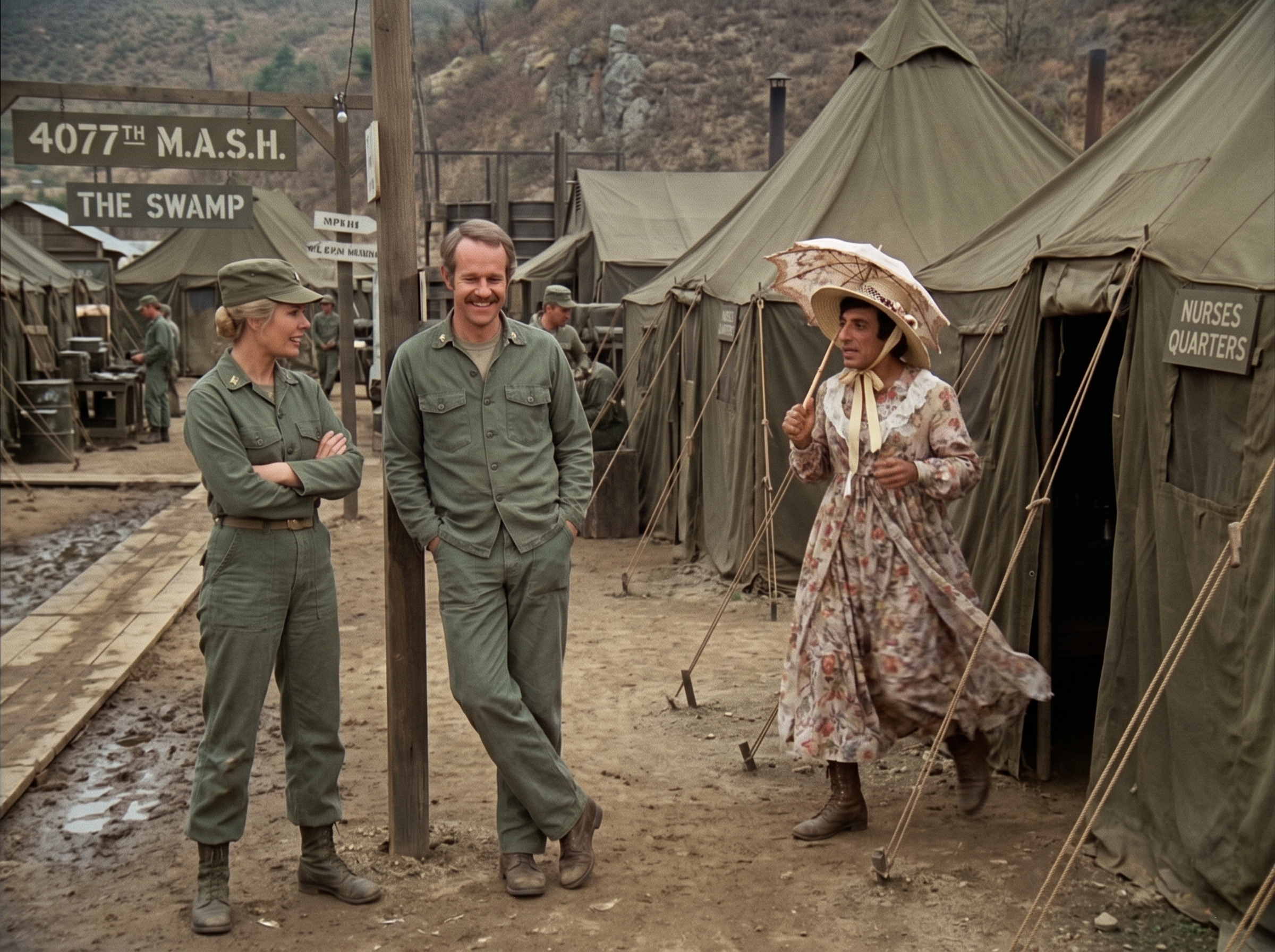
The war had a peculiar way of turning the most absurd sights into the only things that made sense.
It was mid-afternoon at the 4077th Mobile Army Surgical Hospital, though time always felt a little blurred after a marathon session in the operating room. The choppers had finally stopped flying. The relentless, deafening chop-chop-chop of the blades had faded into the distance, leaving behind the heavy, hollow silence that always followed a push.
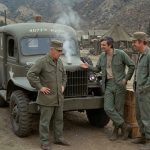
Out in the compound, the world was painted in a hundred different shades of exhausting, unyielding drab. The dust underfoot was a pale, chalky beige. The canvas tents were a faded, sun-beaten olive. Even the sky above the distant Korean hills seemed to have given up on being blue, settling instead for a muted, hazy gray.
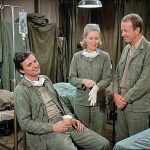
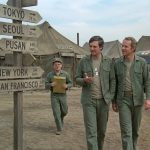
Captain B.J. Hunnicutt stood near the entrance to the Swamp, doing his best to hold up the wooden signpost. He leaned against the rough timber with his hands shoved deep into the pockets of his worn green fatigues. His shoulders sagged with a bone-deep fatigue, but his eyes were bright, sweeping the dusty square with a quiet, observant warmth.
A few yards away, outside the Nurses Quarters, Major Margaret Houlihan stood in the cool air. She wore her standard-issue fatigues and her cap was pinned perfectly in place. Her arms were crossed tightly across her chest in her signature defensive posture. Normally, that stance meant an inspection was coming, or a reprimand was about to be fired across the compound.
But today, there was no fire in her eyes. The tight lines of stress around her mouth had softened. She was looking out toward the center of the camp, and an unmistakable, gentle smile was playing on her lips.
B.J. followed her gaze. You didn’t need to look hard to find the source of the amusement. You just had to look for the color.
Marching between the tents with the rigid posture of a man who had been deeply and personally insulted came Corporal Maxwell Klinger.
He was a vision in floral. Klinger was dressed in a sweeping, ankle-length prairie dress covered in a delicate pattern of spring blossoms. A crisp white ribbon was tied neatly at his ruffled collar. On his head sat a wide-brimmed straw hat adorned with flowers, and in his hand, he carried a dainty, white lace parasol, holding it up as if to protect his delicate complexion from a sun that wasn’t even shining.
It was a magnificent, ridiculous illusion, broken only by the heavy, mud-caked army combat boots stomping rhythmically through the dirt beneath the ruffled hem.
But it wasn’t the outfit that demanded attention. It was Klinger’s face.
He looked furious. He possessed the profound, wounded dignity of a high-society matron who had just been seated next to the kitchen at a five-star restaurant. He marched directly toward the space between B.J. and Margaret, his heavy boots kicking up little clouds of beige dust with every step.
B.J. didn’t move. He just smiled a little wider, letting his mustache twitch. Margaret held her ground, her arms still crossed, her soft smile remaining perfectly intact.
Klinger came to an abrupt, theatrical halt right in front of them. He took a deep, shuddering breath, his chest heaving under the floral bodice. He looked at B.J., then turned his dark, tragic eyes toward Margaret.
With a sharp, dramatic snap, Klinger lowered his lace parasol and pointed the tip straight at the dusty ground. The silence in the compound stretched, heavy and expectant, waiting for the explosion of whatever massive injustice had just occurred.
“Ruined,” Klinger announced, his voice trembling with a heavy, manufactured tragedy.
He didn’t yell. He didn’t scream. He simply stated the word as if announcing the fall of the Roman Empire. He looked down at his dress, then back up at the two officers.
“Utterly and completely ruined,” Klinger continued, his tone thick with sorrow. “I ask you, Captain Hunnicutt. I ask you, Major Houlihan. Is nothing sacred in this miserable, godforsaken place?”
B.J. shifted his weight against the wooden post, his smile remaining incredibly patient. “What seems to be the problem, Max? Did the mess tent run out of cucumber sandwiches for high tea?”
Klinger shot B.J. a look of pure, unadulterated disdain. “This is no time for your pedestrian humor, Captain. I am speaking of a crime. A crime against the very fabric of society. Or, in this case, the fabric of my spring collection.”
He lifted the edge of his floral skirt with a delicate, white-gloved hand.
“Look at this,” Klinger demanded. “Just look at it! I entrusted this magnificent piece to the camp laundry detail. I gave them explicit instructions. Cold water only. A gentle press. And what do I get back? They used starch. Starch! On a delicate chiffon blend!”
B.J. chuckled softly, a warm, rumbling sound that seemed to chase away a little bit of the chill in the air.
“It’s a tragedy, Max,” B.J. said gently, his eyes twinkling. “A verifiable crime against haute couture. I’m sure Colonel Potter will want to court-martial the soap flakes immediately.”
“It throws off the entire drape,” Klinger muttered, dropping the fabric and fussing with the lace collar at his neck. “A dress like this needs to flow. It needs to catch the breeze. Right now, I feel like I’m walking around in a floral cardboard box. The indignity of it all.”
B.J. looked over at Margaret. He expected her to roll her eyes. He expected her to bark an order about proper uniform regulations, or tell Klinger to stop making a spectacle of himself in the middle of a war zone.
Instead, Margaret just kept smiling.
She looked at Klinger, taking in the absurd hat, the lacy parasol, and the muddy combat boots. She saw the exhaustion hiding just beneath the theatrical outrage on the Corporal’s face. They had all been up for thirty hours. They were all drowning in the mud and the blood and the endless monotony of the 4077th.
Margaret understood something in that quiet moment. She understood that Klinger wasn’t really angry about the laundry. And he wasn’t just wearing the dress to secure a Section 8 discharge anymore, even if he still claimed he was.
He was putting on a show. He was providing a splash of ridiculous, vibrant color in a world that was suffocating under the weight of olive drab. He was giving them all a reason to smile, a momentary distraction from the heavy, heartbreaking reality of the wounded men recovering in the post-op ward just a few yards away.
It was an act of profound, bizarre love. And Margaret, underneath all her military discipline, felt a sudden surge of deep affection for the crazy man from Toledo.
She uncrossed her arms and took a step forward.
“It’s not the starch, Corporal,” Margaret said. Her voice was steady, professional, but laced with an undeniable warmth.
Klinger gasped, clutching his parasol as if physically struck. “Major! How can you say that? The stiffness is practically audible!”
Margaret shook her head slowly, her eyes locking onto Klinger’s.
“The dress is perfectly fine, Klinger,” she said, her tone softening into something almost sisterly. “The floral print is lovely. It brings out your eyes. But those boots… the boots completely ruin the line of the skirt.”
Klinger froze. He blinked once. Then twice.
He looked down at his massive, scuffed, mud-covered army boots protruding from beneath the delicate floral hem. He looked back up at Margaret, searching her face for any sign of mockery. He found none. Only a quiet, respectful participation in his grand illusion.
Slowly, the wounded dignity melted away from Klinger’s face, replaced by a soft, genuine smile of appreciation.
“You know, Major,” Klinger said quietly, his theatrical voice dropping to a warm, sincere pitch. “I always told the guys in the Swamp that you were a woman of exceptional taste. You have a real eye for the finer things.”
“Just trying to help, Corporal,” Margaret replied softly, crossing her arms once more, though the stiffness never returned to her shoulders.
“And I appreciate it,” Klinger said. He stood up a little straighter, adjusted the ribbon on his collar, and gripped the handle of his lace parasol with renewed confidence.
With a sharp, graceful movement, Klinger popped the parasol back open. He rested it over his shoulder, the white lace framing his face against the dull, gray Korean sky.
“I suppose I shall just have to walk with smaller steps,” Klinger announced, his voice returning to its regal, haughty volume. “To hide the footwear. Good day, Captain. Major. I must go see if Father Mulcahy has any safety pins. My hem is in desperate need of an intervention.”
Without another word, Klinger turned on his heel. He marched away down the dusty path, his heavy combat boots taking delicate, measured little steps to preserve the illusion of his dress.
B.J. and Margaret stood in the quiet compound, watching him go.
B.J. kept his hands in his pockets, leaning back against the wooden post of the Swamp. He looked over at Margaret, catching her eye. They didn’t need to say anything. The shared, quiet amusement passing between them spoke volumes.
It was just another ridiculous, wonderful afternoon at the 4077th. The war was still waiting for them. The choppers would eventually return. The fatigue would eventually set back into their bones.
But for now, the air felt a little lighter. The dust didn’t seem quite so gray. They were far from home, trapped in a nightmare, but they were trapped together. And as long as they had a guy in a floral dress arguing about laundry starch, they knew they were going to be okay.
Some families are born, but the best ones are built in the dust, held together by tired smiles and lace parasols.