The Mystery on the Metal Tray
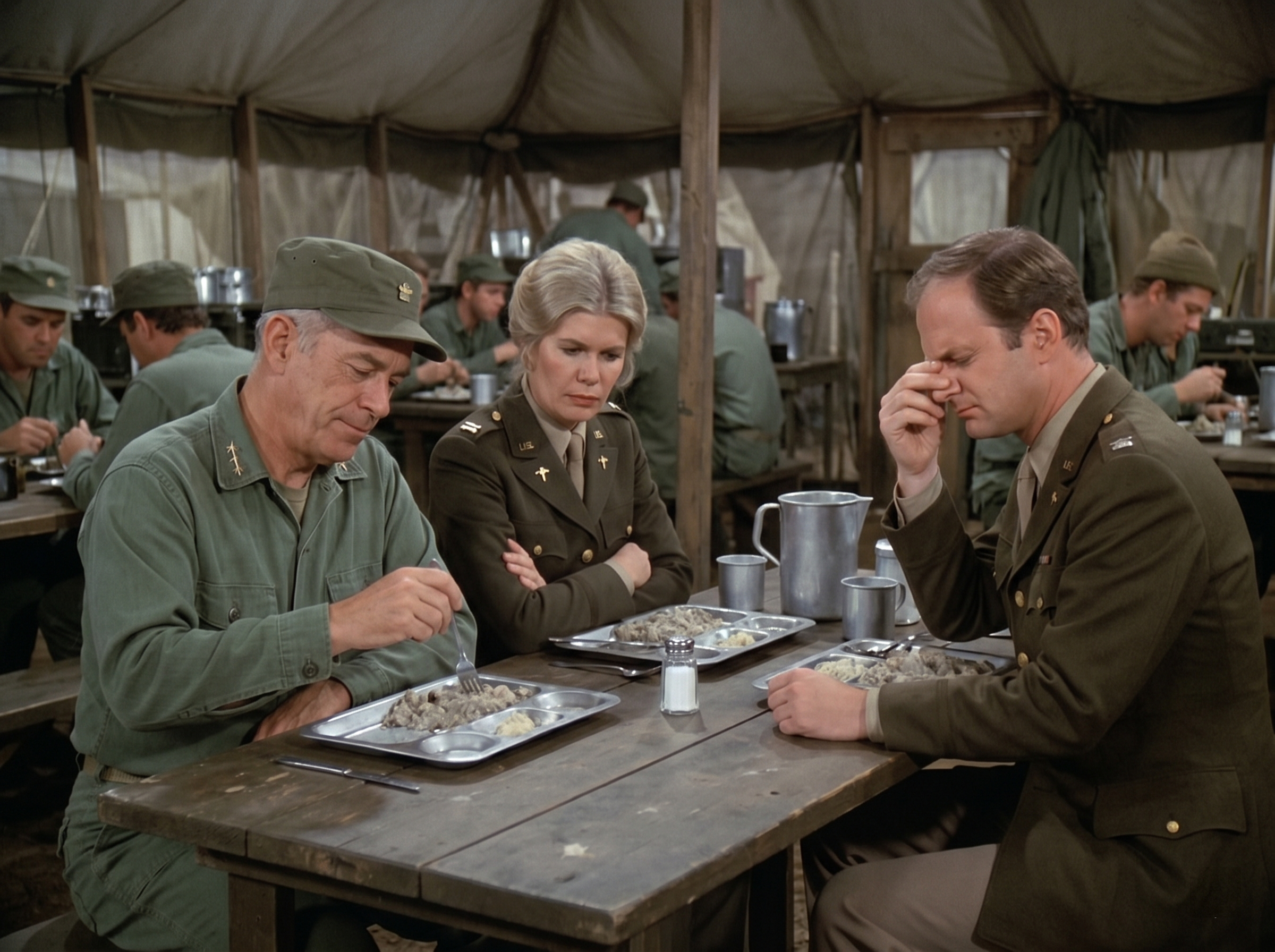
The war didn’t just happen in the operating room.
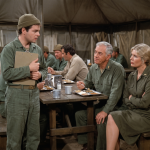
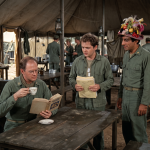
Sometimes, the heaviest battles at the 4077th were fought sitting down at a long wooden table in the mess tent. It was a cold Tuesday afternoon, the sky outside the same dreary, overcast shade as the canvas walls. They had just finished a grueling eighteen-hour shift in the O.R.
The blood was washed from their hands, but the exhaustion was baked deep into their bones.
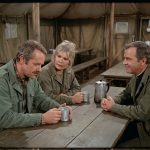
Colonel Sherman Potter sat at the center of the table, his shoulders slumped beneath his green fatigue shirt. In front of him sat a dull metal tray, and upon that tray sat… something. It was a grayish, lumpy mound that defied all military and culinary classification.
Potter didn’t eat it. He just held his fork like a scalpel, calmly poking the gelatinous mass.
He pressed the tines into the center. The food did not yield; it simply absorbed the pressure and slowly pushed the fork back out. Potter sighed, a sound carrying the weight of two previous wars and a lifetime of bad army chow. He wore a look of dryly amused, fatherly exasperation. He had seen mud in the trenches of France that looked more appetizing.
Beside him sat Major Margaret Houlihan.
She was trying, as she always did, to maintain her sharp, composed professional pride. Her uniform was as neat as she could manage after a marathon surgical session. Her arms were folded tightly across her chest in a defensive posture, a physical barrier against the indignity sitting on the table before her.
She stared straight ahead, refusing to look directly at the gray lump. Her jaw was set tight. If she acknowledged the sheer, visible disgust she felt, the carefully constructed walls of her military discipline might just crack. She was regular army, but even the regular army had its limits.
Across from them sat Major Charles Emerson Winchester III.
If Potter was amused and Margaret was stoic, Charles was actively suffering. He sat with his elbows resting heavily on the rough wood of the table, his thumb and forefinger pinching the bridge of his nose. His eyes were closed.
He wasn’t just tired; he was experiencing a profound, refined irritation. For Charles, this meal wasn’t just bad food. It was a personal insult. It was a stark, unavoidable reminder of the horrific class contrast between his beloved Boston and this forsaken patch of Korean dirt.
The mess tent was quiet, save for the dull clatter of tin cups and the murmur of other exhausted doctors. No one spoke at their table. They were fully absorbed in the sheer badness of the food and the heavy silence of each other’s company, actively avoiding the camera of reality.
Potter poked the lump again. It wobbled, sad and defiant.
Finally, Charles lowered his hand from his face. He opened his eyes, staring blankly at the metal tray. The aristocratic disdain vanished, replaced by a sudden, alarming look of hollow despair.
“I cannot do it,” Charles whispered, his voice trembling with a terrifying, quiet finality.
He didn’t sound angry. He sounded entirely broken.
Margaret’s head snapped toward him, her arms tightening. Potter stopped poking with his fork.
Charles slowly pushed the tray an inch away. “I can abide the blood, Colonel,” he said, his voice cracking in the cold air. “I can abide the endless, tragic parade of broken boys. I can even abide the dirt beneath my fingernails. But this…”
He pointed a shaking finger at the gray mass.
“This indignity. This utter absence of humanity on a tin tray… I believe this is the end of me.”
Charles looked up, his eyes shining with unshed, exhausted tears. He looked at Potter, then at Margaret, silently pleading for someone to tell him how they were supposed to survive another day in this place when even the food had given up hope.
The heavy silence stretched across the table, thicker than the mystery meat sitting on their trays.
Margaret uncrossed her arms, the rigid posture of Major Houlihan melting away just enough to reveal the bone-tired woman beneath. She looked at Charles, her usual sharp retorts dying in her throat. She saw his exhaustion because it was an exact mirror of her own.
Colonel Potter didn’t flinch. He slowly set his fork down on the table with a soft clink.
He leaned back, rubbing his chin, looking at the two brilliant, miserable surgeons sitting with him. He had commanded a lot of units in his time, but this collection of drafted doctors and weary regulars was the strangest, most fragile, and most fiercely loyal family he had ever known.
“You know, Charles,” Potter began, his voice gravelly, low, and warm. “Back in the Argonne, during the first big fuss, they brought us something in buckets that they called ‘trench stew.'”
Charles blinked, his trembling breath hitching. He didn’t look away.
“It was mostly rainwater, boot leather, and whatever root vegetables hadn’t been blasted to kingdom come,” Potter continued, his eyes crinkling with the memory. “We were freezing. We were terrified. And it tasted like pure, unadulterated horse hockey.”
Margaret let out a very small, very quiet breath that might have been a laugh if she had the energy for it.
“But we ate it,” Potter said gently. “Because the guy sitting next to you was eating it. And if he could choke it down and survive to complain about it tomorrow, well, then by thunder, so could you.”
Potter leaned forward, resting his forearms on the table, closing the distance between them.
“This food isn’t meant to nourish the soul, Major. It’s barely meant to nourish the body. But it serves a purpose.” Potter tapped his own metal tray. “It gives us something to unite against. It reminds us that no matter how bad things get in that operating room… at least we aren’t the ones who cooked this.”
A tiny, involuntary smirk tugged at the corner of Margaret’s mouth. “It really is an atrocity against the uniform, Colonel,” she admitted softly, her voice missing its usual brassy edge.
“It is a war crime,” Charles stated, though the terrifying hollow look in his eyes was beginning to fade, replaced by his familiar, comforting indignation.
“Exactly,” Potter nodded, picking his fork back up. “And it’s a war crime we are surviving together. Right here. Right now.”
Charles looked down at his tray. He let out a long, aristocratic sigh that ruffled the edges of his collar. He reached into his pocket and produced a perfectly pressed, though slightly faded, linen handkerchief. He carefully dabbed his forehead.
“Colonel,” Charles murmured, his voice steadying, “your attempts to equate this culinary abomination with a team-building exercise are as transparent as they are pathetic.”
Potter smiled. It was a warm, fatherly smile that reached his eyes. “I do my best, Major.”
“However,” Charles continued, sitting up just a fraction straighter, regaining a shred of his Winchester dignity. “Your point regarding the shared misery of this… establishment… is not entirely without merit.”
Margaret reached out and pulled her own tray an inch closer. She didn’t pick up her fork, but she no longer looked away from it. The disgust was still there, but the threat of breaking had passed.
“I’m writing to the Quartermaster,” she said, her voice finding a bit of its usual strength. “I refuse to let my nurses eat something that looks like it was scraped off the bottom of a jeep.”
“You give ’em hell, Margaret,” Potter said softly.
They sat there together in the drafty tent. Outside, the choppers would eventually return. The war would demand their hands, their minds, and their hearts once again. They were thousands of miles from the lives they knew, trapped in a relentless cycle of mud and blood.
But for this one quiet moment, they were just three tired people sitting around a simple wooden table.
Charles pinched the bridge of his nose again, but this time, it was just to soothe a normal headache, not an existential crisis. Margaret rested her hands on the table, her composed professional pride now acting as a blanket rather than a shield. And Colonel Sherman Potter went right back to calmly poking the gray lump with his fork, keeping watch over his people.
They didn’t eat a single bite. But somehow, they left the table feeling full.
It was never about what was on the tray, but who was sitting at the table with you.