A Mountain of Rugs and Small Mercies
The war in Korea wasn’t just fought with scalpels, clamps, and bandages. A large part of it was fought with forms, requisitions, and triplicate copies of sheer bureaucratic nonsense.
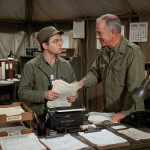
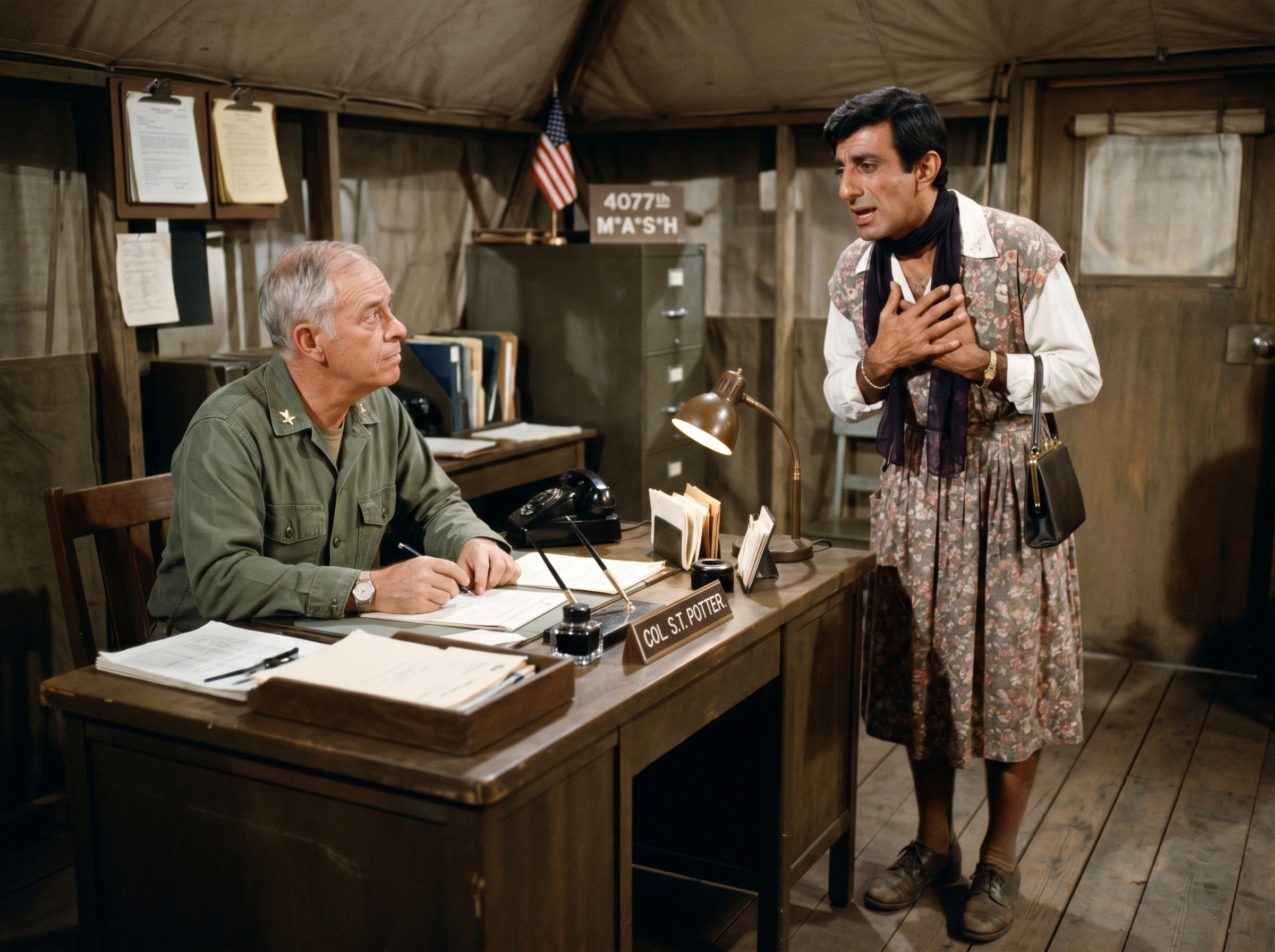
Colonel Sherman T. Potter sat behind his sturdy wooden desk, the warm, practical light of his gooseneck lamp illuminating yet another endless stack of paperwork. Outside the canvas walls of his office, the 4077th was quiet for the first time in three days. The choppers had finally stopped coming, leaving behind a profound, ringing silence in the compound that was almost heavier than the noise.
Potter leaned forward slightly, his green uniform neat, the silver eagles on his collar catching the soft light. He held his pen poised over a requisition form, his eyes heavy with the kind of exhaustion that settled deep in the bones.
Then, the door opened.
It wasn’t a gentle knock. It was a dramatic, sweeping entrance, accompanied by the heavy, unmistakable clomp of sensible Army-issue shoes hitting the wooden floorboards. Potter didn’t immediately look up. He didn’t need to. The faint rustle of rayon announced the arrival of his company clerk.
“Colonel,” a voice trembled, thick with theatrical sorrow. “I come to you in an hour of profound, unspeakable tragedy.”
Potter slowly raised his eyes. Standing before him, framed against the backdrop of the olive-drab filing cabinets and the small American flag, was Corporal Maxwell Q. Klinger.
He was wearing a floral print dress that looked like it had been repurposed from a Toledo grandmother’s springtime curtains. A dark, sheer scarf was draped elegantly around his neck, and a sensible black handbag dangled from his left forearm. His hands were clutched tightly to his chest, right over his heart, his fingers spread in a classic pose of wounded dignity.
Klinger’s face was a masterclass in expressive, dramatic suffering. He looked like the heroine of a silent movie who had just been handed a terrible telegram.
“It’s my Aunt Shirin, sir,” Klinger continued, his voice wavering with perfectly calibrated grief. “A tragedy of epic proportions back in the old neighborhood. A rogue delivery truck. A shipment of discount Persian rugs. She’s trapped, Colonel. Trapped beneath a mountain of woven wool.”
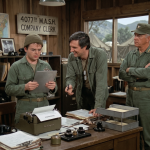
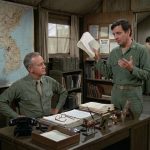
Potter rested his pen on the desk. He looked at the black rotary phone, the glass inkwell, the wooden nameplate reading “COL. S.T. POTTER”, and then back up at the hairy man in the floral dress.
“A mountain of rugs,” Potter repeated, his voice dry as a West Texas creek bed.
“Yes, sir,” Klinger gasped, leaning forward just a fraction, the tragedy radiating from his every pore. “The structural integrity of her living room is compromised. Only a blood relative can safely extract her. I need a compassionate leave, sir. Immediately. Or at least a Section 8, so I can return to Toledo and dig her out.”
Potter stared at him. He didn’t yell. He didn’t throw Klinger out. He just watched the corporal with a look of dryly amused, fatherly exasperation.
The silence in the small tent stretched tight, thick with the weight of Klinger’s ridiculous request and the heavy reality of the war waiting just outside the door. Klinger held his breath, his hands still pressed to his chest, his dark eyes wide and pleading, waiting for the axe to fall.
The quiet in the office held for a long, heavy moment. The only sound was the faint flutter of canvas in the evening breeze and the distant, rhythmic thumping of the mess tent generator.
Colonel Potter leaned back in his wooden chair, the springs groaning in familiar protest. He let his eyes travel over the ridiculous spectacle before him. He took in the floral pattern of the dress, the careful drape of the scarf, and the firm, desperate grip Klinger had on that black handbag. It was absurd. It was completely, undeniably insane.
And yet, looking past the costume, Potter saw what was really standing in front of his desk.
He saw a kid from Toledo, thousands of miles from home, running on three hours of sleep and a diet of powdered eggs and sheer nervous energy. They had all just survived a marathon session in the OR. Thirty-six hours of meatball surgery, patching up boys who were younger than the clerk standing before him. The smell of copper and ether was still clinging to the fabric of the camp.
Every single person in the 4077th was hanging on by a thread. Hawkeye was making jokes that were a little too sharp to hide his shaking hands. B.J. was staring off into the distance a little too long between cups of terrible coffee.
And Klinger? Klinger put on a dress and invented tragedies because the real tragedies in the triage ward were too much to bear.
Potter picked up his pen again and tapped it thoughtfully against the edge of his manila folder.
“Corporal,” Potter said, his voice dropping the dry edge, settling into a low, steady rumble. “Let me get this straight. Your Aunt Shirin is currently pinned beneath a collapsed pile of discount Persian rugs.”
“Yes, sir,” Klinger nodded earnestly, not daring to break character. “It’s a textile disaster, Colonel.”
“And the Toledo fire department,” Potter continued, “is entirely incapable of removing these rugs without your specific, military-trained assistance?”
Klinger’s hands fluttered against his chest. “They don’t understand the weave, sir! If you pull the wrong tassel, the whole pile comes down! It’s a delicate operation. It requires family.”
Potter sighed. It was a long, deep sigh that seemed to carry the weight of thirty years in the Army.
“Klinger,” Potter said softly. “You’re a good clerk. You’re a terrible liar. But you are a surprisingly dedicated nephew.”
Klinger’s posture slipped, just a fraction of an inch. The theatrical wounded dignity began to crack, revealing the sheer exhaustion underneath. The hands slowly lowered from his chest.
“Colonel…” Klinger started, his voice losing its dramatic tremble.
“I can’t give you a Section 8, son,” Potter said, his tone gentle but absolute. “You know I can’t. And I can’t give you a pass to Seoul. The roads are closed, and I need you here.”
Klinger looked down at his chunky shoes. The fight seemed to drain out of him all at once. He suddenly looked very small inside the voluminous floral dress. The game was over.
“Yes, sir,” Klinger mumbled, the reality of the war rushing back in to replace the safe fantasy of Toledo.
Potter watched him for a moment. He knew the danger of letting morale slip. He knew the importance of the game they played. The dresses, the excuses, the wild attempts to get out—it was Klinger’s armor against the madness. And right now, the armor was feeling awfully heavy.
Potter looked down at the paperwork on his desk. He picked up a requisition form for tongue depressors and stared at it as if it held the secrets of the universe.
“However,” Potter said slowly, not looking up.
Klinger’s head snapped up.
“I have a very pressing issue that requires immediate attention,” Potter continued, his voice completely deadpan. “I have received a report that the supply tent is currently suffering from a severe lack of organization. Specifically, the surplus cot blankets in the back corner.”
Klinger blinked, confused. “The blankets, sir?”
“Yes, Corporal. The blankets,” Potter said, finally looking up to meet Klinger’s eyes. “I need someone to go back there, crawl behind the boxes of plasma, and conduct a thorough, personal inventory of those blankets. It is a quiet, dark, and highly isolated area.”
Potter held Klinger’s gaze.
“I expect this inventory to take exactly four hours,” Potter said. “During which time, you are not to be disturbed by anyone. Not even Major Winchester complaining about the noise of the wind. Do I make myself clear?”
Understanding dawned slowly on Klinger’s face. The theatricality vanished entirely, replaced by a profound, genuine gratitude. The Colonel wasn’t giving him a ticket home, but he was giving him a sanctuary. Four hours of uninterrupted sleep in a dark, quiet tent away from the phones and the wounded.
It was a small mercy, but in the 4077th, small mercies were the only currency that kept them alive.
Klinger straightened his shoulders. He didn’t salute—he was in a dress, after all—but he offered Potter a look of pure, unadulterated respect.
“Crystal clear, Colonel,” Klinger said quietly.
“Good,” Potter said, turning his attention back to his paperwork. “And Klinger?”
“Yes, sir?”
Potter didn’t look up, but a small, tired smile touched the corners of his mouth. “Tell your Aunt Shirin I hope they get those rugs sorted out.”
Klinger smiled. A real, genuine smile that reached his dark eyes and melted away the fatigue for just a second. He adjusted his purse on his arm and smoothed down the front of his floral skirt.
“I will, Colonel. Thank you.”
Klinger turned and walked out of the office, the heavy clomp of his shoes fading into the dusty compound. Potter sat alone in the warm light of his gooseneck lamp. He dipped his pen into the glass inkwell, took a deep breath, and went back to fighting the war, one piece of paper at a time.
They were thousands of miles from home and losing their minds a little more each day, but as long as they looked out for each other, they just might make it through.