The Mystery Meat and the Aristocrat
There were only three things you could count on at the 4077th.
The choppers would always come, the coffee would always taste like warm battery acid, and the mess tent would always offer a daily test of a man’s faith.
It was mid-afternoon, and the stifling heat of the Korean summer was baked into the olive drab canvas of the dining tent. The air smelled of damp earth, stale cigarette smoke, and whatever unholy concoction Igor was serving from the metal vats.
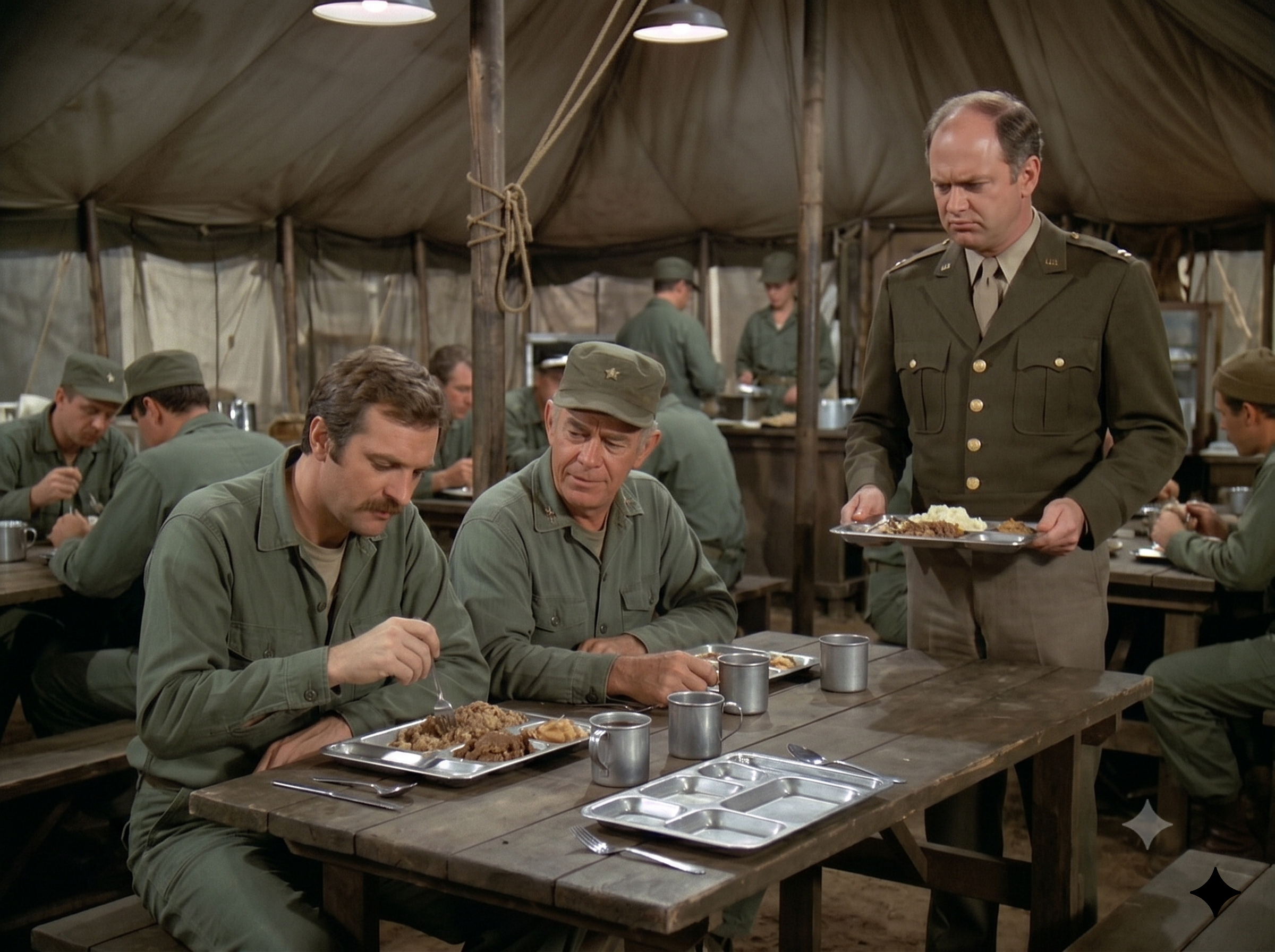
Captain B.J. Hunnicutt sat hunched over the rough wooden table. His eyes were narrowed in intense, dryly amused concentration. He held his Army-issue fork like a surgical instrument, gently prodding a suspicious, gelatinous mound of brown matter resting in the center compartment of his metal tray.
Beside him, Colonel Sherman T. Potter sat with the heavy, weary posture of a man who had seen a lifetime of war and still couldn’t understand military cooking.
Potter didn’t even bother lifting his fork. He just watched B.J.’s scientific investigation with a look of fatherly exasperation. A deep, rattling sigh escaped the Colonel’s chest, a sound born of pure exhaustion and a profound lack of appetite.
“I think it moved, Colonel,” B.J. murmured, tapping the mass again. “If I can find a pulse, I feel morally obligated to triage it.”
“Leave it be, Hunnicutt,” Potter grumbled softly, rubbing a hand over his tired face. “If you make it angry, it might bite back. Just swallow it without chewing and pray your stomach lining holds out.”
But the real tragedy of the afternoon was just arriving at the end of the table.
Standing there, clutching his metal tray like a shield against the indignities of the peasant class, was Major Charles Emerson Winchester III.
Charles was dressed as impeccably as the mud and dust of Korea would allow. His neat uniform jacket was a sharp, dignified contrast to the faded, sweat-stained greens of the room.
But his face was a portrait of pure devastation.
He stared down at his tray with a raised eyebrow and a look of profound, wounded pride. This was not just a bad meal to Charles. This was a personal insult to his lineage.
The clatter of the mess tent seemed to fade as the Boston aristocrat drew a long, shuddering breath. His knuckles turned white around the edges of the tin tray.
B.J. stopped poking his food. Potter slowly turned his head.
They both knew that look. Winchester was about to erupt, and the collateral damage to everyone’s fragile nerves was going to be spectacular.
Charles didn’t yell. He didn’t throw the tray against the canvas wall.
Instead, he spoke in a voice so quiet, so laced with aristocratic despair, that it commanded the attention of the entire table.
“Gentlemen,” Charles whispered, his eyes locked on the brown mound. “I have dined at Maxim’s in Paris. I have enjoyed the finest veal at the Ritz. I have had palate-cleansing sorbets that cost more than this entire encampment.”
He paused, his voice trembling with genuine emotion.
“And yet, the United States Army has managed to present me with something that defies the very laws of nature. It is an affront to basic human decency.”
B.J. leaned back on the wooden bench, a soft, tired smile playing at the corners of his mustache.
“Igor called it meatloaf, Charles,” B.J. offered mildly. “Though I suspect the word ‘meat’ is being used in a highly theoretical, perhaps even spiritual, sense.”
Charles slowly lowered the tray to the table, though he refused to sit. He stood tall, looking down at his bunkmates like a tragic hero facing the guillotine.
“This is not meatloaf, Hunnicutt. This is a crime against the culinary arts. It is an insult to my heritage and a direct threat to my gastrointestinal tract.”
Potter rubbed his chin, a dry chuckle finally breaking through his weariness.
“Sit down, Major,” Potter said, his tone gentle but firm. “You’re blocking the breeze, and Lord knows we need it in here. It all tastes like cardboard eventually anyway.”
“With all due respect, Colonel,” Charles replied, his dignity wounded but intact, “cardboard would be a distinct step up. Cardboard implies a certain structural integrity. This… this is despair served with a side of canned peas.”
B.J. finally pushed his metal tray away. The morbid scientific curiosity gave way to simple, bone-deep exhaustion.
He looked up at Charles, the playful amusement in his eyes softening into genuine, weary camaraderie. They were all just so tired. The OR had been a relentless slaughterhouse for three days straight, and this miserable lunch was the first quiet moment they’d had to breathe.
“Come on, Charles,” B.J. said quietly, patting the empty space on the wooden bench beside him.
“Sit down. If we die of food poisoning, at least we’ll do it together. Besides, if you don’t eat it, Igor will just recycle it into tomorrow’s stew. And none of us want to see this thing a second time.”
Charles looked at B.J., then at Potter, who gave the Major a slow, sympathetic nod.
The heavy aristocratic armor cracked, just a fraction of an inch. The sheer fatigue of the 4077th had a way of leveling everyone, even a Winchester. The shared misery was the only glue holding them together.
With a heavy sigh that carried the weight of a thousand lost fine dining experiences, Charles stepped over the bench and sat down.
He didn’t touch the brown mound. Instead, he reached for his tin cup of coffee, staring into the dark, oily liquid as if seeking answers from the universe.
“I shall consume the peas,” Charles announced quietly, picking up his fork with profound reluctance. “And I shall do so under extreme protest.”
Potter smiled, a warm, fatherly expression that didn’t quite erase the lines of worry around his eyes, but softened them beautifully.
“Noted, Major,” Potter said softly. “Your protest will go in the official log.”
B.J. picked up his own tin coffee mug, leaning over slightly to tap it gently against Charles’s cup.
“To survival, Charles,” B.J. said, his voice stripped of jokes, leaving only quiet sincerity. “One terrible meal at a time.”
Charles hesitated for a moment. Then, he gave a slight, almost imperceptible nod, returning the gesture.
“Indeed, Hunnicutt. To survival.”
The mess tent hummed around them. The clatter of metal trays, the low murmur of exhausted voices, the smell of hot canvas and boiled coffee.
It wasn’t home. It wasn’t even close. But in that small, shared moment of culinary misery, there was a strange, undeniable comfort.
They were a long way from Boston, a long way from Mill Valley, and a long way from Hannibal, Missouri. But sitting shoulder to shoulder on a hard wooden bench, picking at food they couldn’t identify, they were exactly where they needed to be.
They were together.
Some of the deepest bonds of the 4077th were forged not just over the operating table, but over the shared survival of the mess tent.