A Note Before Coffee, A Note To Last A Lifetime.
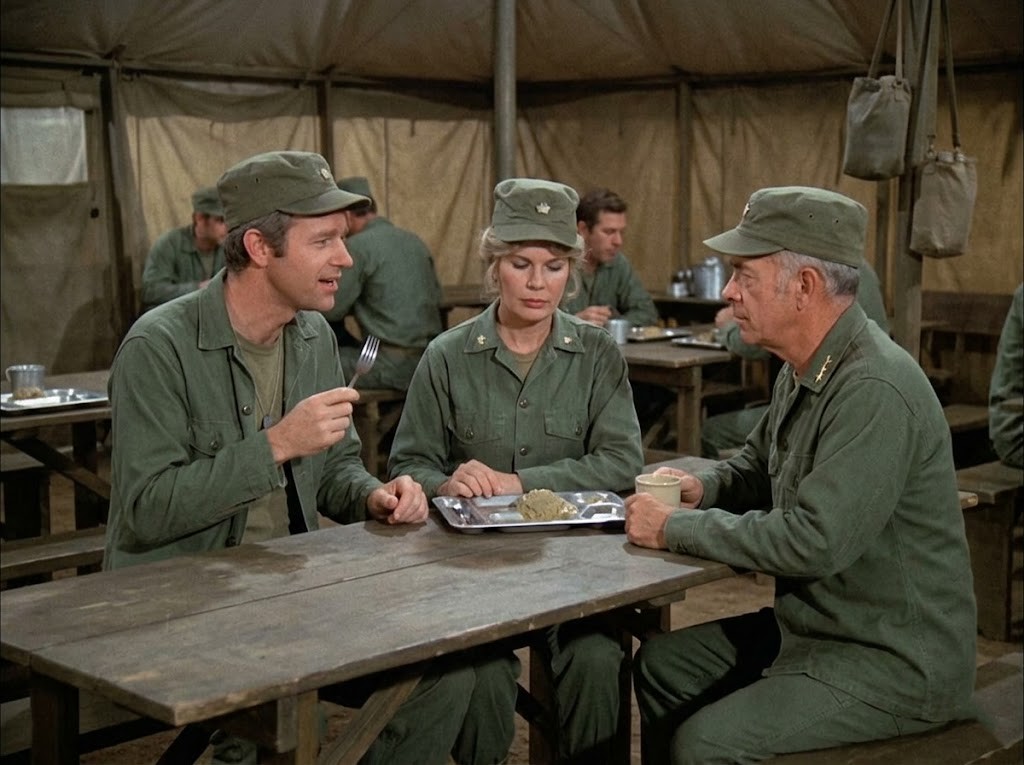
The lighting in the mess tent always has that dim, hazy quality, like a faded photograph of a moment that hasn’t finished happening yet.
It’s a look that’s familiar to everyone here at the 4077th.
That look of bone-deep fatigue, etched in the lines around our faces.
But in this quiet, stolen hour between shifts, there is always an undercurrent of something else: the found family we’ve built, with all its beautiful, messy contradictions.
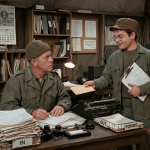
Klinger, standing over a tray that still bears the ghostly imprint of last night’s mystery stew, is talking. He’s talking too loud, his hands moving in that grand, operatic fashion that only a man in a dress and fatigues can truly master.
He’s practically vibrating with an energy that is either desperation or too many hours without sleep.
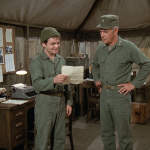
And he’s waving a piece of paper right in front of Captain Pierce, who just wants to get a sip of coffee before his tongue completely shuts down.
Pierce looks up at him with that expression that’s part exhaustion, part ‘here-we-go-again,’ and part affection that he’d never admit to.
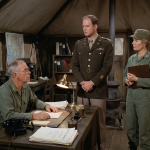
Colonel Potter is right there behind Pierce, holding his own metal coffee cup, looking on with that dry, paternal wisdom.
The look of a man who’s seen too many wars and too much hope, and who understands that sometimes a piece of paper waving in a mess tent is the most important thing in the world.
Then there’s Margaret.
She’s standing there with her tray, her posture perfect even when she feels like she might collapse.
She’s already looking at the piece of paper.
Her eyes are focused on it, and you can see the change happening.
The steel of her military bearing is melting away.
Her usual composed expression is breaking, and something raw and vulnerable is taking over.
Klinger finishes his pitch, whatever it was—a transfer request, a new scheme for a dress, maybe just a long story about Toledo—and his hand falls silent.
The silence that follows is thick enough to choke on.
Nobody moves. Nobody speaks.
All eyes are now drawn to Margaret’s face.
The piece of paper she’s holding isn’t some grand plan.
It’s just a handwritten note. A small, crumpled note.
And as her eyes read the final line, a single, devastating tear begins to roll down her cheek.
The tear tracks a path through the light dusting of dust on her face.
It catches the edge of the light and sparkles, a tiny star falling in the gloom of the mess tent.
B.J., sitting across the table, his eyes always soft and observant, is the first to really react. He sets his coffee down, his brow furrowing with that gentle concern he wears like a second skin.
The tent, usually a low hum of clinking cutlery and tired conversation, has gone completely still. Everyone has stopped eating, stopped moving. It feels as if we are holding our breath for her.
Finally, Colonel Potter speaks. His voice is quieter than usual, that gruff bark gone.
“A problem, Major?” he asks, but it’s not an order for information. It’s an offer of support.
Margaret doesn’t answer immediately.
She just stands there, staring at the small, ragged note that now looks so fragile in her hand. Her fingers tremble slightly.
For a moment, all the rigid protocols, the rank, the hard shell she puts on to survive this hellhole—all of it is gone.
Pierce stops midway through lifting his coffee cup. The cynical, quippy remark that was no doubt bubbling up dies on his lips. He looks at her, and his eyes are filled with a startling, quiet clarity.
And Klinger, who a second ago was the centerpiece of a comic opera, is suddenly still. He looks from Margaret’s face to the paper and back again, his eyes wide and round.
Slowly, Margaret lowers the paper. She takes a breath that is more like a quiet sob.
“It’s from Mrs. O’Reilly,” she says, her voice thick and cracking.
Radar, sitting in the corner, almost disappears into his fatigues at the mention of his name.
“She wanted me to have it,” Margaret continues, still unable to look up. “She wrote… she wrote to say thank you.”
Nobody knows what to say. The note isn’t about an official commendation or a letter of complaint. It’s a note of personal gratitude.
A thank-you for a moment of shared humanity.
We all know the story. There was a period when Radar’s mom wasn’t doing too well. We were all on edge. Margaret, without a word, began corresponding with the woman. A nurse-to-mother correspondence that bypasses official channels. Sharing medical advice. Sharing reassurance. Sharing a connection that transcended rank and war.
And now, here it was. Proof that the connection was reciprocal.
Margaret finally looks up. Her face is flushed, and she looks embarrassed by the display of emotion, but she also looks… lighter.
She folds the note, gently, with reverence.
“The cook didn’t deliver it,” she says, finding a small smile that reaches her eyes. “But I found it in my box. It seems it got mixed in with the mail.”
The dry humor hangs in the air for just a second before we all let out a collective, relieved sigh.
Klinger, a shadow of an idea forming behind his eyes, steps in.
“Well, naturally, Major,” he says, his theatrics returning, but with a softer edge. “A cook delivering a personal message to a high-ranking officer? Unheard of. Simply unheard of. They should have a more efficient system.”
He gives a knowing look to Pierce, who just rolls his eyes and finally takes that first sip of coffee.
Colonel Potter gives a quiet chuckle, a sound like dried leaves rustling in a gentle breeze. He raises his coffee cup in a small, unseen toast.
“Good, good,” he says.
And then, just like that, the mess tent begins to re-animate. The sound of cutlery returns, the conversation begins again, but it’s different now. It’s softer.
The tension has lifted, replaced by a quiet, warm sense of understanding.
Margaret picks up her tray and continues to walk, no longer just a rigid Major, but a woman with a private, precious secret tucked close to her heart.
She’ll go back to being the professional, sometimes-abrasive Head Nurse. She will order people around and maintain standards, because she has to.
But for this moment, in this hazy, coffee-stained air, we all saw the heart that beats underneath the uniform.
We all saw that even in this war-torn wilderness, humanity can find a way to bloom.
And maybe, just maybe, that note from a grateful mother back home is a note to all of us.
A note to last a lifetime.
A note reminding us why we keep going.
And for one brief, clear moment, in that mess tent in Korea, the war was forgotten, and only kindness remained.