The Greatest Battles Are Fought on Paper
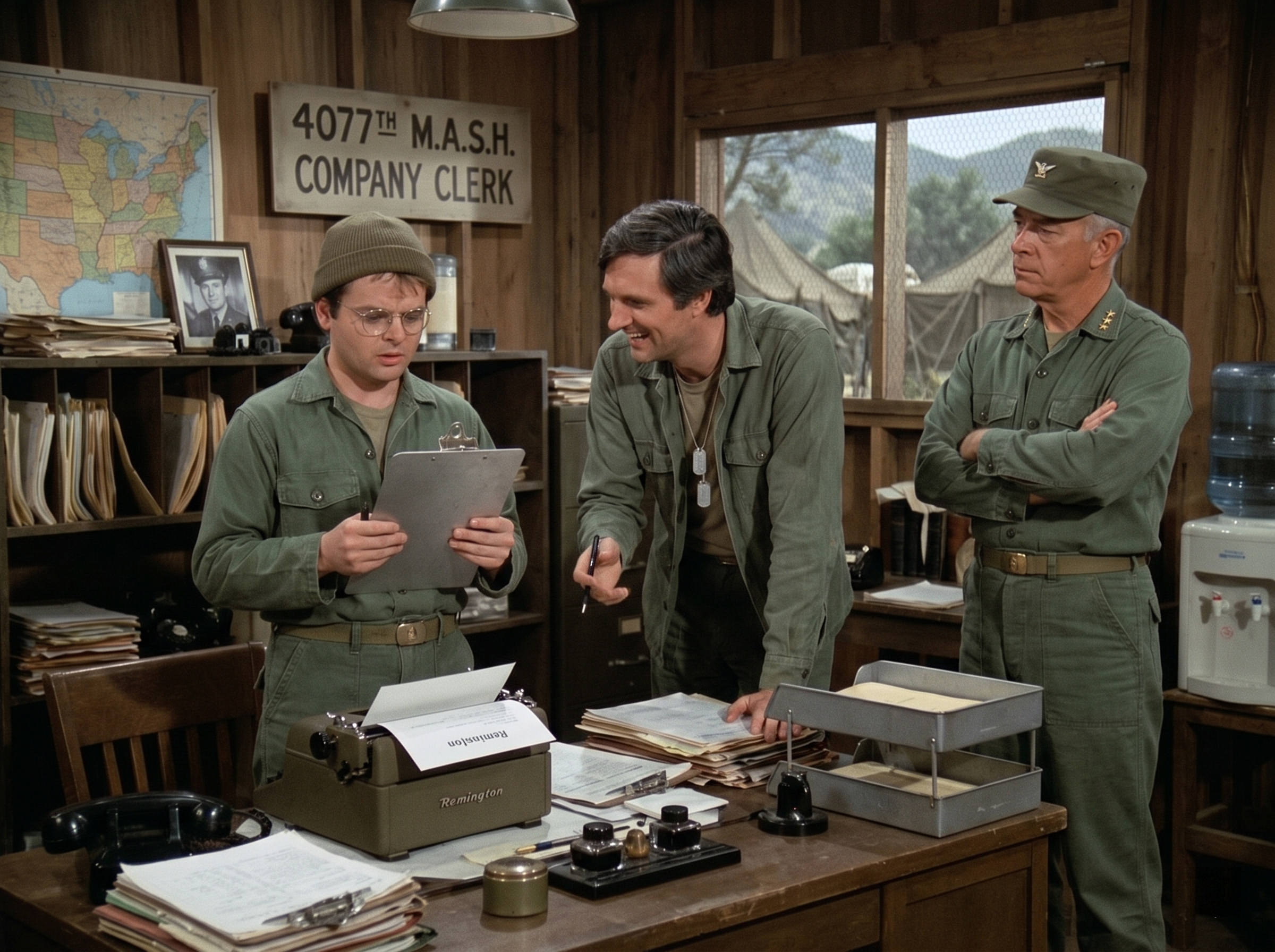
The war was always waiting just over the hills, a low rumble of distant artillery that rattled the teeth and bruised the soul. But inside the Company Clerk’s office on a quiet Tuesday afternoon, the fiercest battle being fought was against the United States Army’s supply chain.
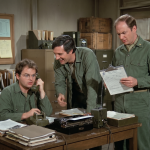
The air in the room was thick with the smell of carbon paper, stale coffee, and the familiar dust of Korea. On the wooden desk sat a heavy, green Remington typewriter, flanked by glass inkwells, stray pens, and neat stacks of unfiled paperwork. Behind them, a simple wooden sign proudly declared this space the “4077TH M.A.S.H. COMPANY CLERK”. It was the nerve center of the camp, where miracles were conjured out of thin air and triplicate forms.
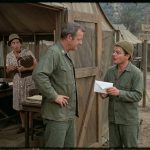
Corporal Walter “Radar” O’Reilly stood nervously behind the desk, holding a metal clipboard with both hands like it was a shield. He wore his signature olive-drab knit cap and wire-rimmed glasses, looking down at his work. His face was a perfect picture of nervous confusion, mixed with a tiny, innocent spark of pride.
Leaning heavily against the wooden furniture next to him was Captain Benjamin Franklin Pierce. Hawkeye looked exhausted, his silver dog tags dangling freely over his unbuttoned green fatigue shirt. But right now, there was a spontaneous, clever smile breaking across his weary face.
He was pointing a pen at the paperwork clipped to Radar’s board, his eyes lighting up with anti-authoritarian delight as he made a joke.
“Radar, you magnificent, devious child,” Hawkeye chuckled, his voice dropping to a conspiratorial whisper. “Tell me I’m reading this right. Tell me you didn’t actually classify a case of Kentucky bourbon and three wool blankets as ‘Topical Antiseptic and Post-Operative Thermal Wraps’.”
Radar shifted his weight, his eyes darting toward the door. “Well, sir, technically alcohol is an antiseptic. And when you’re cold after surgery, a blanket is thermal. It’s just… creative administration.”
Hawkeye laughed, a genuine, warm sound that had been absent for weeks. “Creative? It’s a masterpiece. It belongs in the Louvre, right next to the Mona Lisa’s requisition form for a decent smile.”
Neither of them had heard the door open.
“I hope for your sake, Corporal, that whatever is on that clipboard is legal, moral, and doesn’t involve my camp being audited by a grumpy general from Seoul.”
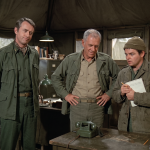
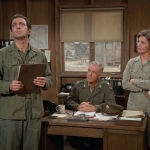
Colonel Sherman T. Potter stood a few feet away, observing the room with calm, terrifying control. He was dressed immaculately in his green fatigues, his officer’s cap perfectly straight, and his arms crossed sternly over his chest.
He wore the expression of a man who had seen three wars, a thousand broken bodies, and an infinite number of camp shenanigans. It was a look of fatherly exasperation and patient, weary wisdom.
Radar froze. The color drained from his cheeks. Hawkeye’s smile faltered, though he tried to maintain his casual lean against the desk.
Potter uncrossed his arms and took a slow, deliberate step forward, the floorboards creaking beneath his boots. He held out one calloused hand, his eyes locked firmly on the young clerk.
“Let me see it, son.”
The silence in the clerk’s office suddenly felt heavier than a sandbag. Outside, the distant, rhythmic thumping of a helicopter chopped through the cold afternoon air, a grim reminder of why they were all here.
Inside the soft, practically lit office, time seemed to stand entirely still.
Radar swallowed hard. His fingers trembled slightly as he reluctantly handed the metal clipboard across the desk to his commanding officer. He looked like a schoolboy waiting for the ruler to snap across his knuckles.
Hawkeye pushed himself off the furniture, his joking demeanor fading instantly into a protective stance. He was always ready to throw himself between the military brass and the people he cared about.
“Colonel, before you read that, you should know I forced him to do it,” Hawkeye lied smoothly, his tone remarkably sincere. “I threatened to replace his teddy bear with a live badger. The kid was under extreme medical duress.”
Potter didn’t even blink at the surgeon. He just held up a single finger to silence him, his eyes dropping to the paperwork on the clipboard.
For a long minute, Potter read. The only sound was the quiet hum of the camp outside and the ticking of the wall clock.
Potter’s eyes scanned the typed lines. “A dozen ‘Post-Operative Thermal Wraps’. Two crates of ‘Topical Antiseptic, 90-proof’. And what in the name of jumping Jupiter is a ‘Multi-Directional Morale Sustaining Cylinder’?”
Radar shrank down into his collar, his wire-rimmed glasses slipping slightly down his nose.
“It’s… um… it’s a record player, sir,” Radar mumbled, his voice barely a squeak. “For the post-op ward. The boys get so down in the evenings, Colonel. The silence gets to them. I figured if we had some music… Benny Goodman, maybe… it might help them heal.”
Potter looked up from the clipboard. He looked at Radar, seeing the boyish earnestness that somehow survived the daily horrors of the meat grinder.
Then he looked at Hawkeye. The captain was watching him closely, his usual cynical armor stripped away. Beneath the jokes, Potter saw the desperate hope of a tired doctor trying to keep his patients—and himself—sane.
The 4077th wasn’t just a mobile hospital. It was a fragile, absurd little island of humanity in the middle of a nightmare. They didn’t have enough plasma, they didn’t have enough sleep, and they certainly didn’t have enough comfort.
If a farm boy from Iowa had to play semantic games with the United States Army to get a few wounded kids a warm blanket and a Benny Goodman record, then so be it.
Potter sighed. It was a long, deep sigh that carried the weight of thirty years in the service. The stern, commanding facade melted away, replaced by the deep, quiet tenderness that made him the father of this makeshift family.
He reached into his breast pocket and pulled out his fountain pen.
Radar gasped softly. Hawkeye blinked in surprise.
“You made a mistake on line four, Corporal,” Potter said gruffly, uncapping the pen.
“I did, sir?” Radar squeaked.
“You did. A ‘Multi-Directional Morale Sustaining Cylinder’ requires a ‘Rotational Friction Stylus’ to operate.” Potter scribbled smoothly on the form. “Otherwise, it’s just a useless box. I’m adding a dozen needles to the requisition. You can’t play Benny Goodman with a rusty nail.”
With a quick flourish, Colonel Sherman T. Potter signed his name at the bottom of the page. He handed the clipboard back to a stunned Radar.
“Make sure this goes out in the afternoon mail,” Potter ordered, turning on his heel. “And Pierce?”
“Yes, Colonel?” Hawkeye asked, a profound respect settling over his tired features.
“When that ‘Topical Antiseptic’ arrives, I expect a dose to be delivered to my tent for inspection. Purely for medical verification, of course.”
Hawkeye broke into a wide, brilliant smile. “I’ll personally ensure it passes all clinical trials, Colonel.”
Potter gave them both a brief, fond look, a twinkle of amusement hiding beneath his weary eyes. He opened the door and stepped back out into the harsh reality of the compound, leaving the warmth behind.
In the office, Radar looked down at the signature, his chest puffing out with that innocent pride once again. He adjusted his glasses and looked up at Hawkeye.
Hawkeye leaned back against the desk, crossing his arms, looking at the young man who kept the whole camp running with nothing but a typewriter and a heart of gold.
“You know, Radar,” Hawkeye said softly, the humor in his voice replaced by a quiet, fierce loyalty. “You’re a terrifyingly good clerk.”
“I just do my job, Captain,” Radar said, reaching over the inkwells to roll a fresh sheet of paper into the green Remington.
Hawkeye watched him type. Tomorrow, the choppers would come again. Tomorrow, there would be blood, noise, and exhaustion. But today, they had won a tiny, ridiculous victory against the darkness. And as long as they had each other, they just might make it through this war.
In a place where tomorrow is never promised, the greatest medicine was always the family we found along the way.