Requisitions, Rations, and the Remington Noiseless
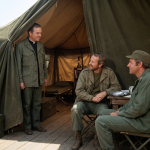
It was a Tuesday afternoon, and the humidity in the 4077th’s administrative tent had settled in like a persistent, uninvited guest.
Outside, the familiar soundtrack of generators, distant artillery, and Klinger’s daily plea for a Section 8 filled the air, but inside, the mood was different.
Corporal Walter “Radar” O’Reilly, seated at the Remington Noiseless typewriter, was operating at a quiet but furious pace.
He was focused on navigating the intricate ballet of a Requisition Form 32B, the bureaucratic lifeline that kept the unit supplied with everything from bandages to canned peaches.
Radar was the master of this paper world.
He was the single human interface between the chaos of a Korean War surgical hospital and the vast, slow-moving administrative beast of the U.S. Army.
Today, however, the beast had just delivered an unwelcome messenger.
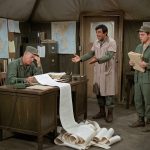
Standing over him, formal in a crisp dress uniform that seemed to deflect the dust, was Major Charles Emerson Winchester III.
Charles did not “enter” the tent; he presented himself, carrying a document with an fastidious grip that made even the beige paper look class-conscious.
His right eyebrow was arched in a perfect question mark of refined irritation, and his gaze was fixed on Radar with a look that suggested the corporal was single-handedly responsible for the decline of Western civilization.
“Corporal,” Charles began, his voice a low, cultivated rumble that commanded immediate attention, “this ‘document’ is a masterpiece of bureaucratic obfuscation.“
Radar, caught mid-stroke on the letter ‘E’, looked up with a flustered expression.
He was earnest and nervous, his posture reflecting the pressure of an entire Army division channeled through a single pair of glasses.
“Ob-fu-ska-shun, sir?” Radar stammered, adjusting his cap.
“It’s a Requisition Form 32B, Major. For… supplies. The usual stuff. Soap. Blankets. The things we use to keep from turning into savages.“
Charles sighed, a long-suffering sound.
“This form, Corporal, requires a signature on line twenty-four. There is no line twenty-four. It ends at twenty-three.“
Radar adjusted his posture slightly, projecting a shy, nervous confusion as he tried to explain the paperwork.
“Ah, well, yes, sir. See, the old forms had twenty-four lines. The new ones don’t, but the regulations still say you have to sign line twenty-four. So I just… write in line twenty-four.“
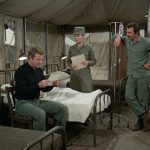
Behind Charles, standing near the door, was Major Margaret Houlihan.
Her arms were folded over her chest, and her face held a composed, sharp, and skeptical expression.
As Chief Nurse, she was a veteran of this administrative theater, and she was watching the scene unfold with the practiced eye of a straight woman observing two distinct forms of human madness.
Margaret didn’t need to speak; her body language spoke of professional fatigue and a clear understanding that logic was an early casualty of war.
“Corporal O’Reilly,” Charles continued, his tone gaining a cutting edge, “are you telling me that my personal requisition for Earl Grey tea, requested a month ago, has been denied because I am incapable of signing a nonexistent line?“
The tension in the quiet, crowded tent spiked gently.
Radar glanced at the ‘RADIOS’ and ‘EE-8’ boxes on his desk, wishing he could use one to call for reinforcements.
“No, sir. Well, not because of that. The Earl Grey request is… still ‘pending review’ at Pusan. This is the request for more surgical gauze.“
Radar took a deep breath and plunged into the bureaucracy.
“But if you do sign the ‘invisible’ line twenty-four on this form, then I might be able to ‘expedite’ a inquiry about the tea requisition. It’s like a ‘favor-for-a-favor’ loop in the paper trail.“
Charles stared at Radar, the depth of his exasperation visible in his scowl, realizing the entire apparatus of the supply line was built on a series of nested absurdities.
“I am a Winchester, Corporal. I do not do ‘loops.‘ I do not ‘expedite.‘ I requisition.“
He gestured with the document again, bringing it closer to Radar’s face, holding and gesturing with that very beige paper that seemed to vibrate with his indignation.
“This gauze is for patients. My tea is for… civilization itself. Are you telling me the Army values gauze more than my mental well-being?“
Margaret unfolded her arms and stepped in.
“Major Winchester, I believe the Corporal is trying to help you. Although, if I had to choose between surgical gauze and Earl Grey, I know which way I’d go. And I suspect the bleeding patient in OR would agree.“
Charles shot a dark look in her direction.
“Major Houlihan, your utilitarian philosophy is charming, but unhelpful. My requisition for tea is valid. The bureaucracy is not.“
He locked eyes with Radar again.
“Corporal. Fix this. Before I requisition a transfer… and your next shipment of Necco Wafers gets ‘lost’.“
The threat was subtle, but effective.
Radar looked genuinely panicked, his mouth half-open.
“Yes, sir! I mean, no, sir. I’ll fix it! The line twenty-four issue, not the wafers. Or the transfer.“
Radar typed faster, the quiet keys of the Remington clicking like desperate signals.
His flustered fingers slipped and… he made a typo.
A visible, obvious typo on the very line he needed Winchester to sign, invalidating the form.
The entire fragile network of favors, invisible lines, and bureaucratic ballet ground to a halt.
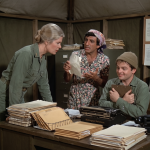
For a moment, all three characters froze in a perfect tableau: Radar staring at the error in paralyzed horror; Charles scowling with victorious, refined rage; and Margaret exhaling a long, skeptical breath, prepared for the next wave of absurdity.
Tension filled the small tent, thick enough to touch.
The silence that followed was heavy, broken only by the rhythmic ‘tick, tick, tick’ of the faulty generator outside.
Radar stared at the misspelled word (‘GUASE’) on the vital line 24.
It was a small error, but in the world of official Army bureaucracy, it was a catastrophe.
His face turned a deep shade of crimson as he looked up at Winchester.
Charles, who had been on the verge of a magnificent, cultivated eruption about administrative incompetence, paused.
He saw the genuine, flustered misery in the young Corporal’s eyes, and something in his posture shifted.
The refined irritation didn’t disappear, but it was overlaid with a reluctant, unexpected wave of compassion.
Radar adjusted his cap with a shaky hand.
“Major… I’m so sorry. I… I made a mistake.“
He was earnest and nervous, his look explanatory, not defensive.
He PROJECTED a shy, nervous confusion as he tried to explain the paperwork again, now invalidated by his own hand.
Charles lowered the beige document he was holding, gesturing with it gently now, rather than as a weapon.
“A mistake, Corporal? In a ‘Winchester Loop’? How… gauche.“
He maintained his posture, formally standing, his gaze still on Radar, but the cutting edge of his sarcasm was gone.
He took a slow breath, the scowl softening into a look of tired understanding.
He WAS refining his class-conscious irritation into a kind of human tolerance.
Margaret, observing near the door, saw the shift.
Her arms were no longer folded. She offered a composed, sharp, and skeptical straight-woman reaction, but it was now tempered by a quiet amusement at the absurdity of the situation.
“Well, Major,” Margaret offered, a touch of genuine humor in her voice, “I suppose ‘GUASE’ is close enough to gauze. At least, it still ends in an ‘E’.“
Charles ignored her, focusing entirely on Radar.
He saw the ‘SUPPLIES’ box next to the radio.
He saw the chaos of forms, the field phone, and the bulletin board covered in orders for other people, other problems.
He saw a tired kid, trying to run an entire war from a corner desk.
“No, Corporal,” Charles said quietly. “It is not fixed. And neither is my tea requisition. But…“
He reached out and picked up the pencil Radar had been using.
“…I believe I can ‘expedite’ your problem.“
He leaned down and, with a few practiced, flourishes, corrected the spelling on the form and signed the newly created ‘line 24’.
He held up the corrected document, his posture still formal, but his expression holding a strange, weary tenderness.
“There. The forms are reconciled. The gauze can be ordered. The invisible line has been signed, and sanity, in this tent at least, has been temporarily restored.“
He handed the paper to Radar.
“Now, Corporal, about that Earl Grey review in Pusan…“
Radar looked at the corrected form, then up at Charles, his expression turning from panic to quiet gratitude.
“Yes, sir. Thank you, Major. I’ll… I’ll write a special memo. It’s a ‘Loop 2C’, for urgent requisitions. We can have an answer within… well, a few months.“
Charles gave a short, elegant snort of laughter.
“Charming. Just charming.“
He turned and looked at Margaret.
“And for you, Major Houlihan, the surgical gauze requisition is now completely valid. You’re welcome.“
Margaret offering a composed, sharp, and skeptical reaction, but she also offered a slight nod.
“Good. Because we have two patients coming in from the front, and we’re actually short on ‘guase’.“
She smiled, a quick, genuine expression that softened her features.
“Now, if you both are done with your ‘loops’, I have some bandages to prepare.“
The moment was visual, easily understood.
The humor came from their personalities, their timing, and a deep undercurrent of tired friendship.
It was warmth from care, loyalty, concern, and the found-family feeling that bonded them together.
The lighting, soft and practical, emphasized the beige paper, the tan canvas, and the muted gray equipment, casting a warm, nostalgic light on the scene.
Charles, having performed his duties, left the tent with a quiet nod of approval.
Margaret, after a final amused look at Radar, walked back toward the medical supplies.
Radar was left alone with his typewriter and the hum of the field phone.
The ‘SUPPLIES’ box stared at him, a symbol of the responsibility he carried.
He adjusted his glasses, carefully filed the newly corrected and signed requisition form, and looked at the ‘REQUISITIONS, RATIONS, AND THE REMINGTON NOISELESS’ bulletin board.
It was a small, clerical battlefield, and today, against all odds, they had won a victory, thanks to a few corrected letters and a nonexistent line 24.
He started typing again, the clicking sound a constant, quiet reassurance that, even in the middle of a war, some small, human things could still be put right.
Sometimes, the most important supply request of all was just a little shared humanity.