The Sound of a Quiet O.R.
The smell of boiled scrub suits, antiseptic, and damp canvas always lingered long after the generator died.
In the 4077th, silence was a rare luxury, usually bought at the price of complete physical exhaustion.
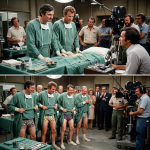
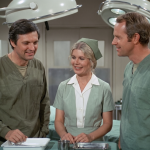
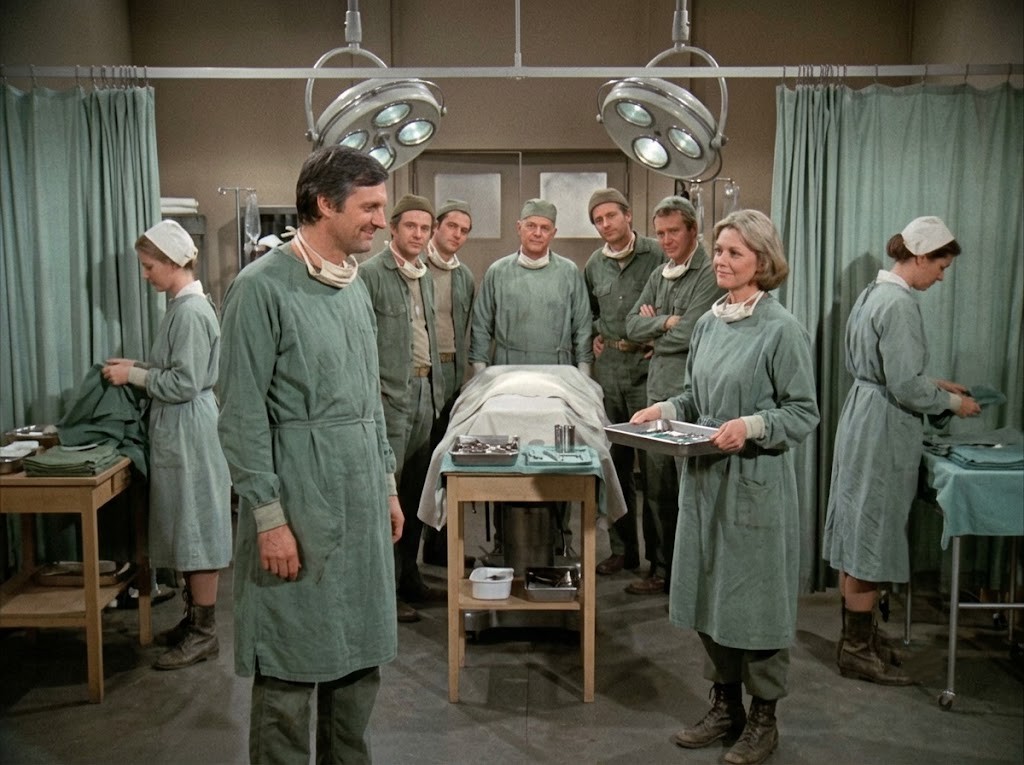
Tonight, the operating room was finally still, bathed in the pale, steady glow of the overhead surgical lamps that hung like metallic suns over an empty table.
An eighteen-hour session of meatball surgery had just drawn to a close, leaving the room suspended in that strange, breathless vacuum between the last stitch and the next incoming chopper.
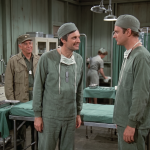
Hawkeye Pierce stood near the front of the room, his green scrub gown tied loosely at the waist, his hands resting quietly at his sides instead of dancing with a scalpel.
He wasn’t cracking jokes, nor was he pacing the floor; he simply stood there, a faint, tired smile brushing his lips as he looked toward the center of the room.
Beside him, the rest of the core staff began to drift together like ghosts assembling for a photograph that none of them had planned to take.
B.J. Hunnicutt stood just a few paces behind Hawkeye, his mustache drooping slightly with fatigue, his hands tucked into the pockets of his fatigue trousers beneath his open gown.
Next to him stood Charles Emerson Winchester III, looking remarkably put together despite a sweat-stained cap, his arms crossed over his chest with an air of aristocratic endurance.
Colonel Potter anchored the center of the group, his fatherly face lined with the weight of every boy they had saved and the few they hadn’t, his hands resting behind his back in a posture of quiet military dignity.
Even Klinger and Father Mulcahy had lingered, standing shoulder-to-shoulder near the back doors, their usual eccentricities melted away by the shared gravity of the night.
To the right, Margaret Houlihan stood holding a stainless-steel instrument tray, her eyes fixed on the empty operating table with a look that was fiercely protective and deeply weary all at once.
The silence in the room was absolute, broken only by the distant, rhythmic thumping of a lone generator outside the tent.
Nobody wanted to leave the room just yet, because leaving meant returning to their lonely cots, where the thoughts they kept at bay with scalpel blades would finally catch up to them.
Suddenly, the quiet was broken by a soft, metallic click from the corner of the room, where Nurse Able was gathering a stack of freshly laundered green towels.
Radar O’Reilly, standing near the left-hand curtain, froze in place, his head tilting slightly toward the ceiling as his eyes widened beneath his surgical cap.
His ears, always tuned to the frequencies of the Korean sky before anyone else heard a thing, twitched in the stillness.
“Colonel,” Radar whispered, his voice cracking slightly in the cavernous quiet of the tent.
Colonel Potter didn’t turn his head, but his shoulders instantly squared, his jaw tightening as he braced for the familiar, dreaded sound of rotors in the distance.
“How many, Radar?” Potter asked quietly, the fatherly warmth in his voice instantly replaced by the crisp authority of a commanding officer.
Radar didn’t answer right away; instead, he stepped closer to the middle table, his hands gripping the wooden edge as he listened to a sound that nobody else in the room could hear yet.
Hawkeye’s smile vanished, his eyes narrowing as he looked from Radar to the empty table, his fingers instinctively curling as if already searching for the cold steel of a fresh clamps.
The entire room seemed to hold its breath, the air growing thick with the collective anxiety of eight people who had given everything they had left, only to be asked for more.
Margaret lowered the instrument tray slightly, her knuckles turning white against the metal, her eyes darting toward the swinging doors that led to the triage pad.
Charles let out a long, slow sigh through his nose, his chin lifting in a silent expression of aristocratic defiance against the endless, unfeeling machinery of war.
“It’s not choppers, Colonel,” Radar said after a long, agonizing pause, a strange, breathless look crossing his innocent face.
B.J. took a step forward, his brow furrowing. “Then what is it, Radar? Don’t leave us hanging out here in the breeze.”
“It’s… it’s a jeep, sir,” Radar murmured, looking up at Potter. “Just one. And it’s not coming from the front line. It’s coming from the south.”
The tension in the O.R. didn’t shatter; it dissolved slowly, like sugar in a cup of camp coffee, leaving behind a profound, aching sense of relief that made everyone’s knees feel a little weaker.
“A jeep from the south?” Hawkeye asked, his voice returning to its familiar, dry cadence as he stepped toward Margaret. “What’s the matter, did General Hammond forget his favorite golf club again?”
“No, sir,” Radar said, a genuine, tired grin finally breaking across his face. “It’s the supply truck from Seoul. The one with the real penicillin… and the mail.”
A collective murmur passed through the room—a mix of small laughs, relieved sighs, and the sound of bodies shifting as the heavy armor of their professional focus finally slipped away.
Colonel Potter let out a soft grunt that might have been a chuckle, his hands coming out from behind his back to rest on his hips.
“Well, don’t just stand there like a bunch of statues in a park, O’Reilly,” the Colonel said, his voice rich with dry affection. “Go see if my Sears Roebuck catalog came in.”
“Yes, sir!” Radar said, turning and slipping through the canvas curtains with the quiet efficiency that kept the entire unit spinning on its axis.
With the immediate threat of more casualties gone, the room returned to its natural, human state—the found family of the 4077th, bound together by grease, blood, and an unbreakable thread of affection.
Margaret set the instrument tray down on the wooden table with a definitive, satisfying clatter, looking over at Hawkeye with a raised eyebrow.
“You look terrible, Pierce,” she said, though the sharp edge of her military discipline was completely missing, replaced by a quiet tenderness she only showed when the work was done.
“Thank you, Margaret,” Hawkeye replied, offering her a mock bow from across the table. “I try to coordinate my complexion with the scrub suits. It’s called fashion. Charles taught me.”
Winchester sniffed, adjusting his cap with two fingers. “If I had any hand in your wardrobe, Pierce, you would be wearing silk, or at the very least, something that didn’t smell faintly of onions.”
B.J. walked over and leaned against the edge of the table, looking at the clean, empty space where so many lives had been mended over the last twenty-four hours.
“Personally, I’m looking forward to a letter from Peg,” B.J. said quietly, his eyes softening as he thought of San Francisco. “And maybe a drawing from Erin to pin over my bunk.”
Father Mulcahy stepped forward, placing a gentle hand on Klinger’s shoulder, who was currently looking down at his muddy boots with an uncharacteristic expression of quiet dignity.
“A good night’s work, everyone,” the priest said softly, his voice a steady, calming presence in the center of the room. “The Lord was certainly in the tent with us tonight.”
“He must have been, Father,” Klinger muttered, looking up with a small, resilient smile. “Because I don’t think my arches could have taken another hour without some kind of divine intervention.”
The small group stood there for a few moments longer, none of them moving toward the door just yet, savoring the rare warmth of a job completed and a moment of peace earned together.
They were thousands of miles from home, trapped in a muddy valley surrounded by hills that shook with artillery fire, but inside this damp canvas tent, they had each other.
Hawkeye looked around at the faces of his friends—his brothers, his sisters, his commanders—and felt that familiar, bittersweet ache that defined every day in Korea.
It was a terrible place to be, but if you had to be in hell, you couldn’t ask for better people to share the fire with.
“Come on, Beej,” Hawkeye said, slapping his partner on the shoulder as he turned toward the exit. “Let’s go see if the mailman brought anything we can turn into a cocktail.”
“Lead the way, Hawk,” B.J. smiled, falling into step beside him as the rest of the staff began to filter out into the cool, gray Korean dawn.
Behind them, the overhead lamps stayed lit for just a moment longer, casting long shadows over the empty tables where humanity always found a way to win.