The Piece That Stayed Behind
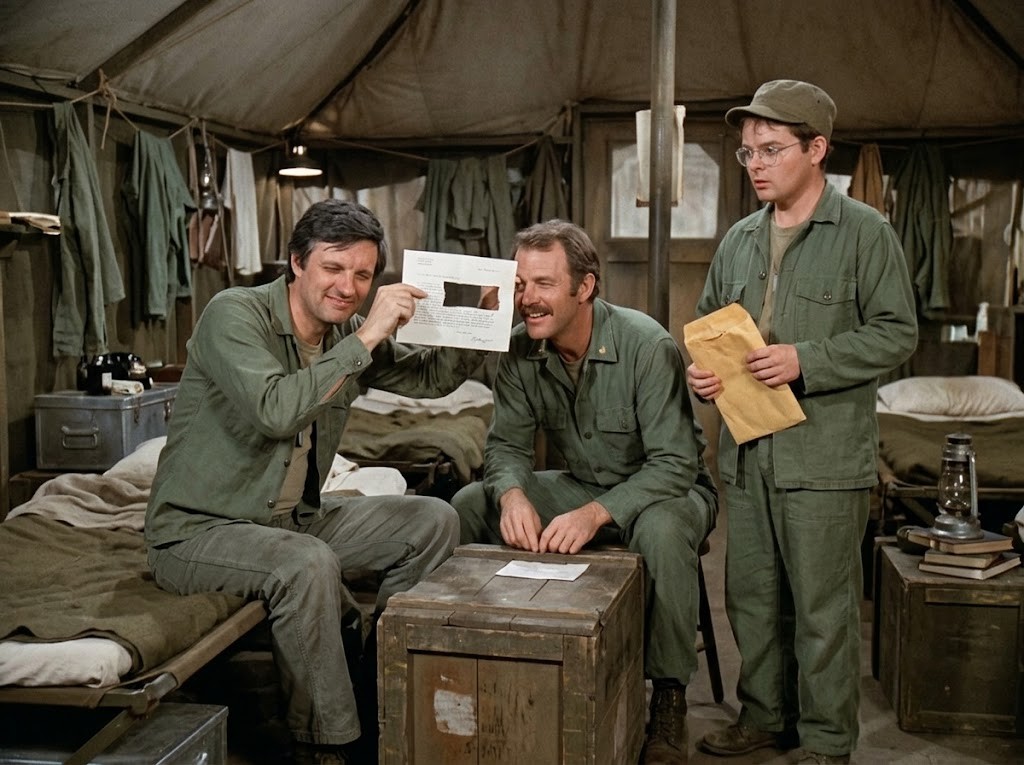
Some days in the Uijeongbu valley don’t announcement themselves with the roar of incoming choppers or the frantic, metallic clash of triage.
Instead, they settle over the 4077th like a heavy, rain-soaked blanket, thick with the smell of damp canvas, sterilized gauze, and the quiet, crushing exhaustion of a thirty-hour shift in the O.R.
It was during one of those breathless, grey afternoons that Corporal Radar O’Reilly slipped into the Swamp, holding a thick manila envelope like it was made of spun glass.
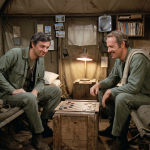
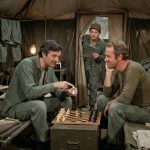
Hawkeye Pierce was slouching on his cot, his long legs stretched out, looking like a collection of loose hinges held together by olive drab cotton.
Beside him, B.J. Hunnicutt sat on a wooden crate, his mustache drooping slightly from fatigue, his eyes fixed on the floorboards as if searching for a missing hour of sleep.
“Mail call, sirs,” Radar whispered, his voice cracking slightly with that earnest, midwestern innocence that the Korean mud could never quite wash away.
“Thought you’d want this one right away, Captain Hunnicutt. It’s from California. Peg.”
B.J.’s head snapped up, the heavy fog of exhaustion instantly evaporating from his eyes as he reached out to take the envelope, his fingers trembling just enough for Hawkeye to notice.
Hawkeye leaned forward, a trademark, lopsided grin splitting his tired face, his sharp wit always ready to shield them both from the ache of home.
“Careful there, Beej,” Hawkeye quipped, swinging his legs off the cot. “If that envelope contains any more drawings of little Erin’s first tooth, I’m going to have to charge you for dental consultation.”
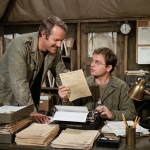
B.J. didn’t answer; he was already tearing into the paper, pulling out a neatly folded letter and a stiff piece of white cardboard.
But as the cardboard came into the light, B.J.’s hands froze, and his warm, grounded demeanor shattered into total, bewildered silence.
In the very center of the photograph his wife had sent, a jagged, rectangular hole had been meticulously sliced out with a razor blade, leaving nothing but an empty, hollow window in the middle of the glossy paper.
Hawkeye’s smile faded instantly, replaced by a sudden, protective tension as B.J. stared at the mutilated picture, his face turning dangerously pale.
“What is it, Beej?” Hawkeye asked softly, the mocking edge entirely gone from his voice, replaced by the deep, fierce loyalty of a brother.
B.J. didn’t speak; he simply held the paper up to the dim light of the tent, his eyes squinting as if he could somehow force the missing piece to reappear.
Hawkeye leaned in close, his brow furrowed, peering right through the square cutout, while Radar stood frozen by the tent pole, clutching the empty manila envelope to his chest with wide, nervous eyes.
“The censor,” Radar swallowed hard, looking genuinely panicked. “Sometimes the military postal censors… they cut things out if it looks like a map, or a landmark, or—”
“Or if they think a housewife in Mill Valley is leaking top-secret troop movements via a snapshot of her backyard?” Hawkeye scoffed, his voice rising with that dry, biting sarcasm he used to fight off the absurdity of the war.
“Look at this, Hawkeye,” B.J. murmured, his voice thick with a strange mixture of disbelief and a rising, heartbreaking ache. “She wrote on the back before she sent it. It says, *’The two people I love most in the world, waiting for you to come home.’*”
The words hung heavily in the damp air of the Swamp.
Through the jagged hole in the cardboard, Hawkeye could see nothing but the rough wood of the crate below them, a stark, empty void where B.J.’s daughter and wife were supposed to be.
The room fell completely silent, the kind of quiet that only happens when the reality of thousands of miles of ocean and dirt crashes down on a lonely tent in Korea.
Then, Hawkeye gently took the paper from B.J.’s hand, holding it up between them, squinting through the cutout with a sudden, brilliant spark in his eyes.
“Wait a minute,” Hawkeye said, his face softening into a warm, gentle grin. “Beej, look at the edges of the cut. Look at the handwriting underneath.”
B.J. looked up, blinking.
“This wasn’t the army censor,” Hawkeye chuckled softly, a quiet, tender sound. “The army uses a stamp, and they aren’t this neat. Look at the corners. They’re slightly rounded. Rounded by a pair of plastic safety scissors.”
B.J. stared at the hole, and suddenly, the realization hit him like a wave of warm California sunshine.
“Erin,” B.J. whispered, a slow, radiant smile breaking through his mustache, his eyes suddenly glistening with tears. “She wanted to keep a piece of the picture for herself. She cut her dad out so she could carry him around in her pocket.”
Radar let out a long, audible breath of relief, his shoulders dropping three inches as he smiled earnestly at the floor.
Hawkeye held the hollow photograph up one more time, peering through it right at B.J.’s grinning face, using his humor to anchor the beautiful, bittersweet weight of the moment.
“Well, look at the bright side, Beej,” Hawkeye smiled, his voice full of affection. “You’re finally exactly where you belong. Even if your daughter had to mutilate a perfectly good piece of mail to put you there.”
B.J. took the letter back, pressing it against his olive drab shirt, looking out the tent door toward the hills, the fatigue of the war momentarily forgotten.
In a place built on pieces and fragments, sometimes the holes left behind are the very things that keep us whole.