A Flash of Pink in a Sea of Green
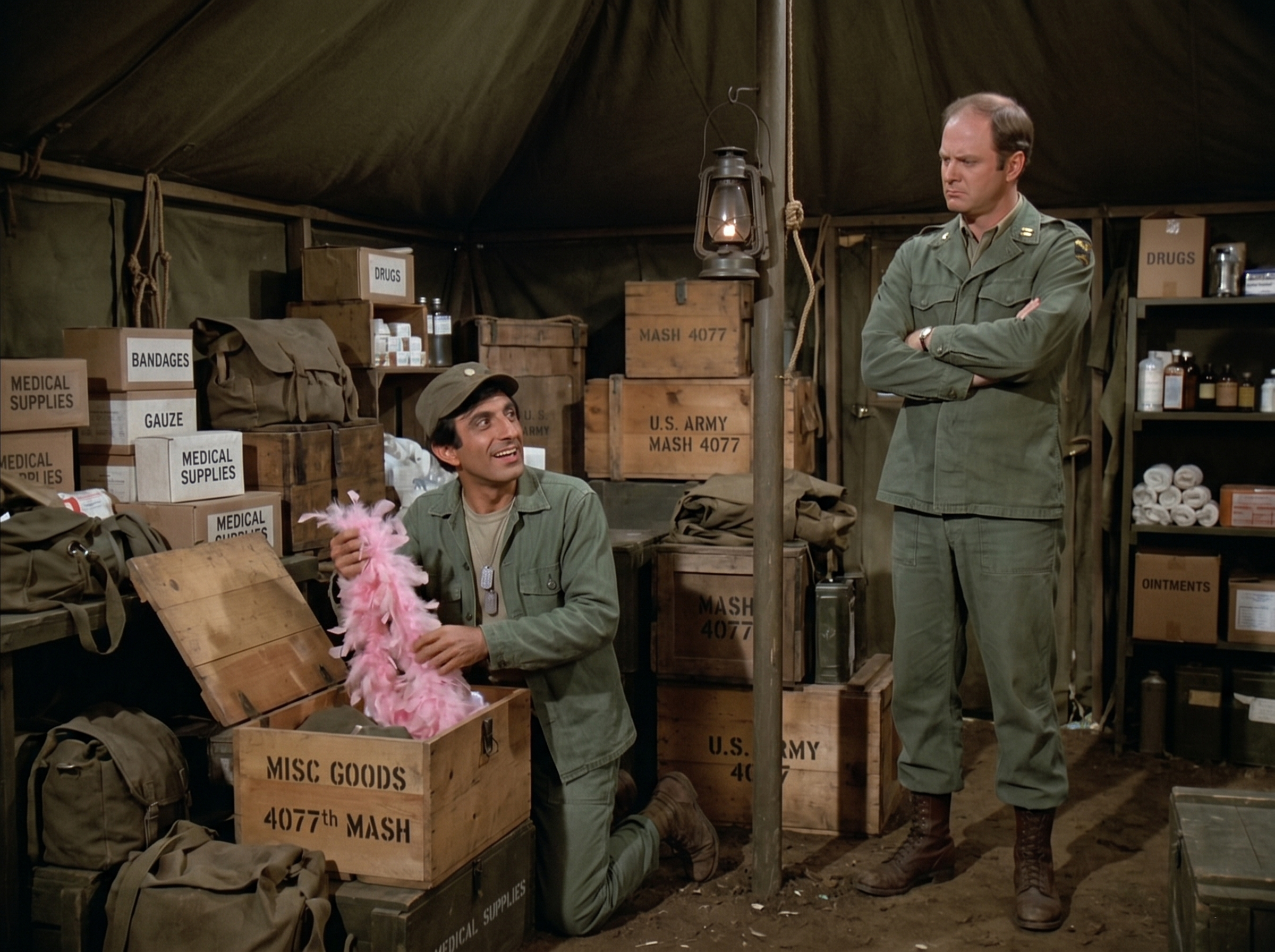
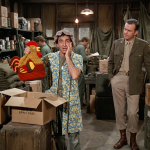
In the 4077th, miracles rarely descended from the sky in any form other than wounded men. If you wanted something beautiful, something entirely separate from the relentless machinery of the war, you had to dig for it. The supply tent was a dusty sanctuary for exactly that kind of desperate archaeology. It was a cavern of heavy canvas and packed dirt, smelling perpetually of mildew, iodine, and damp wood. Rows of stenciled wooden crates—BANDAGES, GAUZE, MEDICAL SUPPLIES—were stacked like a fortress wall against the roar of the incoming choppers. The light in the tent was soft and dim, provided by a single kerosene lantern hanging from the rough wooden center pole.
Corporal Maxwell Klinger was currently deep in the trenches of a newly arrived shipment. He was on his knees, his standard-issue green fatigues blending into the drab background of the tent. He was hunting through a heavy wooden crate vaguely stenciled with the words MISC GOODS 4077th MASH. For Klinger, a box labeled “Miscellaneous” was practically a treasure chest. It was a promise of administrative error, a beacon of hope that some quartermaster in Tokyo had accidentally packed something meant for the USO instead of an army surgical unit.
Standing a few feet away, Major Charles Emerson Winchester III observed this undignified scavenging with a look of profound, aristocratic exhaustion. Charles had retreated to the supply tent seeking a moment of quiet sanctuary. The Swamp was currently uninhabitable, having been transformed into a makeshift distillery and testing ground for Pierce and Hunnicutt’s latest batch of bathtub gin. Charles had simply wanted to stand in a quiet room, fold his arms securely across his chest, and pretend he was anywhere but Korea. Instead, he had found Klinger.
Charles stood rigidly by the center pole, his hands tucked neatly into the sleeves of his impeccably maintained field jacket. His face was a masterpiece of dry, judging superiority. He watched Klinger toss aside woolen socks and canvas belts with the disdain of a society matron sorting through a bargain bin. Charles was just about to deliver a cutting remark about Klinger’s lack of military decorum when the corporal gasped. It was a sharp, reverent sound.
Klinger’s hands emerged from the depths of the wooden crate holding something entirely alien to the olive-drab reality of the camp. It was a feather boa. It was a burst of outrageous, synthetic, violently bright neon pink. It was thick, fluffy, and absurdly theatrical. In the dim, dusty light of the supply tent, the pink feathers seemed to glow with a radioactive vibrancy.
A sly, hopeful smile spread across Klinger’s face. It was a look of pure, expressive comic pride. He held the boa up to the lantern light, letting the pink feathers cascade over his rough green sleeves. He looked at it not as a joke, but as a genuine masterpiece. He looked like a man who had just struck gold.
“Major,” Klinger whispered, his voice trembling with a theatrical sincerity. “Destiny has finally answered my mail.”
Charles slowly raised a singular, withering eyebrow. He looked at the pink monstrosity, and then down at the kneeling corporal. His posture remained utterly stiff. “Corporal,” Charles drawled, his voice dripping with aristocratic disdain, “unless that molting flamingo possesses magical properties capable of transporting us to the Boston Symphony, I strongly suggest you return it to whatever vaudevillian nightmare it escaped from.”
Klinger didn’t flinch. He draped the bright pink feathers gently across his hands, his smile fading into something daring and desperate. “With all due respect, Major,” Klinger said, his voice dropping an octave, “this isn’t a bird. It’s my masterpiece. And I am not leaving this tent until I show you exactly how a true star makes her exit.”
The silence in the supply tent stretched tight, broken only by the distant, thumping rhythm of an artillery barrage miles away. Charles stared down at Klinger, his jaw set in a tight line. He was mentally preparing the disciplinary paperwork. Insubordination. Destruction of government property. Crimes against good taste. The list of charges he could level against the corporal was extensive. Yet, he didn’t move. He simply watched as Klinger carefully lifted the boa, testing its weight, treating the cheap, synthetic feathers as if they were spun silk.
“An exit?” Charles scoffed, breaking the quiet with a sharp bark of humorless laughter. “Corporal, the only exit you will make with that ridiculous accessory is a heavily guarded march to the stockade. It is an affront to the uniform, it is an affront to this camp, and above all, it is an affront to the concept of haberdashery.”
“You have no vision, Major,” Klinger countered, refusing to be intimidated. He shifted his weight on the dirt floor, holding the boa up against his chest. “You look at this and see a joke. You see a crazy guy trying to get a Section 8. But look at the color! Have you seen anything this color in the last six months?”
Charles remained silent. He kept his arms crossed, but his gaze drifted from Klinger’s hopeful face down to the bright, shocking pink of the feathers.
“Everything here is green, Major,” Klinger said softly, his theatrical bravado slipping away, revealing the deep, bone-weary fatigue underneath. “The tents are green. The clothes are green. The food is green. The only time we see any other color, it’s red. And we see way too much of that.”
Klinger ran a hand gently over the fluffy boa. “This pink… this belongs in a nightclub in Toledo. It belongs under a spotlight. It belongs to a world where people laugh, and drink champagne, and go home at the end of the night. Holding this… it’s like holding a ticket to the real world. It reminds me that the whole universe isn’t just mud and blood and olive drab.”
The dry, sarcastic retort died in Charles’s throat. He looked at the kneeling man before him. For a fleeting second, the haughty armor of Major Charles Emerson Winchester III cracked. He didn’t see a scheming corporal in a dress. He saw a man starving for a taste of humanity, desperately clinging to a cheap piece of dyed poultry in a war-torn supply tent.
Charles knew that starvation well. He hid it better, burying it beneath a facade of classical music, gourmet preserves, and biting condescension. But in the quiet hours of the night, when the camp was asleep and the phonograph had stopped playing, Charles felt the same crushing, suffocating weight of the olive-drab world. He missed the velvet curtains of the theater. He missed the crystal chandeliers of his social club. He missed beauty.
He looked back at the pink boa. It was a grotesque parody of luxury, a cheap, gaudy thing that belonged in a burlesque house, not a symphony hall. But in the stark, miserable reality of the 4077th, it was a piece of civilization. It was a defiant spark of color against the darkness.
Charles uncrossed his arms. He took a slow, deliberate step forward, his polished boots crunching softly on the dirt floor. He reached out and pinched one of the bright pink feathers between his thumb and forefinger, examining it with the critical eye of a jeweler appraising a questionable diamond.
“It is, without a doubt, the cheapest, most vulgar shade of fuchsia I have ever had the misfortune of viewing,” Charles said, his voice regaining its usual aristocratic drawl. “It looks as though it was dyed in a bathtub by a blind seamstress.”
Klinger’s shoulders slumped slightly, the spark of hope fading from his eyes. He started to lower the boa back toward the wooden crate.
“However,” Charles continued, raising a hand to stop him.
Klinger froze, looking up with a confused blink.
“However,” Charles repeated, stepping back and folding his hands behind his back. “If you are absolutely determined to masquerade as a woman of questionable repute in a desperate bid for freedom, Corporal, you must at least attempt to understand the fundamentals of color theory.”
Klinger stared at him, his mouth slightly open. “Color theory, Major?”
“Indeed,” Charles said smoothly, looking down his nose. “That shade of pink clashes violently with your complexion, and it is completely inappropriate for daytime wear. But… if paired with a subdued, charcoal grey wrap, and perhaps a tastefully understated pillbox hat, it might just distract the camp commander long enough for you to reach the perimeter fence.”
A slow, brilliant smile broke across Klinger’s face. The comic pride returned, mixed with a deep, silent gratitude. He understood exactly what the Major was doing. Underneath the insults and the fashion advice, Charles was giving him a pass. He was protecting the pink boa. He was acknowledging their shared, absurd desperation.
“You know, Major,” Klinger said softly, carefully draping the boa around his neck, “underneath all that Boston breeding, you’re a real artist.”
“Do not mistake my aesthetic standards for camaraderie, Corporal,” Charles replied stiffly, though the corners of his mouth twitched upward by a fraction of an inch. “I simply refuse to allow you to humiliate yourself with a poorly coordinated ensemble on my watch.”
Charles turned on his heel, his military bearing returning in full force as he prepared to step back out into the noise and the mud of the war. He paused at the flap of the supply tent, looking back over his shoulder.
“Keep it hidden in the crate until Sunday, Corporal,” Charles said quietly. “The Colonel’s eyes are always sharper on Sundays.”
“Yes, sir,” Klinger whispered, practically glowing with joy. “Thank you, Major.”
Charles gave a curt nod and pushed through the canvas flap, disappearing into the glare of the Korean sun. Klinger was left alone in the dim, dusty tent. He took one last look at the bright pink feathers, feeling a warmth in his chest that had nothing to do with the heavy wool of his uniform. He carefully folded the boa, tucking it safely back into the wooden crate among the bandages and the gauze, burying his little piece of Toledo deep within the olive drab.
Even in the darkest of places, a single bright color could remind a weary soul that they were still human.