A Knock on the Canvas
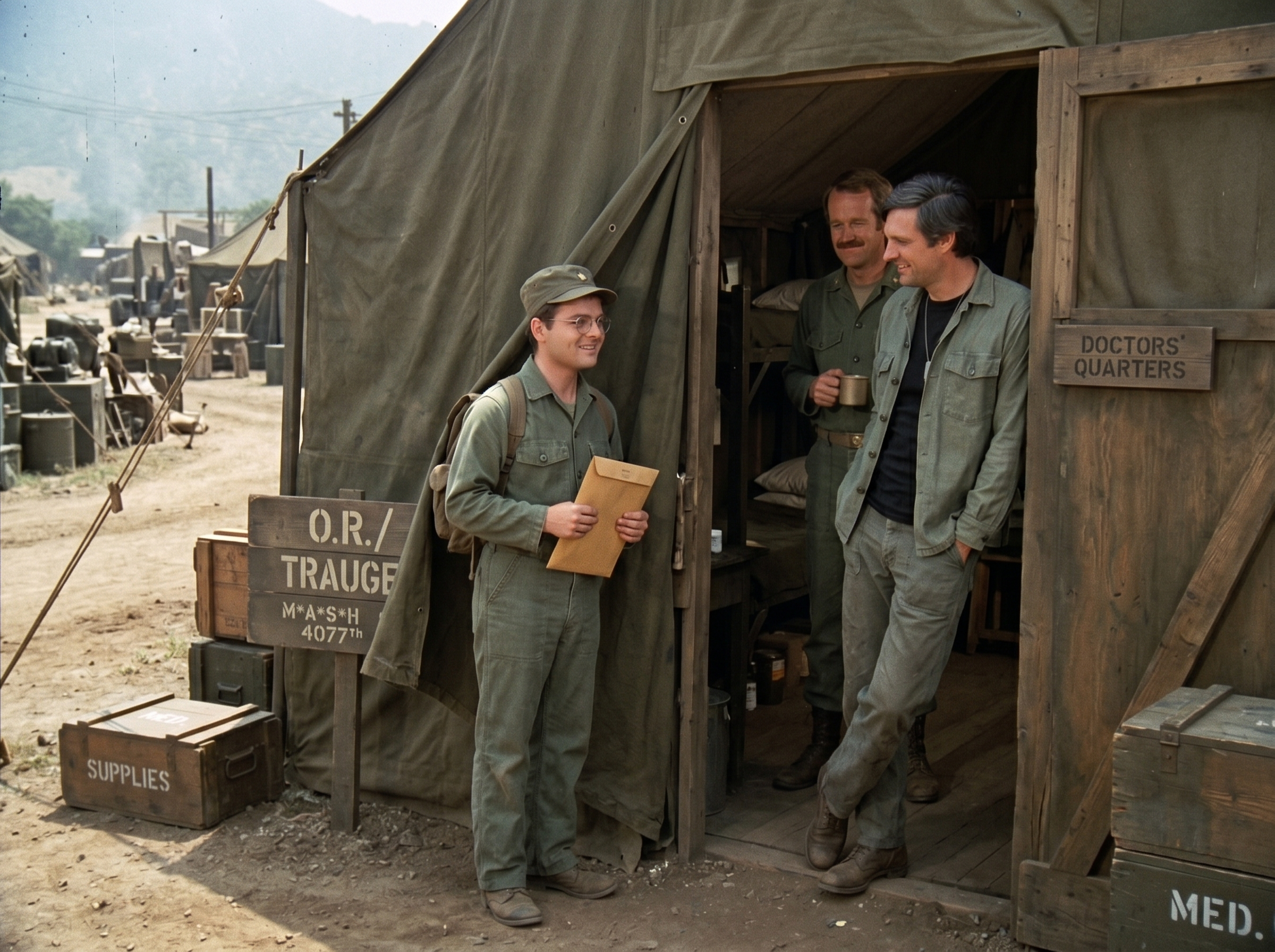
There are only a handful of genuinely quiet moments in a war zone.
Most of the time, the air at the 4077th was filled with the sounds of incoming choppers, the shouting of orders, and the endless, rumbling groan of supply Jeeps.
But occasionally, usually in the late afternoon when the harsh Korean sun began to lower and the dust finally settled on the camp, a heavy, peaceful silence would fall over the Swamp.
Hawkeye and B.J. were sharing one of those rare, fragile moments.
They had just finished a brutal, marathon shift in the O.R. Their shoulders were aching, their hands were scrubbed raw, and their eyes burned from the harsh surgical lights.
Now, back in the familiar, messy comfort of their tent, the war felt just a little bit further away.
The soft, balanced lighting of the late afternoon drifted through the doorway, casting a warm glow against the canvas tan and dusty beige palette of the room. Everything about them was worn and lived-in. Their olive drab t-shirts were faded, their boots were scuffed, and their exhaustion was profound.
Hawkeye was leaning casually against the wooden doorway frame, his body settling into a relaxed, comfortable slouch.
He was nursing a lukewarm drink, staring out at the dusty dirt path that wound past a stack of wooden crates and a small hand-painted sign.
Just inside the tent, B.J. stood quietly, offering the kind of comfortable, steady companionship that didn’t require any conversation.
They were in the middle of a private, tired moment. It was the kind of unspoken shared peace that only happens when the walls are down, and the fatigue is too heavy to hide behind elaborate jokes.
Then, the canvas tent flap rustled.
Standing there in the doorway, half-in and half-out of the afternoon light, was Corporal Radar O’Reilly.
Radar looked exactly as he always did: perfectly out of place in a war, yet entirely indispensable to every single soul in it.
He was clutching a slightly crumpled manila envelope tightly against his chest. He wore a familiar earnest, shy smile on his face, projecting a polite attention that meant he knew he was interrupting a private moment, but felt it was too important to wait.
Hawkeye didn’t flinch. He turned quickly toward the doorway, leaning lazily against the frame.
An amused, affectionate teasing expression immediately painted itself across Hawkeye’s face, masking the deep exhaustion from moments before.
But Hawkeye’s eyes instantly locked onto the envelope in the corporal’s hands.
In this place, an unexpected envelope delivered by hand outside of normal mail call usually meant one of two things.
It was either a sudden, ridiculous new regulation from I Corps, or it was a fragile piece of the real world that had somehow navigated through the madness to find them.
Hawkeye lowered his drink, his easy smile freezing slightly on his lips as he waited for the boy to speak.
The silence in the tent suddenly felt very thick, resting entirely on the mysterious, battered envelope in Radar’s hands.
B.J. shifted his weight just inside the tent, a dry, knowing smile warming his tired face.
He knew that hesitant look on Radar’s face, and he knew Hawkeye’s defensive, joking posture well enough to see right through it.
“Come on in, Radar,” B.J. said softly, his voice a steady, calming anchor in the room. “You’re letting all our premium, imported dust out.”
Hawkeye let out a soft chuckle, his posture remaining perfectly slouched against the wood.
“Yeah, step into our parlor, Corporal,” Hawkeye teased, his eyes crinkling with deep affection. “Though if that envelope contains orders for a ten-mile hike, or a mandatory lecture on latrine maintenance, I reserve the right to pretend I’m legally blind.”
Radar took half a step forward, his boots shuffling lightly against the dirt floor.
He didn’t fully enter, choosing to remain in that safe, liminal space of the doorway, showing his customary respect for the surgeons’ quarters.
“No, sir. It’s not from brass,” Radar stammered mildly, his polite, earnest attention fixed squarely on Hawkeye.
“It’s… well, it’s personal mail, Captain.”
Hawkeye’s teasing smile faltered for a fraction of a second.
“Mail call isn’t until tomorrow, Radar. And usually, you shout it over the P.A. system with all the subtlety of a carnival barker.”
Radar looked down at the envelope, his fingers gently tracing the worn edge of the paper.
“I know, sir. But this one… it got routed to the 8063rd by mistake. It’s been sitting in their dead letter pile for three and a half weeks.”
Radar looked back up, his earnest, round eyes meeting Hawkeye’s.
“Sparky over at Division owes me a favor for that crate of canned peaches I sent him last month. He found it and slipped it onto a supply truck coming our way. I thought you’d want it right away.”
Radar slowly held the envelope out toward the doorway.
“It’s from Crabapple Cove, sir. From your dad.”
The air in the Swamp seemed to stop moving entirely.
Hawkeye simply stared at the envelope.
For the last month, beneath all the martinis, the jokes, and the relentless hours in surgery, Hawkeye had been carrying a quiet, gnawing panic about the total lack of letters from his father.
He had joked about it to B.J., of course. He had loudly claimed the old man was probably just too busy delivering babies and charming the local widows to pick up a pen.
But B.J. knew the truth. And clearly, looking at the gentle, determined face in the doorway, Radar knew it, too.
Hawkeye pushed himself off the doorframe, his relaxed slouch disappearing instantly.
He reached out and gently took the envelope from Radar’s hands.
The paper was worn and soft at the edges, carrying the distinct, weathered feeling of a thousand miles of travel. Hawkeye looked down at the familiar, messy handwriting of Dr. Daniel Pierce.
The witty remark he had chambered suddenly caught and dissolved in his throat.
He just stood there in the soft, dusty light of the doorway, holding the letter like it was the most fragile thing in the entire world.
Behind him, B.J. let out a quiet, relieved breath.
His knowing smile deepened into one of genuine, brotherly warmth.
“Good work, Radar,” B.J. murmured, stepping forward to clap a hand gently onto Hawkeye’s shoulder. “Really good work.”
Radar beamed, his shy smile breaking into a look of pure, innocent pride.
He hadn’t just delivered a piece of misplaced mail; he had delivered a lifeline to a man who desperately needed it.
“It was nothing, sirs,” Radar said, his voice returning to its usual humble pitch. “Just… you know. Keeping track of the logistics.”
Hawkeye finally looked up from the envelope.
His eyes were a little brighter, and a little more vulnerable than they had been a moment ago. He looked at the young corporal standing by the tent flap, recognizing the incredible, quiet grace of the boy from Iowa.
“Radar,” Hawkeye said. His voice was softer than usual, entirely stripped of its protective sarcasm.
“Sir?”
“If you ever need a kidney, a pint of blood, or someone to forge you a pass to Tokyo…” Hawkeye smiled, a true, weary, incredibly grateful smile. “You come to me first. Understood?”
Radar nodded quickly, clearly pleased but embarrassed by the heavy sincerity.
“Yes, sir. I’ll keep that in mind. Enjoy the letter, Captain.”
With a final, polite nod, Radar slipped back through the canvas flap, disappearing into the dusty beige landscape of the camp.
The tent flap fell shut, leaving the Swamp in quiet peace once more.
Hawkeye looked down at the letter, then looked over his shoulder at his best friend.
B.J. gave his shoulder one last, reassuring squeeze before turning back toward his cot to give him some privacy.
“Go on, Hawk,” B.J. said quietly. “Read it.”
Hawkeye walked slowly to his unmade cot, sitting down heavily on the mattress with the envelope in his hands.
Outside, the camp began to stir again. The distant sound of a Jeep engine echoed over the hills, and someone shouted across the compound.
But inside the tent, the war was completely gone.
For a few precious minutes, surrounded by the canvas walls and the comforting presence of a friend, Hawkeye was finally going home.
In a place built on mending the broken, sometimes the greatest medicine of all arrived in a battered paper envelope.