The Weight of a Single Signature
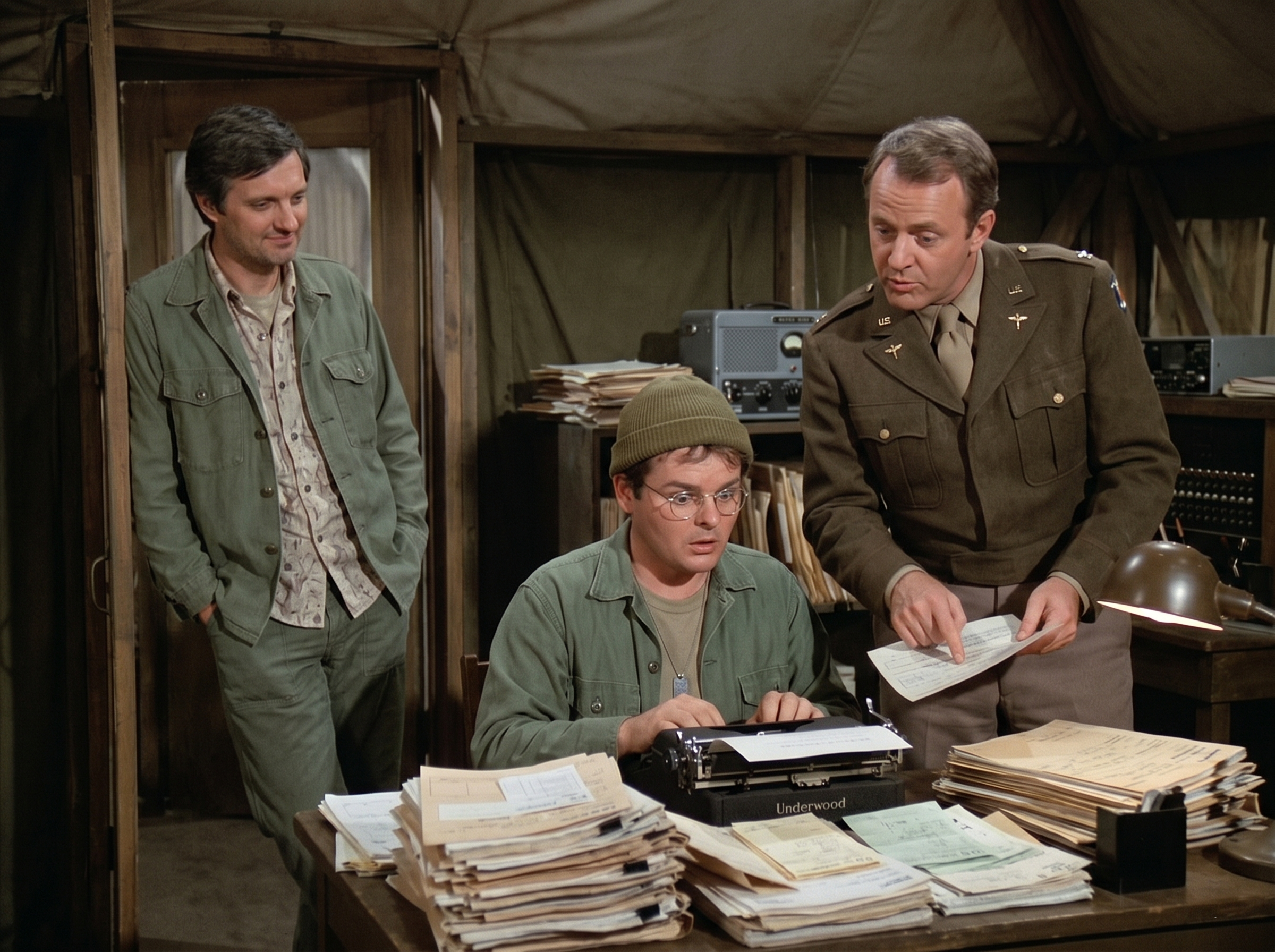
The swamp was cold, but the clerk’s office was always a different kind of drafty. It was the kind of chill that didn’t just settle in your bones; it settled in the paperwork, stiffening the carbon copies and making the keys of the old Underwood typewriter strike with a dull, heavy thud.
Outside, the distant rumble of artillery vibrated through the floorboards of the tent, a constant reminder of why they were all there. But inside, under the harsh glare of a single desk lamp, a different kind of battle was being fought—one fought with forms, supply lines, and bureaucratic red tape.
Radar O’Reilly sat frozen over the keys, his fingers hovering like nervous birds. His green beanie was pulled down tight over his ears, and his oversized glasses reflected the white glow of the paper before him. He stared at the sheet in the carriage as if it might explode.
Beside him stood the Colonel, leaning over the desk with a rare, intense focus. His olive-drab dress uniform was pristine, a sharp contrast to the mud-splattered reality of the 4077th, but his face carried the deep, exhaustion-lined grooves of a man who hadn’t slept in forty-eight hours. His finger was pressed firmly against a specific line on the document, pinning it down like a surgeon holding a flap of skin.
“Right there, Radar,” the Colonel said, his voice a low, commanding rumble that lacked its usual dry warmth. “That’s the discrepancy. If those numbers don’t match the divisional manifest by sunrise, we don’t just lose our next shipment of plasma. We lose our standing.”
Leaning against the doorframe, half-shrouded in the shadows of the entrance, was Hawkeye Pierce. He wore his faded green fatigues over a patterned shirt, his hands buried deep in his pockets. For once, the sharp-tongued surgeon was quiet. He had a faint, tired smile on his face, but his eyes were fixed on Radar, watching the young corporal handle a pressure that no nineteen-year-old from Iowa should ever have to carry.
“Colonel,” Radar whispered, his voice trembling slightly. “If I change this number to match their manifest, it means we’re officially declaring the loss of those crates in transit. It means nobody looks for them. But those crates… they had the specialized pediatric instruments for the local orphanage. And the winter blankets.”
The Colonel didn’t move his finger. “I know what was in them, Corporal. But if we don’t sign off on the error now, Seoul locks our entire supply account until an audit is completed. That takes three weeks. Three weeks without basic surgical gloves, Radar. Three weeks without penicillin.”
The tension in the room thickened until it felt as heavy as the canvas tent walls. Radar looked up, his eyes wide and searching, turning toward the doorway where Hawkeye stood. He was looking for a joke, a distraction, or a miraculous piece of Hawkeye logic to break the deadlock.
But Hawkeye just looked back at him, the smile fading from his lips, replaced by a profound, heavy silence. The typewriter seemed to grow larger, the white paper a glaring blank canvas demanding a sacrifice. Radar’s fingers lowered to the keys, trembling. One wrong stroke, one official signature, and a choice would be made between the survival of the camp and the comfort of innocent children.
The silence stretched, punctuated only by the rhythmic *tick-tick-tick* of the wind whipping against the tent ropes outside.
Radar’s eyes darted from the paper to the Colonel’s stern face, then back to Hawkeye. He felt the immense weight of the 4077th resting entirely on his narrow shoulders. To the rest of the world, it was just a supply form—Form 104-B, a dull piece of military bureaucracy. To the three men in the room, it was a ledger of human suffering.
Hawkeye finally shifted his weight, stepping away from the doorframe. He walked slowly over to the desk, the floorboards groaning under his boots. He reached out and gently tapped the top of the Underwood typewriter, a soft metallic *ping* breaking the spell.
“You know, Pierce,” the Colonel said without looking up, “if you’re here to offer one of your trademark cocktails of cynicism and wit, I’m fresh out of glasses.”
“No jokes tonight, Colonel,” Hawkeye said softly, his voice devoid of its usual theatrical edge. He looked down at Radar. “Just thinking about how a piece of paper travels faster than an ambulance. A clerk in Seoul stamps a document, and three hundred miles away, someone gets colder.”
The Colonel sighed, a sound that seemed to drain the last remaining energy from his frame. He lifted his finger from the paper and straightened up, rubbing the small of his back. “It’s the army, Hawkeye. We play by their rules so we can keep saving the pieces they break. If we don’t have penicillin, it doesn’t matter how many blankets the orphanage has. We won’t be alive to deliver them.”
Radar looked down at the keys. He knew the Colonel was right. He always was. It was the brutal arithmetic of the war, a math problem where every answer felt wrong.
“But sir,” Radar said, his voice barely audible. “There’s got to be another way. I can’t just… I can’t just write them off.”
Hawkeye looked at the stacks of paper piled high on the desk, the endless records of admissions, discharges, and requisitions. He saw the profound innocence in Radar’s face—the one thing the war hadn’t managed to completely grind away yet. It was the same innocence that kept the rest of them sane, the quiet reminder of home that they all fought to protect.
“Radar,” Hawkeye said, leaning down so he was eye-level with the corporal. “What if the crates weren’t lost in transit? What if they were mislabeled?”
The Colonel looked at Hawkeye, his eyebrows knitting together. “Mislabeled? Pierce, the manifest clearly states—”
“The manifest states whatever the clerk types, Colonel,” Hawkeye interrupted gently. He looked over at Radar with a sudden, subtle glint in his eye. “And we happen to have the best clerk in the United States Army sitting right here. Radar, what happens if a shipment of, say, ‘Surplus Engine Gaskets’ accidentally gets routed to the local civilian coordinates, while our penicillin manifest remains completely untouched?”
Radar blinked, his mind spinning through the labyrinth of military regulations he knew by heart. A slow, tentative light sparked behind his glasses. “Well… engine gaskets are handled under a completely different department. Supply Section Four. They don’t lock accounts for Section Four discrepancies; they just issue a routine delay notice.”
The Colonel stared at Hawkeye, then down at Radar. For a long moment, the fatherly commander looked entirely unreadable. His jaw was set, and his hands went behind his back. The room went still again.
“Corporal O’Reilly,” the Colonel said, his voice dropping into a formal, clipped tone.
“Yes, sir?” Radar squeaked.
“Are you telling me that our inventory system is so complex that a typographical error could result in automotive parts being sent to a civilian sector, without affecting our primary medical stores?”
“It… it could happen, sir. Especially if the clerk was very tired. And if the commanding officer happened to sign the secondary routing slip without looking at it too closely.”
The Colonel looked at the paperwork, then looked out the dark window of the tent toward the distant hills. A faint, dry smile tugged at the corner of his mouth, vanishing as quickly as it appeared.
“I am a very tired man, Corporal,” the Colonel said quietly. “And my eyesight isn’t what it used to be in the States. Type up the manifest correction. Ensure our medical supplies are secured.”
“And the engine gaskets, sir?” Radar asked, a look of pure relief washing over his face.
“I don’t know anything about engine gaskets, Radar,” the Colonel replied, turning toward the door. “But I expect whatever is in those crates to be delivered before the morning shift. Pierce, go get some sleep. You look like hell.”
“Goodnight, Colonel,” Hawkeye said, bowing his head slightly in a gesture of genuine respect.
As the Colonel stepped out into the chilly night, the flap of the tent falling shut behind him, Hawkeye looked back at Radar. The young corporal was already typing, his fingers flying across the keys with a frantic, joyful energy. The heavy, oppressive atmosphere of the room had vanished, replaced by the comforting, rhythmic clack of the Underwood.
Hawkeye stayed for a minute, just watching him. In a world full of madness, mud, and endless loss, they had managed to save a few blankets and a handful of children’s instruments. It wasn’t a victory that would make the newspapers, and it wouldn’t change the course of the war. But as Hawkeye turned to walk back to the Swamp, he felt a little bit warmer.
Amidst the endless paperwork of war, the 4077th always found a way to write their own rules of humanity.