The Endless List of Ordinary Miracles
Some days in Korea, the mud wins. Other days, the sheer, exhausting weight of the calendar takes the wind right out of your sails.
But every once in a while, a moment comes along that stops the clock entirely, turning a cramped, olive-drab office into the center of the universe.
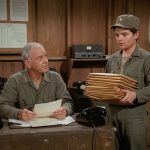
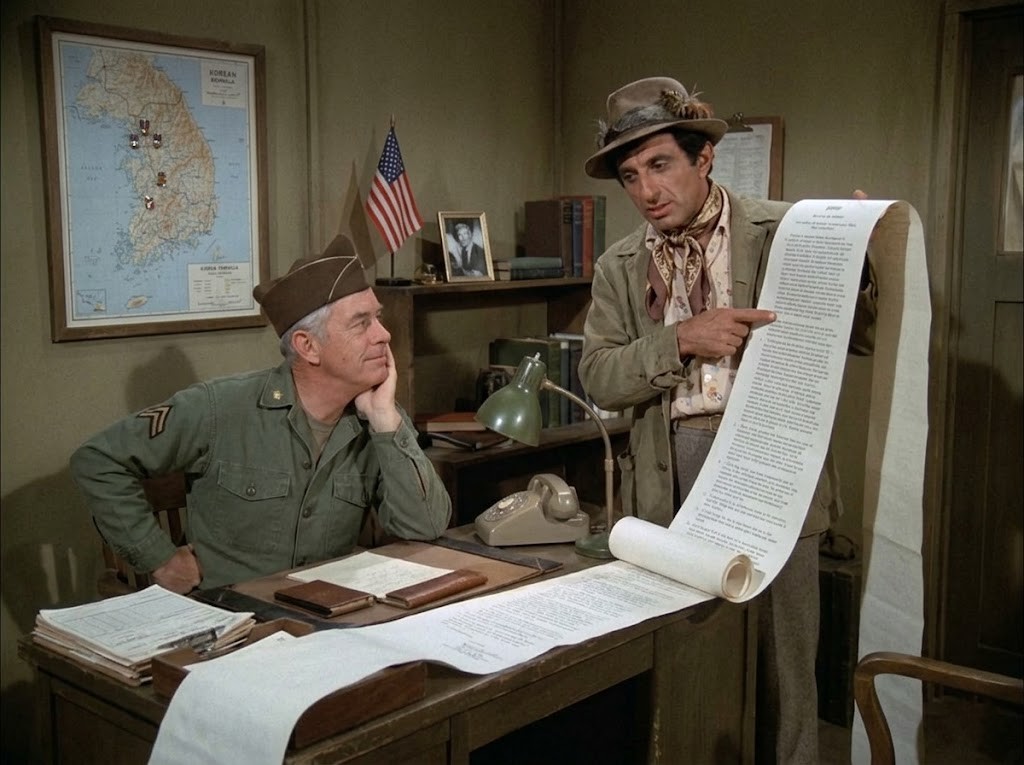
In the administrative heart of the 4077th, Company Clerk Radar O’Reilly sat frozen behind his desk, his chin resting heavily in his palm.
His eyes were fixed not on the usual mountain of requisitions or the daily casualty reports, but on an impossibly long, unspooling ribbon of paper.
Standing beside him, looking like a cross between a theatrical promoter and a tired guardian angel, was Corporal Maxwell Klinger.
Clad in a civilian hat adorned with feathers, a patterned scarf, and a loose jacket, Klinger held the top of the scroll high, his finger pinning down a specific line with absolute, dramatic conviction.
On the wall behind them, the map of Korea remained pinned with small markers—a constant, silent reminder of the fractured world just outside their door.
But inside the office, the air smelled faintly of stale coffee, old ink, and the unmistakable scent of a man who refused to let a war dictate his wardrobe or his spirit.
“Look at it, Radar,” Klinger insisted, his voice a low, intense rumble that vibrated with a strange kind of reverence. “Just read line forty-seven. I didn’t make the rules, I just transcribed them from the deepest, most sacred desires of the human soul.”
Radar didn’t move his hand from his face. He just let out a long, slow sigh that rustled the edges of the paperwork scattered across his blotter.
“Klinger, the Colonel is going to walk through that door in exactly five minutes,” Radar warned, his voice cracking slightly with its usual nervous energy. “If he sees this… if he sees what you’ve actually written on government-issue teletype paper, he’s going to have us both cleaning the latrines with toothbrushes until the next decade.”
“This is bigger than the Colonel, Radar,” Klinger countered, gesturing wildly with his free hand toward the scroll that cascaded all the way down to the floor, looping like a paper river across the desk. “This is a manifesto. It’s a testament to survival.”
Radar finally shifted his gaze upward, looking at Klinger with a mixture of profound exhaustion and deep affection.
The camp had been operating on three hours of sleep for a week straight, the OR had been a conveyor belt of broken bodies, and everyone was frayed at the edges.
“It’s three pages long, Klinger,” Radar whispered, his eyes wide. “And the first item is a direct violation of military protocol.”
Klinger didn’t blink. He just pointed harder at the paper, his face deadpan. “It’s not a violation, Radar. It’s an essential supply request for the preservation of morale. Now, do you sign it, or do we let the dream die right here?”
The telephone on the desk sat silent, a rare occurrence, while the green desk lamp cast a warm, localized glow over the document that threatened to change the entire mood of the 4077th.
Radar reached out a hesitant hand, his fingers hovering over the bottom of the scroll, knowing that once his initials went on an official-looking document, there was no turning back.
The tension in the room hung as thick as the morning fog over the hills, broken only by the faint, rhythmic ticking of the wall clock.
Radar’s pen hovered. He knew the risk, but looking at Klinger—the man who fought the absurdity of war with his own brilliant brand of madness—he felt the icy wall of military rigidity begin to melt.
“Alright, let’s say I put the company stamp on this,” Radar muttered, looking up into Klinger’s intense brown eyes. “How do you expect Hawkeye and B.J. to react when they find out their names are attached to an official requisition for twelve crates of genuine Toledo hot dogs and a life-sized statue of the Ohio State buckeye?”
Klinger smiled, a slow, brilliant expression that crinkled the corners of his eyes. “Captain Pierce will weep tears of pure mustard, Radar. And Captain Hunnicutt will probably try to milk the statue. But that’s just page one.”
Klinger allowed the scroll to unfurl a little further, the white paper tumbling gracefully over the wooden edge of the desk.
“Look further down,” Klinger said softly, his theatrical tone dropping into something much quieter, much more grounded. “Line eighty-two. A shipment of real, heavy-knit wool blankets for the kids at the orphanage. Line ninety-four. Enough penicillin to ensure we don’t have to ration it between the local villagers and the intake tent next month.”
Radar paused, his eyes scanning down the long, typed columns. Mixed in with Klinger’s ridiculous, desperate attempts to find a ticket home and his cravings for the comforts of Ohio, were things that mattered to everyone.
There were requests for new jazz records for Winchester to play when the silence got too loud, a specific brand of tea that Father Mulcahy loved but never asked for, and a fresh supply of canvas that Margaret needed to fix the nurses’ quarters before the monsoon season hit.
It wasn’t just a list of demands. It was a map of their small, temporary family’s heart, written by the camp’s most beautifully eccentric son.
“You’re a section eight candidate, Klinger,” Radar said, a small, genuine smile finally breaking through his tired features. “But you’re a lousy selfish person.”
“Don’t ruin my reputation, O’Reilly,” Klinger snapped back with a wink, though his posture relaxed. “I’m a desperate man looking for a way out. I just happen to need a lot of luggage space for the rest of you idiots when I go.”
Suddenly, the heavy wooden door at the back of the office creaked open. Both men froze.
Colonel Potter stepped into the room, his boots clicking sharply on the floorboards. He stopped, his sharp eyes instantly taking in the scene: Radar slumped but smiling, Klinger holding a scroll longer than a man is tall, and a desk covered in unauthorized hope.
Potter walked over, his face an unreadable mask of old-school army discipline. He looked at the scroll, then at Klinger’s feathered hat, and finally down at Radar.
“What in the name of General Pershing’s ghost is going on here?” Potter barked, though there was a familiar, paternal twitch at the corner of his mustache.
Radar scrambled to stand, but Klinger held his ground, clearing his throat. “An addendum to the monthly report, Colonel. Just making sure the army knows exactly what it takes to keep this machine running.”
Potter stepped closer, reaching out to touch the paper. He read a few lines silently. He saw the Toledo hot dogs, he saw the wool blankets, and he saw a small note at the very bottom, written in Klinger’s hurried script, requesting a new set of paintbrushes for a certain regular army Colonel.
The room was deathly quiet. Then, Potter let out a dry, short cough and turned toward his inner office.
“O’Reilly,” Potter called out over his shoulder as he opened his door.
“Yes, Sir?” Radar squeaked.
“Make sure that document is filed under ‘Urgent Miracles.’ And Klinger?”
“Sir?”
“If those paintbrushes don’t show up with the hot dogs, you’re on guard duty until Christmas.”
The door closed behind the Colonel, leaving a stunned, beautiful silence in the room. Klinger looked at Radar, and Radar looked at Klinger. With a quiet chuckle, Radar picked up his official stamp, breathed on the ink pad, and brought it down on the paper with a definitive, satisfying thud.
In the middle of a forgotten valley, surrounded by a war that made less sense by the day, two soldiers rolled up a piece of paper that held the weight of their world, knowing that as long as they could laugh together, the mud would never truly win.
—
Sometimes home isn’t a place on a map, but the beautiful, chaotic people who keep you sane while you’re waiting to get there.