The Weight of a Plain Manila Envelope
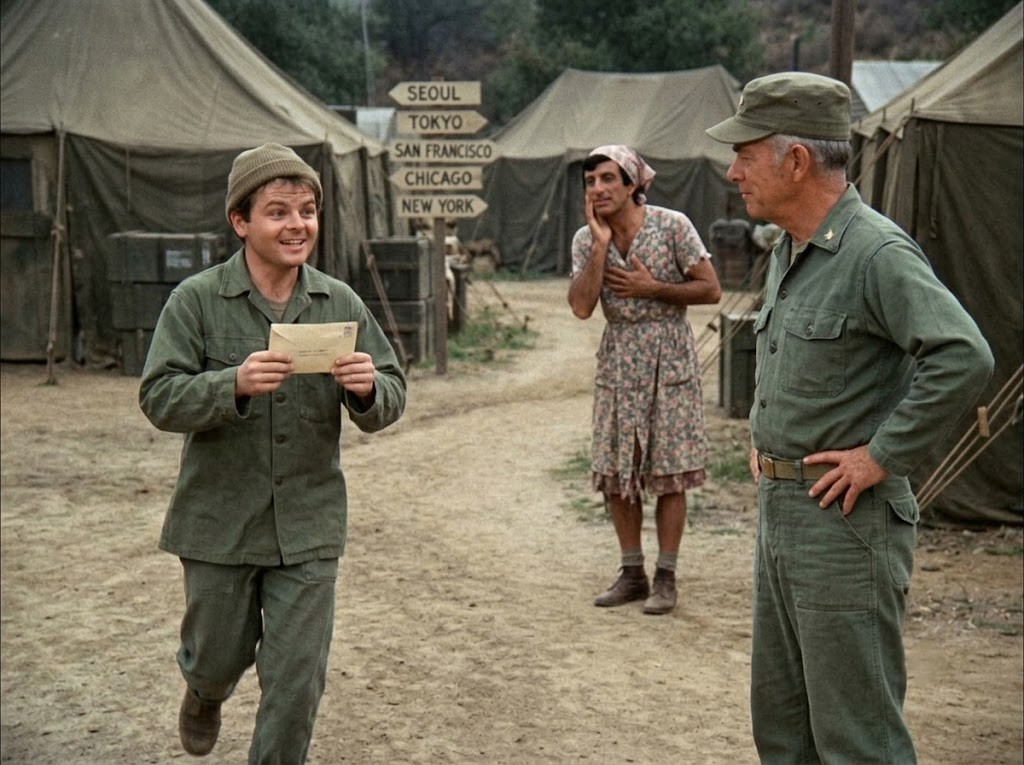
The mail jeep hadn’t even come to a full stop before the dust of the compound was stirred by a pair of heavy boots. In a place like the 4077th, mail wasn’t just paper and ink; it was oxygen, delivered in battered canvas sacks to a valley starving for home.
Radar O’Reilly had the letter gripped tightly in both hands, his face lit up with a grin so wide it threatened to split his ears. He skipped and jogged across the hard-packed dirt of the compound, his knit cap pulled low, navigating the familiar pathways between the drab olive-drab tents.
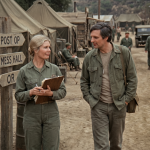
Behind him, the iconic signpost pointed toward places that felt like beautiful myths—Seoul, Tokyo, San Francisco, Chicago, New York. But right now, the only geography that mattered was the few yards between Radar and Colonel Sherman T. Potter.
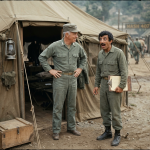
Colonel Potter stood with his hands resting firmly on his hips, his posture commanding yet deeply paternal. He watched the young clerk approach, his eyes narrowing slightly with an expression that mixed mild amusement with a father’s quiet curiosity.
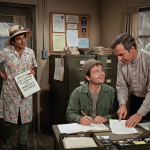
Just a few paces back, Maxwell Klinger stood frozen in mid-stride, wearing a floral print dress and a matching headscarf. One hand was pressed dramatically to his cheek, the other clutched against his chest in a gesture of pure, breathless anticipation, his eyes wide as he watched Radar run.
“Colonel! Colonel Potter, sir!” Radar gasped out, his voice cracking slightly with the exertion and excitement as he skidded to a halt in front of the commanding officer.
Potter shifted his weight, a faint smirk playing beneath his seasoned gaze. “Calm down, son, before you bust a seam. What’s got you running like a thoroughbred at Churchill Downs?”
Radar held up the plain manila envelope, his thumbs tracing the edges as if it were made of spun gold. “It’s here, sir. The official packet from Ottumwa, Iowa. It’s got the notary seal and everything!”
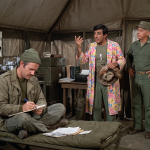
Klinger let out a soft, theatrical gasp from the background, his civilian attire rustling in the slight breeze. “Oh, broad shoulders, don’t tell me… is it the family hardship discharge?”
Radar didn’t look back; his eyes were locked on the Colonel, his smile turning slightly more serious, carrying a weight that didn’t usually belong to a kid from Iowa. “No, Klinger. It’s better. It’s the permission paperwork for the farm.”
Colonel Potter’s demeanor softened, the rigid military posture yielding just a fraction to the warmth of a man who knew exactly what a piece of land meant to a family back home. “The tractor parts, Radar? Or the new zoning line your mother was fretting about in her last three letters?”
Radar swallowed hard, his grip tightening on the envelope as the joy in his face suddenly mixed with a sudden, sharp vulnerability. “It’s both, sir. But there’s a handwritten note on the back from the town doctor… about my Uncle Ed.”
The air between them seemed to grow heavy, the distant clatter of the Swamp and the faint hum of the generator fading into the background. Radar’s smile faltered just a bit, the high point of his excitement suddenly clashing with the quiet terror every soldier carried—the fear of what the mail actually said once you broke the seal.
—
Colonel Potter didn’t say a word at first. He reached out a weathered hand and gently tapped the corner of the envelope, guiding Radar’s hands down so the boy would stop squeezing it to pieces.
“Well, don’t just stand there like a frozen sentinel, Radar,” Potter said, his voice dropping into that low, comforting gravel that could settle a room full of panicked surgeons. “Open it up. Let’s see what the home front has to say.”
Radar took a deep breath, his fingers trembling slightly as he slid his thumb under the flap of the envelope, carefully tearing it open. Klinger took two soft steps closer, completely forgetting his usual routine of angling for a Section 8, genuinely caught up in the life of the kid from Iowa.
Out peeled the official-looking documents, crisp and intimidating, but folded neatly inside was a small, lined piece of notepad paper covered in shaky, elegant cursive. Radar scanned it quickly, his eyes darting across the page as the compound around them seemed to hold its breath.
For a second, nobody spoke. The silence stretched out, fragile and heavy, the kind of silence that usually preceded bad news in a field hospital.
Then, a slow, watery grin broke across Radar’s face, casting away the shadows. “He’s up, Colonel. Dr. Bleeker says Uncle Ed is back on his feet. He even managed to fix the radiator on the old John Deere himself last Tuesday.”
Klinger let out a loud, dramatic sigh of relief, dropping his hands to his sides and looking up at the gray Korean sky. “Thank beautiful Toledo. My ulcer couldn’t take any more suspense.”
Colonel Potter let out a long, slow breath, a deep chuckle rolling from his chest as he patted Radar firmly on the shoulder. “A good tractor and a stubborn Iowan are two things you can never truly break, son. Your mother must be breathing a whole lot easier.”
“Yes, sir,” Radar beamed, carefully folding the note and tucking it safely into his breast pocket, right over his heart. “She says the corn is looking real good this year, too.”
From the door of the pre-op tent, Hawkeye Pierce emerged, wiping his brow with a towel, his tired eyes taking in the little gathering. “What’s the commotion out here? Did Klinger finally find a dress that matches his complexion, or did Iowa just declare peace on Illinois?”
“Better, Pierce,” Potter said, turning back toward his office with a lighter step. “The O’Reilly farm is still standing, and Uncle Ed is too ornery to give up.”
Hawkeye leaned against the tent pole, a soft, genuine smile replacing his usual cynical smirk. “Well, write him back, Radar. Tell him if he needs any medical advice, we’ve got a wonderful collection of rusty tools and a direct line to a very fashionable Toledo housewife.”
Klinger sniffed dramatically, adjusting his headscarf. “An elegant housewife, if you please, Captain.”
As the group began to drift apart—Klinger heading toward the mess hall with a bit more bounce in his step, and Hawkeye heading to the Swamp for a well-deserved nap—Radar remained standing by the signpost for a moment longer.
He looked down at the envelope in his hand, then up at the wooden arrows pointing to cities thousands of miles away. In the middle of a war zone, surrounded by mud, tents, and the constant reminder of human fragility, a piece of paper from a small town in Iowa had just rebuilt the walls of his world.
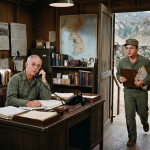
Colonel Potter paused at the door of his office, looking back at the young clerk who looked so small against the backdrop of the mountains. “Get back to work, Radar,” the Colonel called out softly, his voice full of unmistakable affection. “Those morning reports won’t typing-error themselves.”
“Yes, sir!” Radar called back, his voice bright, his spirit anchored firmly back home.
—
Because in a place like the 4077th, a good piece of news from home didn’t just save one family—it kept the whole camp breathing.