The Measure of Endurance in a Metal Tray
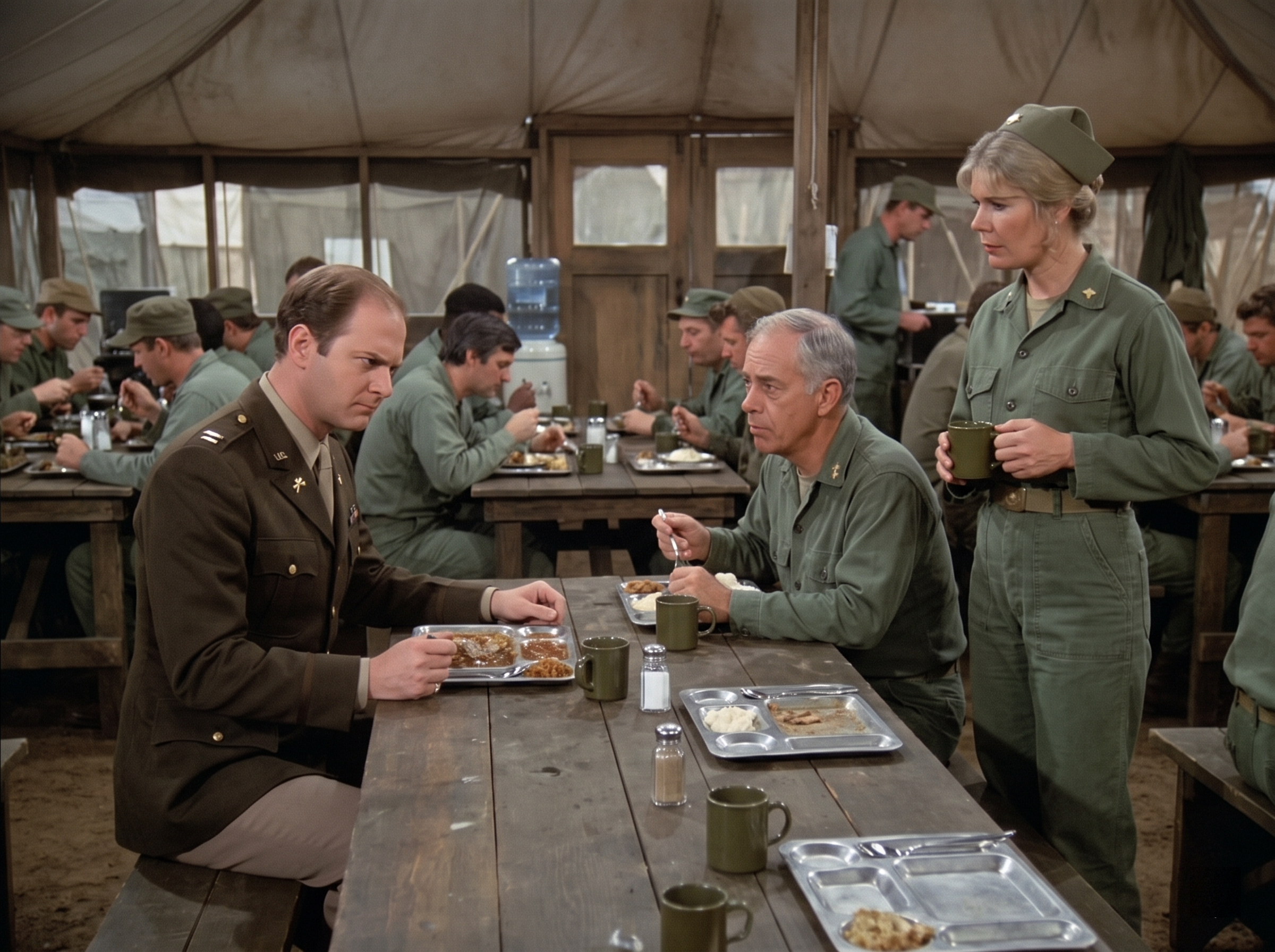
The air in the mess tent always smelled like a blend of stale coffee, powdered eggs, and the sharp, distinctive aroma of an unidentifiable stew that everyone simply called “that red stuff.” It was a smell you never really forgot, a smell that clung to fatigues and memory alike.
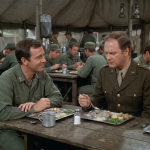
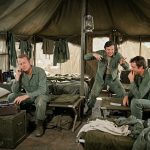
Today, Major Charles Emerson Winchester III stared at his meal with a look that suggested he had just found a worm in his vintage Bordeaux. Dressed with a touch more refinement than his surroundings strictly required, his very posture was an act of quiet, dignified rebellion. He sat upright, his brow slightly furrowed in an expression that was one part deep irritation, one part haughty superiority, and two parts simple, exhausted disgust.
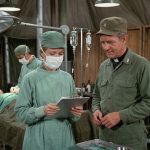
Across from him, Colonel Sherman Potter sat eating with a grounded, compact calm that defined his command. He seemed entirely focused on the mechanics of ingestion, holding his silverware with practiced efficiency. He’d eaten far worse, in muddy trenches and frozen camps. Yet, his gaze remained fixed on Charles, a complicated expression of fatherly weariness, dry amusement, and practiced authority flickering in his eyes.
Standing just to the side, Major Margaret Houlihan held a coffee mug in a tightly controlled grip. Her posture was straight, professional, and composed, yet her eyes were sharp, observing the silent battle of wills at the table with a knowing skepticism. She had seen countless iterations of this dance between their commanding officer’s pragmatic endurance and Charles’s high-society sensitivities.
“I believe this… substance… has achieved sentience,” Charles remarked, his voice a smooth, cutting baritone that somehow made the tent seem more crowded. “It is staring back at me, Colonel. And I believe it has a message, and that message is: ‘You are going to lose this meal.‘”
Colonel Potter continued to chew, slow and methodical. He took a sip of his coffee, eyes still fixed on Charles. He just listened. He didn’t interrupt, he didn’t correct, he just let Charles’s words hang in the heavy air. The background chatter of other soldiers in the tent faded just enough for the silence at their table to feel noticeable.
“I am a surgeon of international repute, not a participant in some tragic biological experiment!” Charles declared, raising his spoon as if to challenge the food itself. His voice was gaining energy, a controlled storm of indignation that spoke of his deep, proud outsider nature. He looked from his tray to Potter, demanding some kind of acknowledgement, some hint of shared humanity, even if it was just a grumbled agreement that the food was awful. He needed to know that at least someone else saw the indignity, the utter absurdity of their daily rations. The silence was beginning to feel like a judgment, a dismissal of his entire world.
Colonel Potter finally swallowed. He took another deliberate sip from his mug, his eyes softening just a tiny fraction. The corner of his mouth twitched, not with humor, but with a weary understanding.
He set his mug down with a soft, final thud. “You’re right, Major. It’s an atrocity. An insult to the very concept of food.”
Margaret’s watchful gaze didn’t waver, but a tiny, barely-there smile touched her lips. She recognized that unique blend of shared suffering and fatherly guidance.
Potter leaned in slightly, his voice dropping to a calm, steady rumble. “I’ve eaten worse. Stuff that wouldn’t pass as dog food. Rations we had to crack on a rock before we could even attempt a chew. It didn’t taste good, and it sure wasn’t pretty. But we ate it. We ate it because it was all we had. We ate it because our bodies needed fuel, and that fuel kept us moving, and that moving kept us alive.”
He looked directly at Charles, who had lowered his spoon. The haughtiness in Charles’s expression was gone, replaced by a complex mix of discomfort and a new, almost surprised realization. He was listening. Really listening.
“You’re a fine surgeon, Major. The best we have,” Potter continued, his voice softer now. “But out here, refinement doesn’t count for much. Endurance does. That tray doesn’t care about your reputation. It just is what it is. And we eat it together. We eat it because the men in pre-op are waiting, and because we are all this camp has got. So we make do. We complain, we laugh at it, and we endure. Together.”
Margaret stepped forward, just an inch, her coffee mug held tight. A look passed between her and Charles – a quick, knowing understanding of the mission, the struggle, and the common bond that made them all part of the same exhausted, durable family in uniform.
Charles looked back down at his tray. He didn’t smile, and his expression was still one of deep distaste, but the open revolt had faded. His sarcasm was still there, but tempered with a newfound, begrudging respect for the grit Potter embodied.
He picked up his spoon again, this time with a slow, deliberate movement. “Very well, Colonel. For the civilized world.” He glanced at Margaret and Potter, a tiny, subtle nod of acknowledgement, before bringing a small spoonful of the “red stuff” to his mouth.
Potter didn’t smile, but he did offer a single, brief nod. He picked up his own fork, and the clinking of silverware returned, joining the hum of conversation that seemed a little warmer, a little more unified. It wasn’t about the food anymore. It was about the shared burden and the quiet strength they found in each other.
Because sometimes, the best medicine is just the shared strength found in enduring the small indignities together.