The Silence After the Sirens
The hardest part of the war wasn’t the noise.
It wasn’t the rhythmic, heart-pounding thud of the chopper blades echoing over the hills, or the screech of the ambulance brakes outside the triage doors. It wasn’t the shouted orders, the clatter of dropped clamps, or the hissing of the autoclave.
The hardest part was the sudden, ringing silence that followed when it was all finally over.
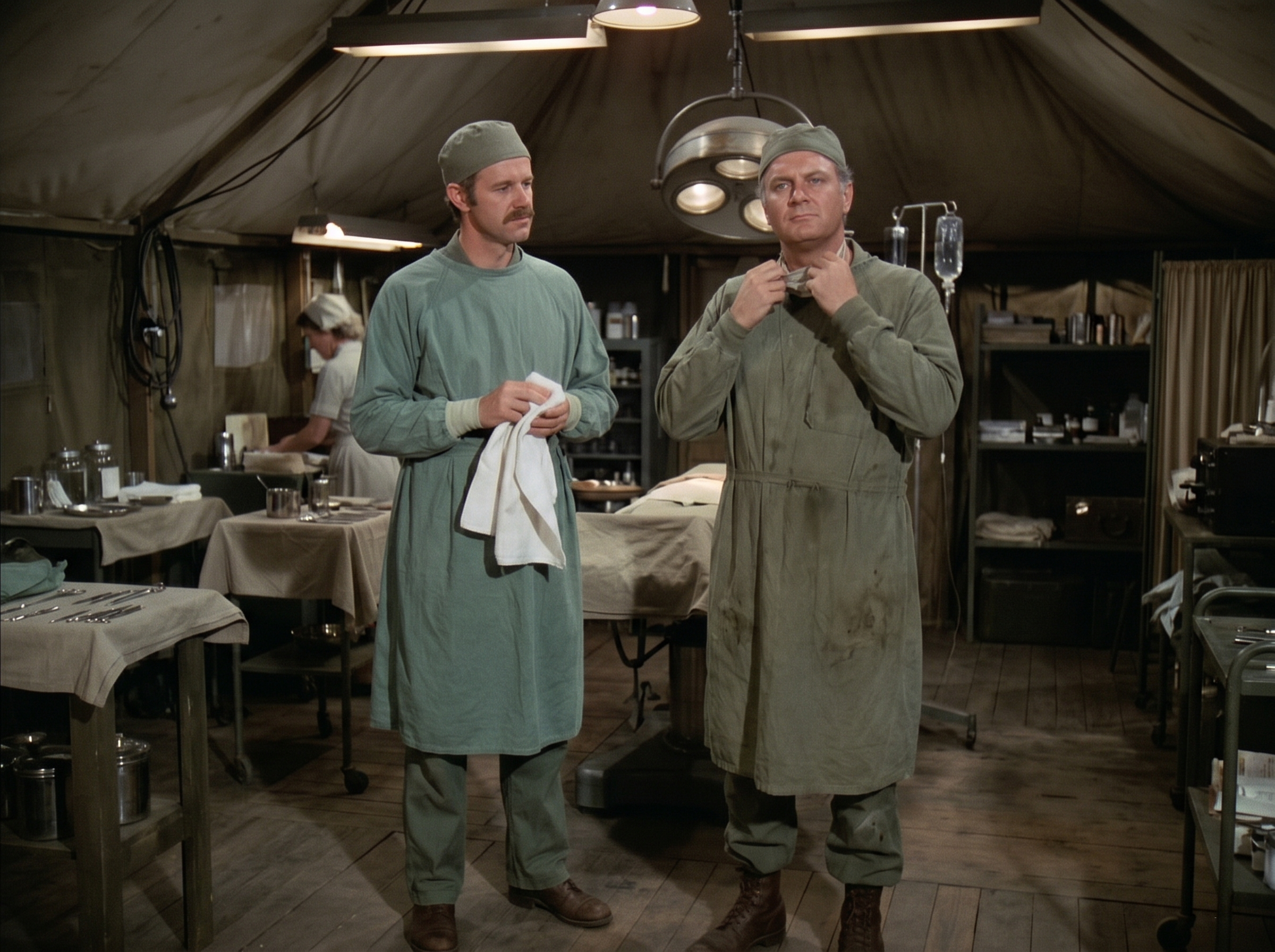
Inside the surgical tent of the 4077th, the air hung thick and heavy. The harsh glare of the overhead lamp cast long, exhausted shadows across the wooden floorboards. In the background, a lone nurse quietly gathered the last of the metal trays, the soft clinking of instruments the only sound left in the room.
The eighteen-hour session of meatball surgery had finally ended. The last patient had been stabilized, wheeled away to post-op to face whatever tomorrow would bring.
Now, there was only the aftermath.
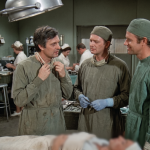
B.J. Hunnicutt stood entirely still, a stark contrast to his usual easygoing, California rhythm. His shoulders were slumped, his posture rigid and hollowed out by fatigue. In his hands, he gripped a simple, white surgical towel.
He had picked it up to wipe the sweat from his brow, but his hands had simply stopped halfway. He was staring at nothing, his eyes fixed on a scuff mark near the scrub sinks, lost in the weary fog of a mind that had seen too much over the last two days. The warm, grounded doctor from Mill Valley was temporarily gone, replaced by a man running purely on fumes.
A few feet away, Charles Emerson Winchester III stood in parallel silence.
If B.J. wore his exhaustion like a heavy coat, Charles fought it like a mortal enemy. His chin was tilted upward, a desperate, ingrained attempt to maintain his aristocratic dignity even in a canvas tent in the middle of a war zone.
His gloveless hands moved to his neck, meticulously adjusting the ties of his surgical gown and the collar beneath it. It was a phantom gesture. There was no silk cravat to straighten, no tailored lapels to smooth down. There was only the rough, blood-speckled green cotton of the United States Army.
Yet, Charles adjusted it anyway. It was his armor. It was his desperate, necessary routine to remind himself that he was a civilized man, a Bostonian, a Winchester, and not just a mechanic patching up broken boys in a mud puddle.
They stood there, side by side, two men from entirely different universes bound together by the same relentless nightmare. They didn’t speak. They didn’t have the energy to form words. The silence stretched, thick with the smell of iodine and damp canvas.
Then, the quiet tension in the room finally snapped.
B.J.’s knuckles turned white around the towel. A sudden, violent tremor ran through his arms. His knees, locked for too many hours over an operating table, suddenly gave way. He swayed dangerously to the left, his eyes fluttering shut as the crushing weight of the shift finally pulled him toward the hard wooden floorboards.
“Hunnicutt.”
The voice was sharp, a perfectly modulated baritone that cut through the sterile air like a scalpel.
Before B.J. could completely lose his balance, a firm hand gripped his elbow. Charles had moved with surprising speed, abandoning the meticulous adjustment of his collar to catch his colleague. He didn’t panic, and he certainly didn’t offer a comforting embrace. That wasn’t the Winchester way.
Instead, Charles held B.J. up with a rigid, dignified strength, his grip steady and unyielding.
B.J. blinked, his eyes snapping open. He took a sharp breath, his boots shuffling against the floorboards as he found his center of gravity again. He looked over at the hand gripping his arm, then up at Charles.
“Careful, Hunnicutt,” Charles said dryly, his voice remarkably steady despite the deep bags under his own eyes. “If you intend to collapse, kindly do so outside in the mud where you belong. The floor in here is filthy, and I have absolutely no desire to sew you back together on my own time.”
B.J. let out a short, breathy exhale that was half-sigh, half-laugh. The tension in his shoulders finally cracked. The trembling stopped.
“Thanks, Charles,” B.J. muttered, his voice raspy and thin. He looked down at the white towel still clutched in his hands, finally lifting it to wipe his face. “For a second there, I thought I was back in San Francisco, falling off a cable car.”
Charles slowly released his grip, stepping back to his perfectly measured distance. He smoothed the front of his worn green gown, sniffing dismissively.
“I assure you, a cable car would be a significant upgrade from this dreadful upholstery,” Charles replied, looking around the dimming tent with standard disdain. But beneath the haughty exterior, his eyes lingered on B.J. for an extra second, a quiet, unspoken check to ensure the California doctor was truly steady on his feet.
B.J. caught the look. He didn’t point it out. You didn’t point out a Winchester’s compassion; it spooked them.
“That last one,” B.J. said quietly, his voice dropping to a murmur. “The kid with the chest wound. He was… he was too young, Charles.”
Charles paused. He turned his gaze toward the empty surgical table, the overhead lamp reflecting dimly in his eyes. The haughty veneer melted away, leaving only the profoundly tired, deeply brilliant surgeon underneath.
“They are all too young, Hunnicutt,” Charles said softly. The sarcasm was entirely gone. “Every single one of them.”
He reached up, finally untying the knot at the back of his neck. The green canvas slipped off his shoulders.
“But,” Charles continued, his tone carrying a quiet, absolute certainty, “thanks to the rather… adequate work performed in this room today, that particular young man will live to see another terrible sunrise. And frankly, that is the only metric of success we have left in this godforsaken place.”
B.J. looked at Charles, a slow, genuine smile touching the corners of his mouth beneath his mustache. It was as close to a compliment as Charles would ever give, and as close to a confession of mutual respect as he would ever offer.
“Adequate,” B.J. repeated, nodding slowly. “I’ll take adequate.”
“See that you do,” Charles sniffed, slipping back into his familiar armor. He turned toward the door, his posture perfectly upright despite the dragging weight of his worn boots. “Now, if you will excuse me, I am going to return to the Swamp. I intend to sleep for precisely forty-eight hours, and if either you or Pierce wakes me before then, I will personally see to it that you are reassigned to an outpost in Alaska.”
B.J. watched him go, the white towel dangling loosely from his hand. The heavy, suffocating despair of the shift had lifted, replaced by a weary, profound gratitude. He wasn’t alone. None of them were. They drove each other crazy, they came from different worlds, but in this room, they were the only family that mattered.
“Hey, Charles,” B.J. called out softly as Winchester reached the flap of the tent.
Charles paused, turning his head slightly. “Yes?”
“Save me a drop of that awful brandy you hide in your footlocker, will you?”
A tiny, almost imperceptible smirk graced Charles’s lips. “I hide nothing, Hunnicutt. I simply store things out of the reach of peasants. But… I suppose I might accidentally leave a glass unattended.”
Charles pushed through the canvas flap, stepping out into the cool, gray Korean morning. B.J. took one last look around the quiet operating room, tossed the white towel into the laundry bin, and followed his friend out into the dawn.
In a place designed to break you, the greatest medicine they had was the quiet dignity of standing side by side.