The Crochet Chicken and the Boston Brahmin
Some days at the 4077th Mobile Army Surgical Hospital didn’t start with the thwack-thwack of incoming chopper blades, but with a different kind of madness entirely. It was the heavy, exhausting lull between casualties, where the mud seemed thicker, the coffee tasted more like battery acid than usual, and the walls of the camp felt like they were closing in on everyone.
Down in the dim, drafty labyrinth of the Supply Area, the air smelled of damp cardboard, aged canvas, and the faint, sweet scent of the Toledo-brand cologne Corporal Maxwell Klinger wore to feel civilized.
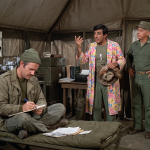
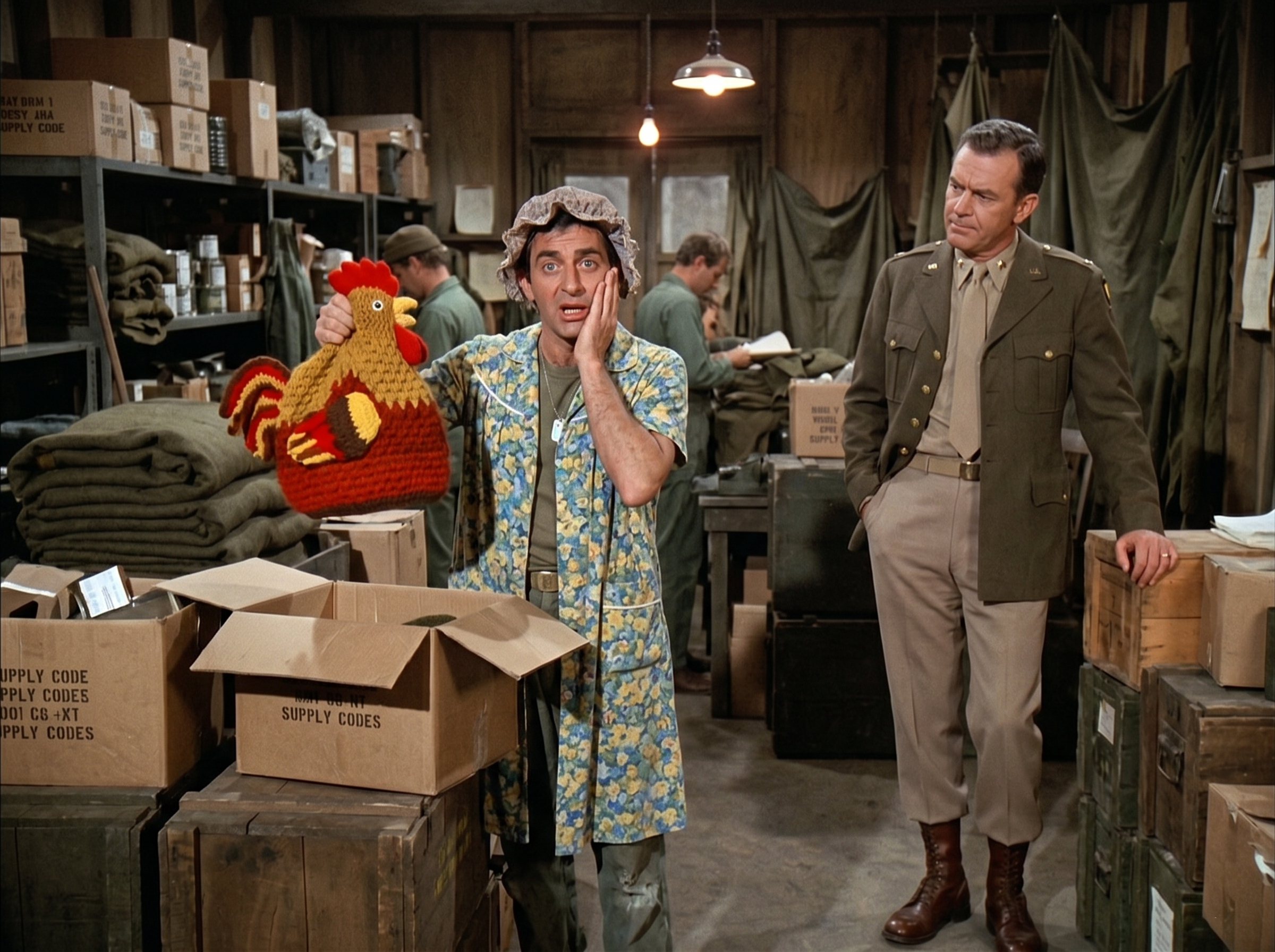
He was currently knee-deep in a fresh shipment of requisitioned crates, wearing a floral-printed housecoat and a matching ruffled bonnet that defied every regulation ever written in the standard Army manual.
“I ask for penicillin, Major,” Klinger cried out, his voice echoing off the wooden rafters as he plunged his arms into another cardboard box. “I beg for fresh winter socks. I pray on both knees to the supply gods in Seoul for a single crate of real, non-powdered eggs.”
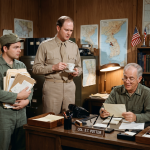
A few feet away, Major Charles Emerson Winchester III stood like a statue of absolute, unwavering Bostonian refinement amidst the military clutter. His olive-drab officer’s uniform was impeccably pressed, his posture rigid, and his hand casually tucked into his trouser pocket as if he were waiting for a train at Back Bay Station rather than standing in a canvas outpost in Korea.
Charles slowly raised a single, judgmental eyebrow, his gaze dripping with a mixture of dry superiority and profound exhaustion. “And instead, Corporal, your relentless incompetence has yielded what, precisely? More standard-issue disappointment?”
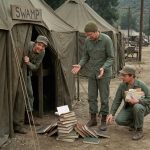
With a theatrical gasp, Klinger whipped his hands out of the box and held his latest discovery high in the air with dramatic, rigid finger placement.
It wasn’t medical supplies. It wasn’t ammunition.
It was a large, brightly colored, heavily textured crochet chicken tea cozy, complete with a bright red comb and yellow stitched wings.
Klinger’s eyes went wide with a mixture of theatrical disbelief and undeniable comic pride. “Behold! The pride of the Seventh Supply Catalog! It’s a masterpiece, Major! A sign from above!”
Charles stared at the yarn bird, his face hardening into an expression of utter, aristocratic disdain. “Merciful heavens. It is an abomination of yarn, Klinger. Put it away before it offends my sense of sight any further.”
But Klinger didn’t put it away; instead, his theatrical smile suddenly faltered, his eyes locking onto a small, faded handwritten tag pinned to the bottom of the yarn chicken, and the comic light in his eyes instantly vanished, replaced by a sudden, heavy silence that made Charles stiffen.
“What is it, Corporal?” Charles asked, his voice losing just a fraction of its sharp edge, though his posture remained formal. “Has the yarn developed a pulse?”
Klinger cleared his throat, his theatrical bravado completely melting away. He gently touched the small piece of paper attached to the crochet stitch.
“It’s a note, Major,” Klinger said softly, his voice dropping its usual Toledo twang. “It says… ‘To the boys at the 4077th. My church group made these to keep your coffee pots warm in the winter. We know it gets cold over there. God bless you. From Mrs. Eleanor Higgins, Iowa.’“
Charles blinked, his raised eyebrow slowly lowering. He looked from Klinger’s somber face to the garish, brightly colored chicken. For a long moment, the only sound in the supply room was the distant, rhythmic hum of the camp generator and the quiet rustle of paper as another supply clerk worked in the background.
To a man like Charles Emerson Winchester III, a crochet tea cozy from Iowa was the epitome of useless, provincial tackiness. But as he stared at the worn, clumsy stitches, he didn’t see yarn anymore. He saw an old woman sitting by a radio somewhere in the American Midwest, worried sick about a bunch of young men she had never met, pouring her prayers into a ball of wool.
Klinger looked down at his own ridiculous outfit, then back at the chicken. “She doesn’t even know us. She just knew we were cold.”
Charles took a slow step forward, his hand remaining in his pocket, maintaining his rigid posture, but his eyes softened with a quiet, undeniable compassion. He wouldn’t let his guard down completely—he was a Winchester, after all—but the dry superiority in his demeanor dissolved into something deeply human.
“Well,” Charles said quietly, his Boston accent thick and strangely comforting in the cold room. “It seems Mrs. Higgins possesses a far greater sense of civic duty than the entire United States Army Quartermaster Corps.”
Klinger looked up, a small, genuine smile breaking through his disbelief. “You think we should keep it, Major?”
“Corporal, if you dare let that… that poultry-shaped monstrosity leave this camp, I shall personally see to it that your next shipment of dresses consists entirely of burlap sacks,” Charles replied, a faint, wry smirk playing at the corner of his mouth. “Furthermore, the Swamp’s coffee pot is currently freezing. Take it to Pierce and Hunnicutt. Tell them it is an artifact of high culture.”
Klinger clutched the crochet chicken to his chest with a look of pure, affectionate pride. “Aye, aye, Major.”
Charles gave a single, stiff nod, turned on his heel, and walked out of the supply room, his uniform perfectly straight, leaving Klinger alone in the warm, practical light of the warehouse.
Later that evening, the camp would face another influx of wounded, the operating room would smell of ether, and the fatigue would settle deep into everyone’s bones again. But for now, a silly yarn chicken sat proudly atop a dented metal coffee pot in the Swamp, keeping the bitter cold at bay, reminding a few lonely doctors that someone, somewhere, remembered they were there.
It was a place where a piece of yarn from Iowa could bridge the distance between a Boston aristocrat, a boy from Toledo, and the home they all desperately missed.