The Weight of Home in the Mud of Uijeongbu
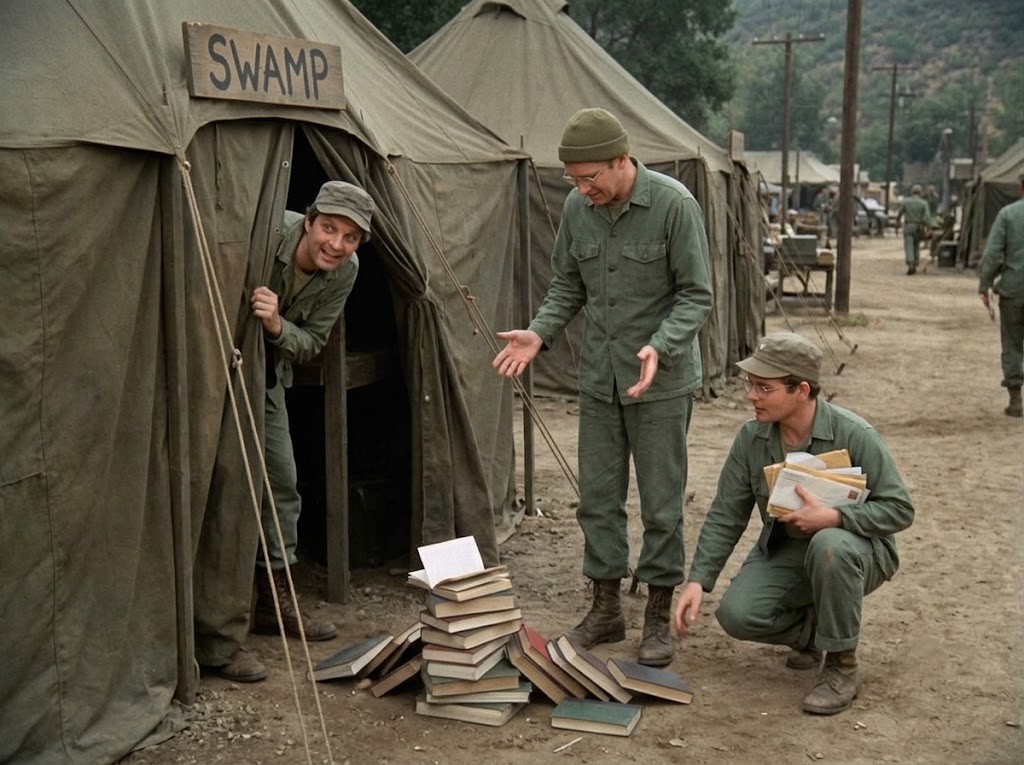
They say you can survive anything in Korea if you have the right roommates and a steady supply of local ingenuity. But on a Tuesday afternoon when the heat felt like a wet wool blanket thrown over the tents, even ingenuity was running low.
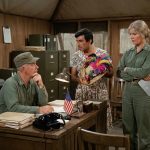
Hawkeye Pierce poked his head out from the canvas flap of the Swamp, a crooked grin plastered across his face that didn’t quite reach his eyes. He had been in the compound for thirty-six straight hours of triage, smelling of antiseptic and exhaustion, looking for any excuse to find a sliver of ordinary life.
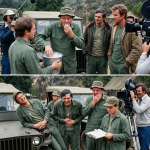
Just outside the door, B.J. Hunnicutt stood with his hands spread wide in an gesture of mock defeat, staring down at the dirt. Between them lay a collapsed, messy pyramid of heavy, leather-bound books that had just slipped from an old wooden crate.
Kneeling in the dust beside the pile was Radar Reilly, his arms still tightly clutching a thick bundle of official mail and envelopes tied with kitchen twine. Radar’s face was a mixture of absolute panic and quiet reverence, his glasses slipping down his nose as he looked at the scattered pages.
“I told you to be careful with them, Radar,” B.J. said, his voice a mix of dry amusement and genuine concern. “Those aren’t just medical journals; those are Winchester’s prized possessions, and if a single page gets stained by the 4077th mud, he will have us court-martialed for treason against the arts.”
“I didn’t mean to, Captain, honest!” Radar squeaked, adjusting his grip on the letters. “The bottom of the box just gave out. It’s the humidity. Or the trucks. Or maybe the Army just builds boxes out of hopes and bad glue.”
Hawkeye leaned further out of the tent, resting his arm against the wooden sign that proudly proclaimed their quarters as the ‘SWAMP.’ His cap was tilted back, revealing the deep lines of fatigue etched into his forehead.
“Don’t look at it as a tragedy, Radar,” Hawkeye said, his voice carrying that familiar, rhythmic cadence of a man who used humor as armor. “Look at it as a literary buffet. The ground was hungry for knowledge, and you fed it.”
“But they aren’t medical books, Hawkeye,” B.J. sighed, nudging one of the fallen volumes with the toe of his combat boot. “Look at the titles. It’s classic poetry. Keats. Shelley. Wordsworth. Charles brought them all the way from Boston to keep his sanity intact.”
Radar looked down at the open book at the top of the pile, its pages fluttering slightly in the hot breeze. “He’s gonna scream, isn’t he? He’s gonna turn that purple color he gets when the mess tent serves Spam two days in a row.”
The tent flap behind Hawkeye rustled, and the imposing figure of Charles Emerson Winchester III stepped into the sunlight, his chin held high despite the sweat on his brow. He took one look at the scene—the dirt, the scattered poetry, the three men surrounding his treasures—and his face went entirely pale.
For a second, nobody moved. The distant hum of a generator and the faint, rhythmic chopping of a helicopter miles away filled the silence of the camp.
Charles didn’t scream. Instead, he stepped forward with a slow, deliberate gravity that made Radar swallow hard and press the mail closer to his chest.
“My mother shipped those from the family library,” Charles said, his voice surprisingly quiet, devoid of its usual booming theatricality. “They belonged to my grandfather. They were supposed to be… an antidote to this place.”
Hawkeye dropped his grin, his expression softening instantly into that quiet, deep empathy he usually reserved for patients on the table. He stepped out of the Swamp, his boots crunching on the gravel as he walked over to the pile.
“They’re not ruined, Charles,” Hawkeye said softly, kneeling down opposite Radar. “The mud is dry today. Look, not a single tear.”
B.J. knelt down too, his large hands carefully picking up a volume of Tennyson, gently blowing the dust off the cover before handing it to Winchester. “We’ll help you wipe them down. No harm done.”
Charles looked at the book in B.J.’s hand, then looked around at the camp—the olive drab tents, the dust, the miles of lonely hills surrounding them. For a moment, the mask of the arrogant Boston aristocrat slipped, revealing a man who was just as tired, homesick, and terrified of losing his connection to the civilized world as anyone else.
“Thank you, Pierce. Thank you, Hunnicutt,” Charles muttered, taking the book with a care that bordered on religious devotion.
Father Mulcahy walked by just then, stopping to observe the little gathering with a gentle smile playing on his lips. “You know, Major, standard Army regulations don’t cover poetry, but I believe keeping a beautiful thought alive in a place like this is a form of essential service.”
Radar smiled, his panic fading as he carefully handed the rest of the mail to B.J. so he could use both hands to stack the books safely back together. “I can find a better box in Supply, Major. A sturdy one. From the good PX shipments.”
“See to it, Radar,” Charles said, though the usual bite was gone from his tone. He tucked the volume under his arm, looking down at his roommates and the young clerk who worked so hard to keep their world spinning.
By the time the books were stacked securely on Hawkeye’s arms to be carried inside, the sun was beginning to dip below the Korean hills, casting long, golden shadows across the compound. They were still dirty, still exhausted, and tomorrow would bring more choppers and more pain.
But for five minutes in the afternoon dirt, four men from completely different worlds had stood together to protect a few verses of poetry, simply because it reminded them of who they were before the war started.
In the end, we didn’t just survive the 4077th by patching up bodies; we survived by holding onto the pieces of home we dropped along the way.