The Loudest Silence in the O.R.
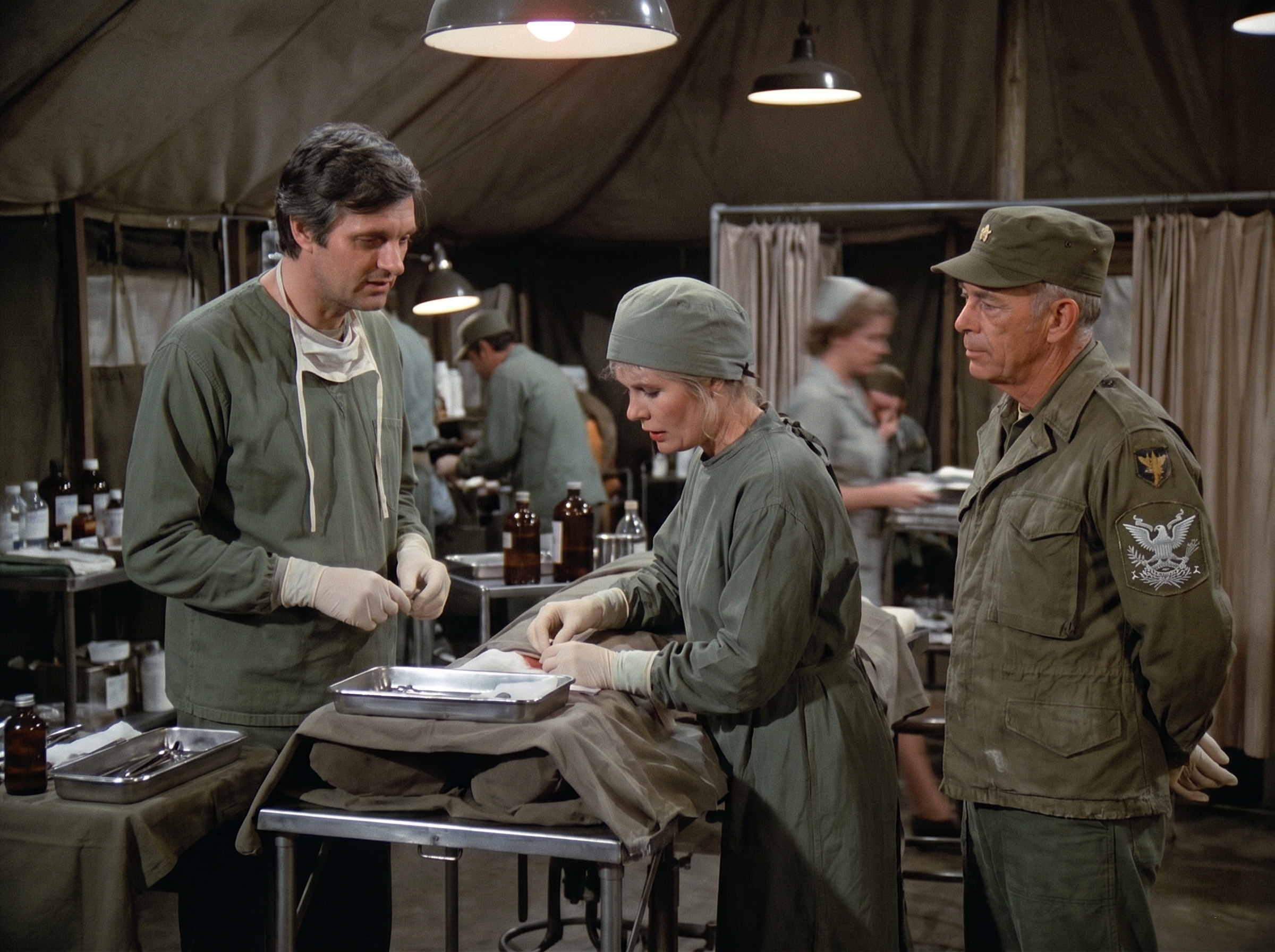
The worst sound in the 4077th Operating Room wasn’t the deafening roar of incoming medevac choppers. It wasn’t the sharp snap of sterile gloves, or the metallic clatter of dropped clamps, or even the panicked shouts for more O-negative blood.
The worst sound in the O.R. was the heavy, suffocating silence that fell over the room at the tail end of an eighteen-hour shift, when the adrenaline had completely burned away, leaving nothing behind but raw nerves and bone-deep exhaustion.
It was three in the morning, and the camp was wrapped in a thick, damp Korean fog. Inside the surgical tent, the harsh, bright glow of the overhead lamps cut through the shadows, illuminating a scene that had played out a thousand times before. The major casualties had finally been stabilized. The endless line of litters outside the door had dwindled to nothing.
There was only one patient left on the table. A young farm boy from Iowa who looked entirely too small beneath the harsh surgical lights.
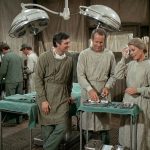
Captain Benjamin Franklin “Hawkeye” Pierce stood beside the table, his posture deceptively relaxed. His surgical mask was pulled down around his neck, and his green scrub shirt was stained with the desperate hours of the long day. He held a pair of forceps loosely in his gloved hands, his eyes dark and thoughtful.
Hawkeye was running on fumes, black coffee, and the sheer, stubborn refusal to let a nineteen-year-old kid die on his watch. To keep the heavy silence from crushing them all, he had been keeping up a steady stream of dry, softly delivered commentary.
“You know, Major,” Hawkeye murmured, his voice lacking its usual sharp bite, settling instead into a gentle, teasing rhythm. “If you stare at that incision any harder, it’s going to ask you for a commitment. I think you’re supposed to buy it dinner first.”
Across the surgical table, Major Margaret Houlihan didn’t rise to the bait.
She was leaning heavily into her work, her body angled over the patient with fierce, professional dedication. Wearing her surgical cap and a sterile green gown over her fatigues, she looked like a woman trying to hold back the tide with her bare hands. She was attempting to extract a microscopic, jagged sliver of shrapnel that was resting dangerously close to a major artery.
“Quiet, Pierce,” Margaret said softly. Her voice didn’t have its usual military bark. It sounded frayed at the edges, thin and exhausted.
Standing just a few feet away, Colonel Sherman T. Potter watched them both. He was dressed in his olive drab shirt and cap, his hands resting comfortably at his sides. He projected an aura of absolute, unwavering calm. He was the anchor in the storm, observing his two finest surgeons with a mixture of weary pride and quiet concern.
Potter had commanded enough units to know when a surgeon was hitting the wall. He could see it in the slight slump of Hawkeye’s shoulders, and he could see it in the rigid, unblinking intensity of Margaret’s gaze.
“He’s just trying to keep the ghosts out of the room, Major,” Potter said gently, his gravelly voice grounding the space. “Take your time. The boy isn’t going anywhere.”
Margaret didn’t look up. Her gloved fingers gripped the surgical instrument with white-knuckled intensity. She took a slow, trembling breath, trying to steady herself. But the exhaustion of the past eighteen hours was finally catching up to her. The harsh overhead light glared off the metal tray, and for a terrifying second, her vision swam.
Her hand, normally as steady as carved stone, gave a microscopic tremor.
Margaret froze. She squeezed her eyes shut for a fraction of a second, fighting back a sudden, overwhelming wave of fatigue and panic. If her hand slipped now, by even a millimeter, the young soldier on the table would bleed out before they could clamp the artery.
“I…” Margaret whispered, the word barely making it past her mask. She stopped moving entirely, hovering over the wound. The silence in the tent suddenly felt deafening. “I can’t see the edge. It’s too close.”
Hawkeye immediately dropped the casual slouch. The dry wit vanished from his eyes, replaced instantly by the sharp, brilliant focus of a chief surgeon who recognized a partner in distress.
He didn’t make a joke. He didn’t offer a sarcastic remark. He just stepped a half-inch closer to the table, closing the physical and emotional distance between them.
“You’ve got this, Margaret,” Hawkeye said. His voice was incredibly soft, pitched for her ears alone. It was stripped of all the usual armor he wore. “You have the best hands in this camp. Better than mine, and you know I’d never admit that to anyone with a star on their collar.”
Margaret swallowed hard, keeping her eyes fixed on the surgical field. Her shoulders were rigid with tension. “Pierce, if I pull this, and the artery tears…”
“It won’t,” Hawkeye interrupted smoothly, leaning in just enough so she could feel his steady presence beside her. “Because you’re not going to pull it. You’re going to ease it out. Just like you did on that corporal last week. I’m right here. I’ve got the clamp ready if you need it. But you won’t need it.”
Colonel Potter didn’t move to intervene. He didn’t bark an order or take over the table. He simply shifted his weight, his eyes filled with a deep, fatherly wisdom. He knew that taking the instrument from Margaret now would shatter her confidence, and he needed her whole and fighting for the next batch of wounded that would inevitably come tomorrow.
“Listen to the man, Major,” Potter said, his tone rich with quiet authority. “You’ve been holding this camp together for two days straight. Just take a breath. Find the angle. We’ve got all the time in the world.”
Margaret took a slow, deep breath, letting the stale air of the O.R. fill her lungs. She held it for a beat, letting the steady presence of the two men ground her. She wasn’t alone in this impossible place. She was surrounded by her people.
Slowly, the tremor in her fingers faded. Her professional discipline kicked back in, overriding the exhaustion.
She leaned down again, adjusting her angle under the bright lamps. The room held its collective breath. Hawkeye hovered his own hands just inches away, completely ready to back her up, his eyes entirely locked on her precise movements.
A agonizing minute ticked by. The only sound was the distant, rhythmic hum of the camp’s diesel generators.
Then, with a microscopic twist of her wrist, Margaret pulled back.
A tiny, jagged piece of dark metal came free, gripped tightly in her forceps. The artery beneath it pulsed, completely untouched and intact.
Margaret let out a long, shaky exhale, her shoulders dropping two inches as the immense tension left her body. She moved her hand over the metal medical tray and dropped the shrapnel. It hit the tin surface with a sharp, echoing clink.
“Got it,” she breathed, her voice thick with relief. “I’ve got it.”
Hawkeye let out a long sigh, immediately sagging back into his relaxed, tired posture. A slow, genuine smile spread across his face, reaching all the way to his weary eyes.
“I always said you had a magnetic personality, Houlihan,” Hawkeye said, his voice returning to its familiar, comfortable cadence. “Drawing all the heavy metal to you.”
Margaret looked up at him. She didn’t glare, and she didn’t threaten to put him on report. Instead, she offered him a small, exhausted, remarkably tender smile. It was a look of pure, unspoken gratitude.
“Just get the sutures ready, Captain,” she said softly, turning her attention back to closing the wound.
Potter let out a quiet grunt of approval, a proud gleam in his eye. He adjusted his cap, feeling a sudden wave of affection for the brilliant, crazy, resilient misfits under his command. They fought like cats and dogs in the mess tent, but when the chips were down, there was no team on earth he would rather have in the trenches.
“Beautiful work, both of you,” Potter said, his voice warm and steady. “Sew this young man up, get him to post-op, and then get yourselves some sleep. And that, ladies and gentlemen, is an order.”
Hawkeye picked up his instruments, moving in perfect, unspoken synchronization with Margaret as they began to close. The heavy silence of the O.R. was gone, replaced by the quiet, comfortable rhythm of friends working side by side. They were exhausted, they were a long way from home, and they would have to do it all over again tomorrow. But in that small, softly lit moment under the canvas roof, they were exactly where they needed to be.
In a place built on the tearing apart of lives, their greatest defiance was the quiet, stubborn way they held each other together.