A Message in the Dust
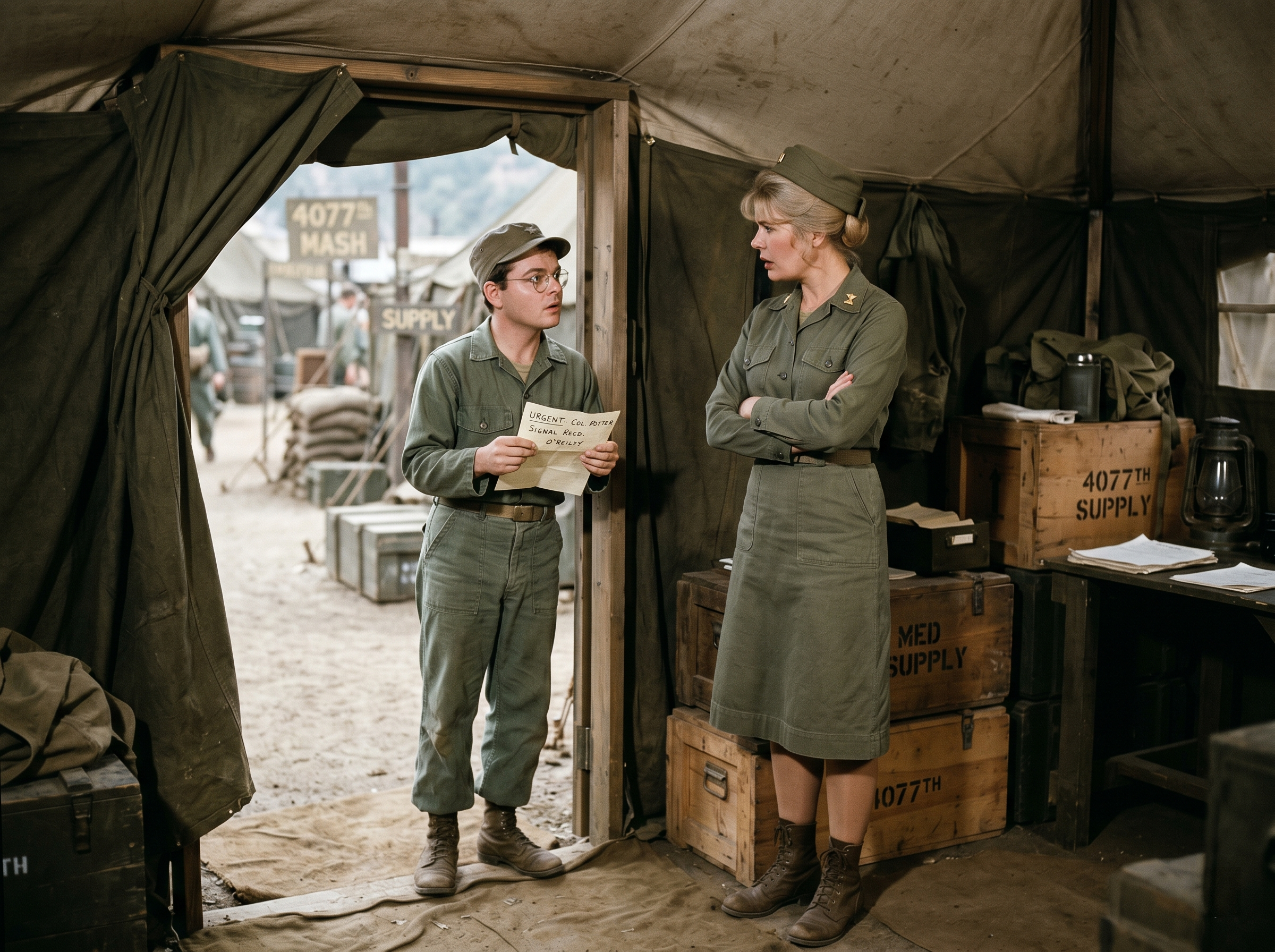
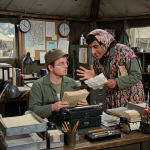
It was a well-known fact around the 4077th that Corporal Walter “Radar” O’Reilly never truly walked into a room.
He didn’t have a heavy footprint. He didn’t slam doors. He simply materialized, usually three seconds before you realized you needed him.
But when it came to the canvas threshold of Major Margaret Houlihan’s tent, even Radar hesitated.
The late afternoon sun was baking the camp, casting a warm, dusty beige light over the compound. The air smelled of dry earth, old canvas, and the faint, ever-present scent of motor oil from the motor pool.
Inside her tent, Margaret was off duty. She was standing near the center pole, her arms crossed tightly over her chest. It had been a grueling thirty-six hours in the operating room.
The casualties had been heavy, the sleep non-existent. Margaret was holding onto her strict, military composure through sheer force of will. Her shoulders were rigid. Her jaw was set. She was a professional, and professionals did not crumble.
Then, the tent flap moved.
The heavy olive canvas was pushed aside, letting in a sudden triangle of bright, harsh daylight and a view of the dusty camp walkway outside.
Radar stood half-in, half-out of the doorway. He was framed by the canvas, the dusty path, and a stack of wooden medical crates resting in the background.
He wasn’t holding his usual clipboard. He was holding a single piece of yellow teletype paper.
He stood politely at attention, his posture respectful but unsure. His round glasses reflected the indoor light, and his eyes were wide with a nervous, urgent concern.
“Major?” Radar said softly, his voice catching just a little in his throat.
Margaret reacted instantly. Her spine stiffened even further. Her arms remained tightly folded, a protective barrier against whatever chaos the camp was about to throw at her next.
Her gaze was sharp, focused, and laced with the sudden surprise of an interrupted sanctuary.
“Corporal,” Margaret snapped, her voice crisp and defensive. “I am off duty. Unless the General himself is bleeding in my pre-op, I suggest you let that flap drop and find someone else to bother.”
“Yes, ma’am. I mean, no, ma’am,” Radar stammered, shifting his weight awkwardly in the doorway. He didn’t step backward. That, in itself, was unusual.
Margaret’s eyes narrowed. She studied the boy in the doorway.
He looked incredibly young, swamped in his practical, lived-in olive drab uniform. He clutched the yellow paper with both hands, treating it as if it were incredibly heavy, or perhaps incredibly fragile.
“Well, which is it, O’Reilly?” Margaret asked, her tone dropping a fraction of an octave. The sharpness remained, but a sliver of genuine inquiry slipped through. “What is so important that you have to stand there letting the flies into my quarters?”
Radar swallowed hard. His wide-eyed gaze met hers.
“It’s a priority cable, Major,” Radar said quietly. “From Tokyo General.”
Margaret froze.
Her breath hitched, stopping completely in her chest. Tokyo General was where they sent the worst cases. It was where they had sent Lieutenant Sarah Owens three days ago.
Owens was one of Margaret’s youngest nurses. She had been severely injured when a rogue mortar hit near the showers. Margaret had held the girl’s hand all the way to the chopper, projecting absolute strength while terrified on the inside.
“Is it…” Margaret began, her voice suddenly losing all of its military edge. Her rigid composure trembled. “Is it about Lieutenant Owens?”
Radar nodded slowly, looking down at the paper in his hands, his expression tight with anxiety.
Margaret’s arms gripped her own elbows so hard her knuckles turned white. She closed her eyes for a fraction of a second, bracing herself for the worst news a commanding officer could hear.
“Read it, Corporal,” she ordered, her voice a fragile, terrified whisper.
Radar cleared his throat. The sound seemed impossibly loud in the quiet, dust-moted air of the tent.
He looked down at the yellow paper, holding it up slightly to catch the warm afternoon light spilling through the doorway.
“Message begins,” Radar read, his youthful voice stumbling slightly over the formal phrasing. “Patient Lieutenant Sarah Owens. Post-operative status…”
He paused, his eyes scanning ahead to the next line.
Margaret took a half-step forward. Her arms were still folded, but the defensive posture had entirely melted away, replaced by a desperate, agonizing need to know.
“Read it, Walter,” she pleaded, dropping the rank, dropping the armor.
Radar looked up, his wide eyes meeting hers. A small, tentative smile suddenly broke through the worry on his face.
“…status stable,” Radar finished, his voice rising with a sudden brightness. “Internal hemorrhaging stopped. Patient is conscious and alert.”
Margaret let out a sharp gasp. It was a sound that was half-sob, half-laugh.
Her knees suddenly felt weak. She turned her head away for a moment, breaking eye contact. A single tear escaped, cutting a clean track down her dusty, exhausted cheek.
She quickly raised a hand and wiped it away, taking a deep, shuddering breath. She needed a moment to rebuild her walls, to piece the “Major Houlihan” persona back together.
But Radar didn’t leave.
He stayed in the doorway, letting the tent flap rest against his shoulder. He knew when to disappear, but he also had a strange, quiet wisdom about when people shouldn’t be left completely alone.
He watched her with earnest, polite patience. He didn’t judge the tear. He didn’t even pretend he hadn’t seen it. He just held the space for her.
“There’s more, ma’am,” Radar said gently.
Margaret turned back to him. She sniffled quietly, lifting her chin. She crossed her arms again, but loosely this time. The rigid, sharp-edged commander was gone; only the deeply caring, exhausted woman remained.
“Go on,” she said, her voice thick but steady.
Radar looked back at the teletype. “Message continues. ‘Patient demands to know if Major Houlihan approved of the surgical stitching. Patient insists she will not sleep until she receives official orders from the 4077th to do so. Awaiting your reply.'”
A genuine, warm smile broke across Margaret’s face. It was a beautiful, tired smile that reached all the way to her eyes.
“That stubborn, foolish girl,” Margaret whispered affectionately.
“She sounds just like you, Major,” Radar blurted out.
He instantly clamped his mouth shut, his eyes widening in terror behind his glasses. He braced himself for an explosion, fully expecting to be assigned a month of latrine duty.
But the explosion never came.
Instead, Margaret let out a soft, genuine laugh. It was a rare sound in the camp, quiet and melodic, completely lacking her usual booming authority.
“She does, doesn’t she?” Margaret agreed softly.
She walked over to the doorway. Radar instinctively stood a little taller, but he didn’t back away.
Margaret stopped just inches from him. She looked at this boy—this young man in an oversized cap, who carried the administrative weight of a bloody war on his shoulders, and who always seemed to know exactly what the people around him needed.
She reached out and gently took the yellow paper from his hands. Their fingers brushed briefly. It was a small, deeply human connection in a place that saw too much trauma.
“Thank you, Radar,” she said, her voice filled with a quiet, profound gratitude.
“You’re welcome, Major,” Radar replied, blushing slightly. He rubbed the back of his neck. “I, uh… I saw it come over the wire and I just ran it right over. I figured you’d want to know right away.”
“I did,” Margaret said. She looked down at the flimsy paper, treating it like it was made of gold. “I really did.”
She looked back up at him, her professional mask slipping back into place, though much softer now.
“Corporal,” she ordered gently. “I need you to send a reply to Tokyo General immediately.”
“Yes, ma’am. Ready to copy,” Radar said, instinctively tapping his pockets for a pencil he didn’t have, before realizing he was just going to have to memorize it.
“To Lieutenant Sarah Owens,” Margaret dictated, her chin high, her voice carrying a warm, protective authority. “Stitching is acceptable. You are hereby ordered to rest, recover, and keep your mouth shut until you are fully healed. Disobeying this order will result in severe disciplinary action. Signed, Major Margaret Houlihan.”
Radar smiled warmly. “I’ll get it on the wire right away, Major.”
He stepped backward out of the tent, tipping his cap slightly in a gesture of absolute respect.
He let the canvas flap fall closed, sealing the tent once again.
Margaret stood alone in the warm, dusty light filtering through the fabric. She unfolded her arms completely. She held the telegram to her chest, right over her heart.
Outside, the familiar sounds of the 4077th continued. The rumble of a passing jeep. A distant shout from the Swamp. The ever-present hum of the generators.
But inside the tent, for the first time in three days, Margaret Houlihan finally felt like she could breathe.
In a place where tomorrow was never promised, sometimes a single piece of yellow paper was enough to remind them all why they kept fighting.