The Softness of Home in a Hard-Luck War
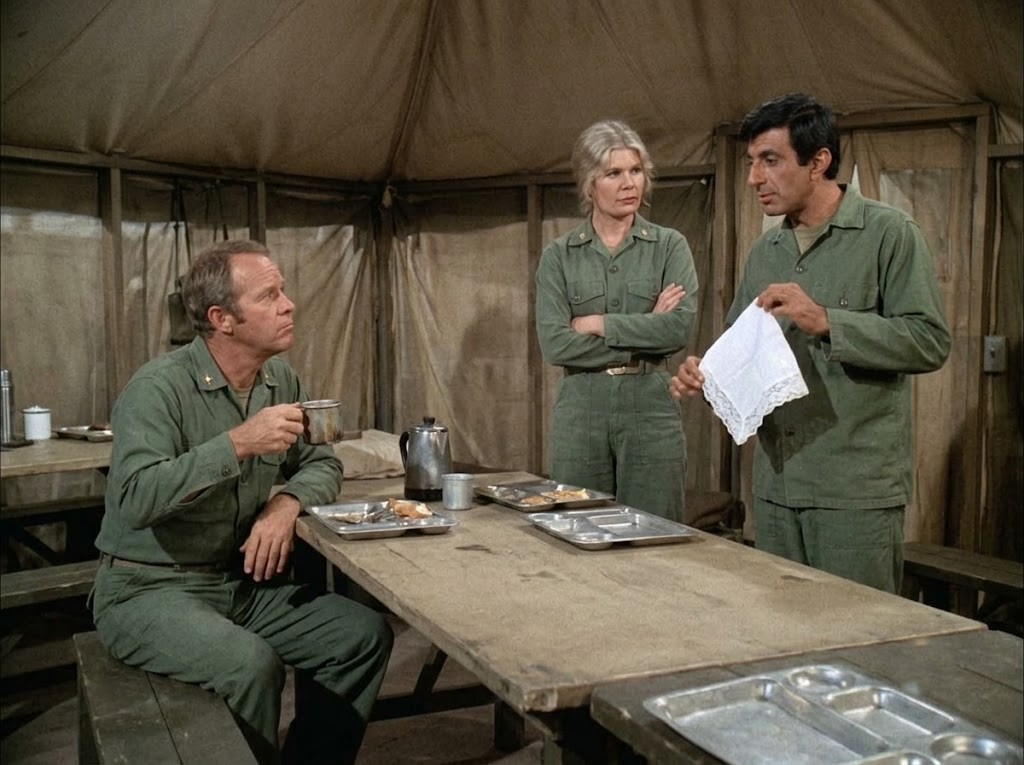
The mud outside the 4077th never really washed away, but sometimes, the smallest piece of fabric could make you forget the swamp was even there.
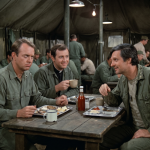
It was one of those rare, heavy afternoons when the generators hummed a little too loudly and the smell of boiled cabbage hung thick in the mess tent. The operating room had been quiet for exactly four hours, leaving behind the kind of exhaustion that settled deep into a person’s bones.
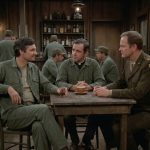
Colonel Sherman Potter sat at the corner of the long wooden table, cradling a metal mug of army coffee that tasted more like battery acid than beans. He stared ahead, his weathered face etched with the weight of command, looking for all the world like a man trying to solve a puzzle with half the pieces missing.
Standing just behind him, Major Margaret Houlihan kept her arms tightly crossed over her olive-drab fatigues. Her posture was textbook perfect, a shield against the weariness threatening to slump her shoulders, but her eyes gave her away. They were tired, carrying the lingering shadows of the lives they had spent the last three days stitching back together.
Then there was Klinger.
He wasn’t wearing a chiffon gown or a fruit-laden hat today; he was in his standard-issue uniform, but his flair for the dramatic was fully dressed. Standing before the Colonel and the Major, he held a delicate, pristine square of white lace handkerchief between his fingers, holding it up as if it were a rare Renaissance painting.
“Look at the stitching, Colonel,” Klinger said, his voice a mix of a carnival barker and a proud museum curator. “Direct from Toledo. Hand-embroidered by my Aunt Nona. You can’t find craftsmanship like this anywhere in the Far East.”
Potter didn’t move his head, only shifting his eyes upward toward the fragile piece of cloth. “Klinger, if this is another attempt to prove you’re psychologically unfit to wear combat boots because of an obsession with delicate linens, you’re barking up the wrong general.”
Margaret let out a sharp, impatient breath, her foot tapping against the dirt floor. “Corporal, we are in the middle of a war zone. We have a shortage of penicillin, a shortage of fresh water, and a shortage of sleep. The last thing this camp needs is a black-market haberdashery.”
Klinger didn’t back down; instead, his expression softened into something entirely earnest. “This isn’t a scam, Major. And it’s not a ticket to Ohio. I didn’t write to Aunt Nona for myself.”
He took a step closer, the humor draining from his face, replaced by a quiet vulnerability that caught both Potter and Margaret completely off guard.
“Then what’s the angle, Corporal?” Potter asked, his voice dropping its sharp edge, replacing it with the gentle, fatherly tone he reserved for the moments when his people were hurting.
Klinger lowered the handkerchief slightly, looking down at the delicate lace. “Two weeks ago, during the heavy rains, I saw Major Houlihan tracking through the mud after a double shift. She was looking for that silver compact her mother gave her—the one that fell out of her pocket during the evacuation chaos.”
Margaret’s arms slowly uncrossed, her hand instinctively drifting to her empty hip pocket. Her eyes widened slightly, a sudden flush rising in her cheeks.
“We never found it,” Klinger continued softly, looking up to meet Margaret’s gaze. “The mud swallowed it whole. I saw how much it broke your heart, Major. You didn’t cry in front of the nurses, but I saw you looking for it when everyone else was asleep.”
The mess tent fell completely silent, save for the distant hum of a jeep bouncing down the road. Margaret stood frozen, her professional armor cracking just enough to let the raw emotion show through. She wasn’t just a major right now; she was a daughter thousands of miles away from home, missing the only tangible connection she had left to her family.
“I knew I couldn’t find the compact,” Klinger said, holding the handkerchief out toward her with both hands, his manner entirely respectful. “But I remembered Aunt Nona had this. She only gives them to the women in our family when they get married or when they face a great trial. I figured running a nursing staff in a tent city qualifies as a trial. It’s a piece of home, Major. For you.”
Potter took a slow sip of his coffee, a quiet, knowing smile tugging at the corner of his mouth. He looked at Klinger, no longer seeing a soldier trying to escape, but a man showing the kind of deep, protective loyalty that kept the 4077th alive.
Margaret stepped forward, her movements hesitant. She reached out and took the small square of white lace. Her fingers brushed against the delicate embroidery, a stark contrast to the rough, grease-stained wood of the table and the heavy canvas of the tent.
For a long moment, she couldn’t speak. She stared at the handkerchief, her breath catching in her throat, the tough exterior she wore every day melting away into pure gratitude.
“It’s… it’s beautiful, Klinger,” Margaret whispered, her voice thick with an emotion she rarely allowed herself to show in public. She looked up at him, her eyes bright with unshed tears. “Thank you.”
Klinger offered a modest, goofy smile, offering a polite nod. “Just doing my duty to keep morale up, Major. Besides, white goes with everything, even army green.”
Potter cleared his throat, a dry chuckle escaping him as he stood up from the table, clapping a heavy, supportive hand onto Klinger’s shoulder. “Good work, Corporal. Now, clear out before I find a detail for you that involves a lot less lace and a lot more laundry.”
“Sir, yes, sir,” Klinger said, giving a crisp, proud salute before turning and slipping out of the tent, a little extra bounce in his step.
Margaret stood by the table, carefully folding the handkerchief and placing it safely into her breast pocket, right over her heart. She looked out the tent flap, watching the olive-drab figures move through the compound, feeling a little less cold, a little less tired, and a lot closer to the strange, beautiful family they had all built together in the mud.
In a place where everything was painted the color of mud, it was the small, hidden threads of kindness that kept them all from unravelling.