The Sherry and the Swamp: A Quiet Salute
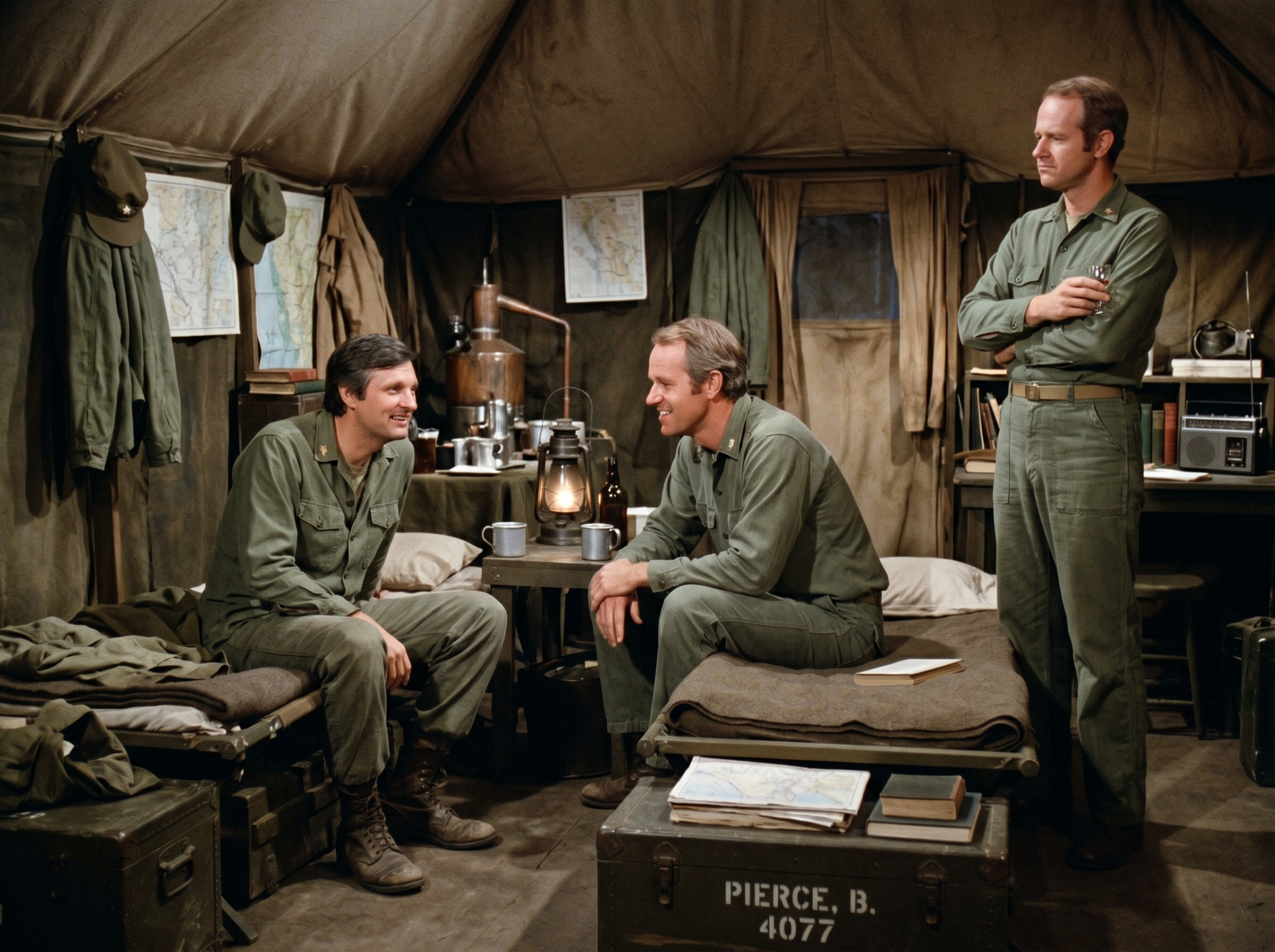
The only sounds in ‘The Swamp’ that night were the distant, rhythmic cough of a generator and the familiar clink of Hawkeye’s makeshift martini glass.
The air inside the tent was thick with the scent of old canvas, woodsmoke, and the invisible residue of a sixteen-hour operating session. It was the smell of the 4077th, a scent they would all carry for the rest of their lives.
Hawkeye Pierce, a man whose wit was often his only weapon against the endless stream of wounded, was perched on his cot, a ghost of a smile playing on his lips. His posture was deceptively relaxed, hiding the bone-deep fatigue that seeped into his very marrow.
Across the small, lantern-lit table, B.J. Hunnicutt leaned forward, a warm, quiet expression on his face. He was listening, but he was also just… being there. His steady presence was a comfort, an anchor.
Charles Emerson Winchester III stood slightly apart, arms crossed, his posture refined even in the chaotic intimacy of the tent. He held his sherry glass with an air of superior detachment, looking down at his two roommates.
He looked, as B.J. would sometimes say, like a man waiting for his valet to deliver his other shoe. He was, as always, both within the group and fundamentally outside of it.
Hawkeye, however, was on a roll. He was finishing a story about a particularly stubborn mule and an unfortunate encounter with Radar’s ‘borrowed’ jeep. He gestured with his free hand, his voice low, dryly comedic.
“So there I am,” Hawkeye said, “staring at this animal that clearly has no intention of moving. It has all the charm of Frank Burns and the cooperative nature of… well, this war.“
He paused, letting the silence settle for a beat. The small joke was a welcome, fragile comfort. B.J.’s smile broadened. Even Winchester, fighting the urge, let a faint, barely perceptible softening touch his otherwise critical gaze.
“And it makes you wonder,” Hawkeye continued, looking from B.J. back to Charles, “what sort of beast we’ve all become. Just… waiting for the inevitable heave-ho from a higher authority.“
Winchester, sensing an opening to assert his superior intellectual standing, or perhaps just to regain his sense of decorum, took a slow sip of his sherry.
The room held its breath, the atmosphere shifting from weary camaraderie to a familiar, fragile tension. They were colleagues, they were brothers-in-arms, but they were also three men desperately trying to cling to their distinct identities in a world that sought to merge them into one collective groan of survival.
He didn’t speak. He just looked at them, his silence a profound statement of his distaste for their ‘vulgar’ jokes and the relentless, shared humanity that bound them. The clink of his glass back onto the table felt unusually loud.
The silence stretched, not awkward, but heavy. It was the weight of unsaid things, of Shared Exhaustion. B.J. looked from Hawkeye to Winchester, his warm expression now holding a flicker of concern.
Finally, Charles spoke, his voice surprisingly quiet, devoid of its usual booming condescension. “Vulgar, Hawkeye. Truly.“
It was classic Winchester, yet on this particular night, it lacked its usual sting. It felt almost… comfortable. A return to the standard script.
“But,” Charles added, and B.J.’s eyebrows went up a fraction, “perhaps, in its own primitive, backwoods manner… it was slightly less intolerable than the alternative.“
The alternative, of course, was another silence, another moment of facing the invisible ghosts that shared their tent. Charles’s admission was the closest he came to a compliment.
Hawkeye let out a soft, low chuckle. It was a sound that had echoed through ‘The Swamp’ countless times—part amusement, part resignation.
“You are a prince, Charles,” Hawkeye said, his dry tone softening ever so slightly. “Even if your sherry does taste like fermented prune juice.“
Winchester stiffened, as if on cue. He looked down his nose. “It is a 1922 Amontillado, you philistine. I would no more expect you to appreciate it than a mule to quote Shakespeare.“
They all laughed then. It wasn’t loud, it wasn’t a comedic peak, but it was theirs. It was the shared, bittersweet laugh of three men who had seen too much and knew that, tomorrow, the helicopters would return.
Winchester, having defended his dignity, finally unfolded his arms. He looked from his glass to their cots, then to the worn, cluttered center table with its lone lantern and the still seen faintly in the background.
Slowly, as if it pained him slightly, Charles reached into a wooden case near his bunk and produced two small, mismatched, slightly chipped sherry glasses. He must have saved them from somewhere.
“I have often observed,” Charles said, maintaining his patrician air, “that hardship can forge a certain, shall we say, tolerance. One must occasionally… adapt to his environment.“
He didn’t make a grand gesture. He simply placed the two small, empty glasses next to the large martini glasses on the table. He didn’t look at them as he made the offer.
Hawkeye looked from the glasses to Winchester, a genuine flicker of warmth replacing his typical playful cynicism. B.J.’s smile, which had never quite left, now held a deep, profound tenderness.
Without a word, Winchester picked up his bottle of 1922 Amontillado and poured a careful, small, one-finger measure of the amber liquid into both new, chipped glasses.
The three of them raised their mismatched vessels. They didn’t clink. They didn’t make a toast. They didn’t need to.
In that quiet tent, surrounded by the absurdity and the tragedy of war, they found a different kind of strength. It was the quiet strength of finding family when you least expect it, a family that endures the bickering, the sarcasm, and the silence.
They sat there, sipping, three distinct pieces of the same impossible puzzle, held together by nothing but the shared, fragile warmth of ‘The Swamp’.
A family built not of blood, but of canvas, courage, and a shared salute to another night survived.