The Healing Silence of Post-Op
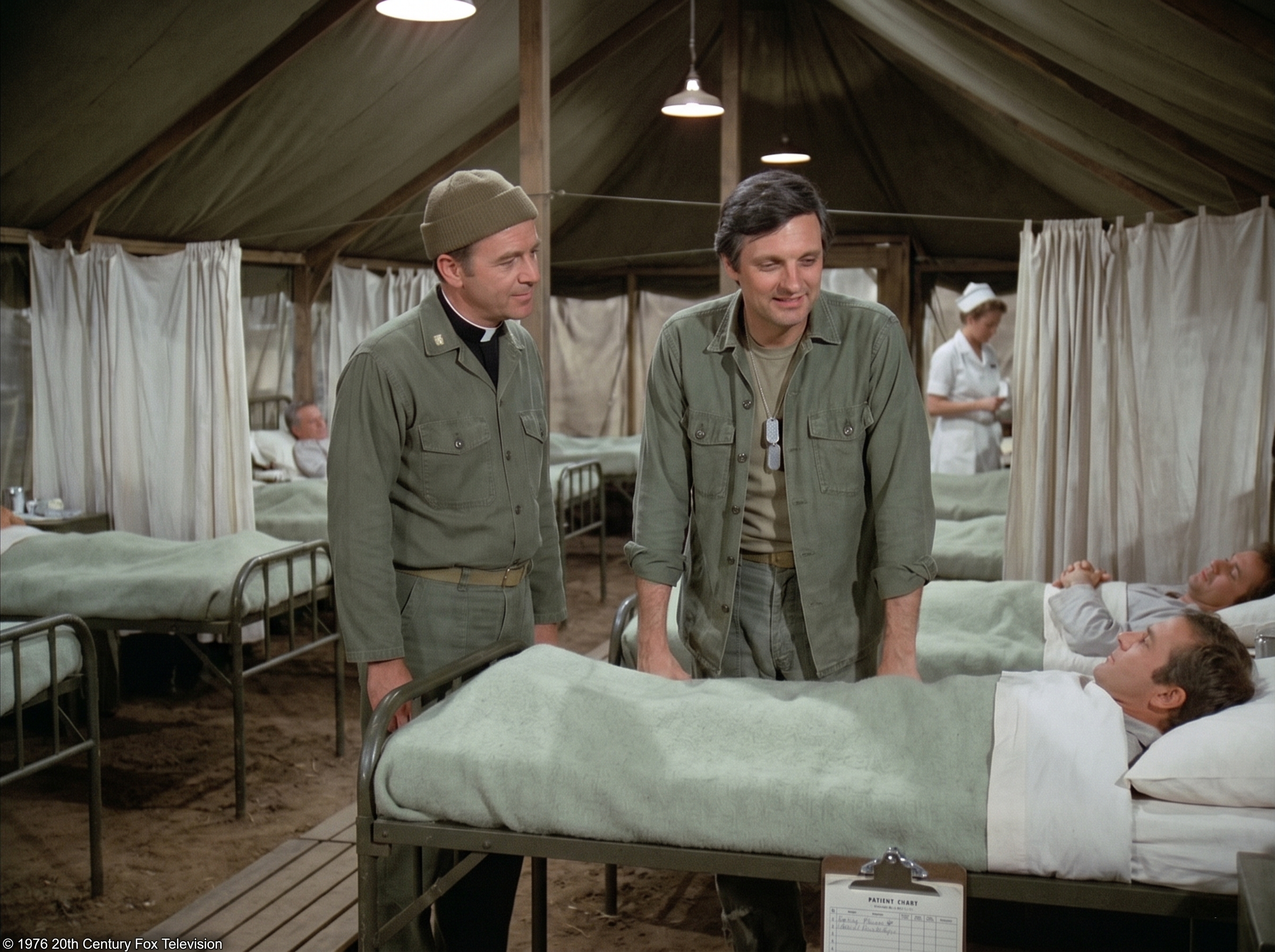
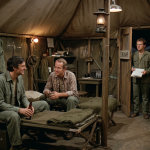
There was a specific, heavy kind of quiet that always fell over the Post-Op ward after a grueling marathon in the operating room. It wasn’t a true silence.
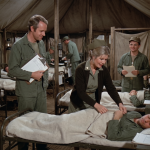
It was a hushed canvas sanctuary filled with the soft sighs of sleeping soldiers, the rustle of a nurse’s uniform in the background, and the collective exhale of survival.
Hawkeye Pierce stood beside one of the metal-framed cots, his posture a masterclass in exhausted deflection. His olive drab fatigue shirt hung loose and unbuttoned over a faded t-shirt, his silver dog tags resting coolly against his chest.
Beside him stood Father Mulcahy. The chaplain wore his familiar green fatigues, the stark white of his clerical collar peeking out, topped off with his beloved olive knit watch cap.
They were checking on Private Tommy Hayes, a kid who looked barely old enough to shave. Tommy had just drifted up from the murky depths of anesthesia. The physical pain was currently at bay, but the fear was wide awake.
“Am I in pieces, Doc?” Tommy mumbled, his eyes darting frantically around the rows of identical beds and pale green wool blankets.
Hawkeye didn’t miss a beat. He leaned against the metal frame of the bed, falling into his natural rhythm. “In pieces? Kid, you’re the most beautifully assembled thing in this entire camp. I personally supervised the stitching.”
Hawkeye offered a charismatic, practiced grin, trying to protect the boy from his own sadness. “You’ve got a seam down your side so perfectly tailored, Paris designers are going to steal it for their spring collection. You’re going to be the envy of every runway in Ohio.”
Tommy managed a weak, drug-hazed smile. Beside Hawkeye, Father Mulcahy beamed, his expression full of gentle, supportive warmth, grateful for the chief surgeon’s ability to inject a little light into the gloomy tent.
But the relief was fleeting. The lingering fog of the medication couldn’t completely mask the trauma of the battlefield.
Tommy’s knuckles turned white as he gripped the edge of his blanket. His gaze shifted desperately from Hawkeye to the chaplain. “Doc… Father…” he whispered, his voice suddenly small and trembling.
“I heard the sirens before I went under,” the young soldier continued, his eyes welling with tears. “I saw the other stretchers in the dirt. My buddy, Jenkins. He was right beside me when the dirt exploded. Did… did he make it to the camp?”
Hawkeye’s witty armor instantly fractured. The charismatic smile vanished, replaced by a profound, heavy stillness.
He knew the answer. He had been at the triage bus when Jenkins was carried off. There had been absolutely nothing they could do.
The canvas tent suddenly felt suffocatingly small. The air grew thick with an agonizing, unspoken truth. Hawkeye stared down at the chart resting on the foot of the bed, his wisecracks utterly failing him in the face of a frightened kid’s breaking heart.
Hawkeye’s jaw tightened. For a man who could talk his way out of a court-martial, spin a yarn to charm a visiting general, or fill an entire mess tent with breathless laughter, the silence that gripped him now was deafening.
He looked at the boy’s terrified eyes. He wanted to lie. He desperately wanted to conjure up an elaborate, ridiculous story about Jenkins being on a train to Tokyo, flirting with beautiful nurses and eating his weight in strawberry ice cream.
But the 4077th didn’t run on fairy tales, no matter how comforting they might be in the dead of night. It ran on a brutal, exhausting, shared reality.
Father Mulcahy, sensing the immense weight crashing down on the surgeon’s shoulders, stepped slightly forward. He didn’t interrupt Hawkeye, but his physical presence shifted gracefully.
The chaplain leaned in closer to the bed, his face radiating a profound, compassionate concern. It was a silent offer of spiritual strength, a gentle reminder to Hawkeye that he didn’t have to carry the grief of this war entirely by himself.
Hawkeye let out a long, ragged breath. He let go of the bravado. He let go of the fast-talking persona that kept the darkness at bay. He was just Benjamin Franklin Pierce, a tired doctor a long way from Maine.
His expression softened entirely. He stood relaxed by the bed, his shoulders dropping. He looked down at Tommy, his face reflecting an emotionally alert, quietly wounded empathy.
“Tommy,” Hawkeye said softly, his voice stripped of all its usual theatricality. “I’m not going to lie to you. The blast was… it was bad.”
The young soldier’s breath hitched. A single tear tracked through the dirt and dried iodine on his cheek.
“We did everything we could,” Hawkeye continued, his voice steady but incredibly gentle. “But your friend didn’t make it. I am so, so sorry.”
The words hung heavily in the dim, dusty air of the canvas tent. It was the absolute hardest part of the job. Harder than the frantic meatball surgery, harder than the endless hours on his feet over an operating table. It was the terrible moment you had to look a child in the eye and hand them a piece of a broken world.
Tommy squeezed his eyes shut, turning his head away toward the muted white sheets. The silence stretched out, filled only by the muffled, quiet sobs of the grieving private.
Hawkeye didn’t move away. He didn’t pat the boy awkwardly on the arm and flee to the next bed. He stayed right where he was, standing vigil by the bedside, anchoring the kid to the room.
Father Mulcahy reached out and placed a remarkably steady hand over the pale green blanket. “He was a brave young man,” Mulcahy murmured, his voice a soothing, hopeful balm. “And I have no doubt he was a good friend to you. He would want you to rest now, Thomas. He would want you to heal.”
Tommy slowly opened his eyes, looking up at the two men standing over his cot.
Hawkeye offered a small, deeply genuine smile. The witty defense mechanism was gone, replaced by pure, exhausted care. It wasn’t a joke this time. It was a lifeline. It was a promise that even in the middle of this senseless, muddy madness, someone was looking out for him.
“You focus on getting better, kid,” Hawkeye said, his tone tender, subdued, and full of quiet hope. “You heal up that designer seam of yours. Let us worry about the rest of the world for a while. That’s what we’re here for.”
Tommy gave a barely perceptible nod. The raw edge of his panic had been blunted by the honesty and the steadfast companionship of the doctor and the priest. The medication was beginning to pull him back under, drawing him toward a much-needed, dreamless sleep.
As the boy’s breathing evened out, Hawkeye stood up a little straighter. The moment of acute vulnerability passed, but the warmth in the room remained palpable.
He glanced sideways at Mulcahy. The chaplain offered a knowing, gentle nod in return. There was no need for words between them. They both knew the terrible toll this place took on the soul, and they both knew the absolute necessity of leaning on each other to survive it.
In a world defined by the chaotic noise of incoming choppers and distant artillery, these quiet, fragile moments of humanity were the only real victories they had.
Hawkeye reached down and adjusted the chart on the clipboard at the foot of the bed. Then, with a slow, exhausted grace, he moved on to the next patient, the priest walking quietly in step beside him.
Even in the darkest, most exhausting hours of the 4077th, the best medicine was often simply standing by someone’s side.