The Paperwork General of the 4077th
In a war built on mud, blood, and the roar of choppers, the real daily battlefield was often made entirely of paper.
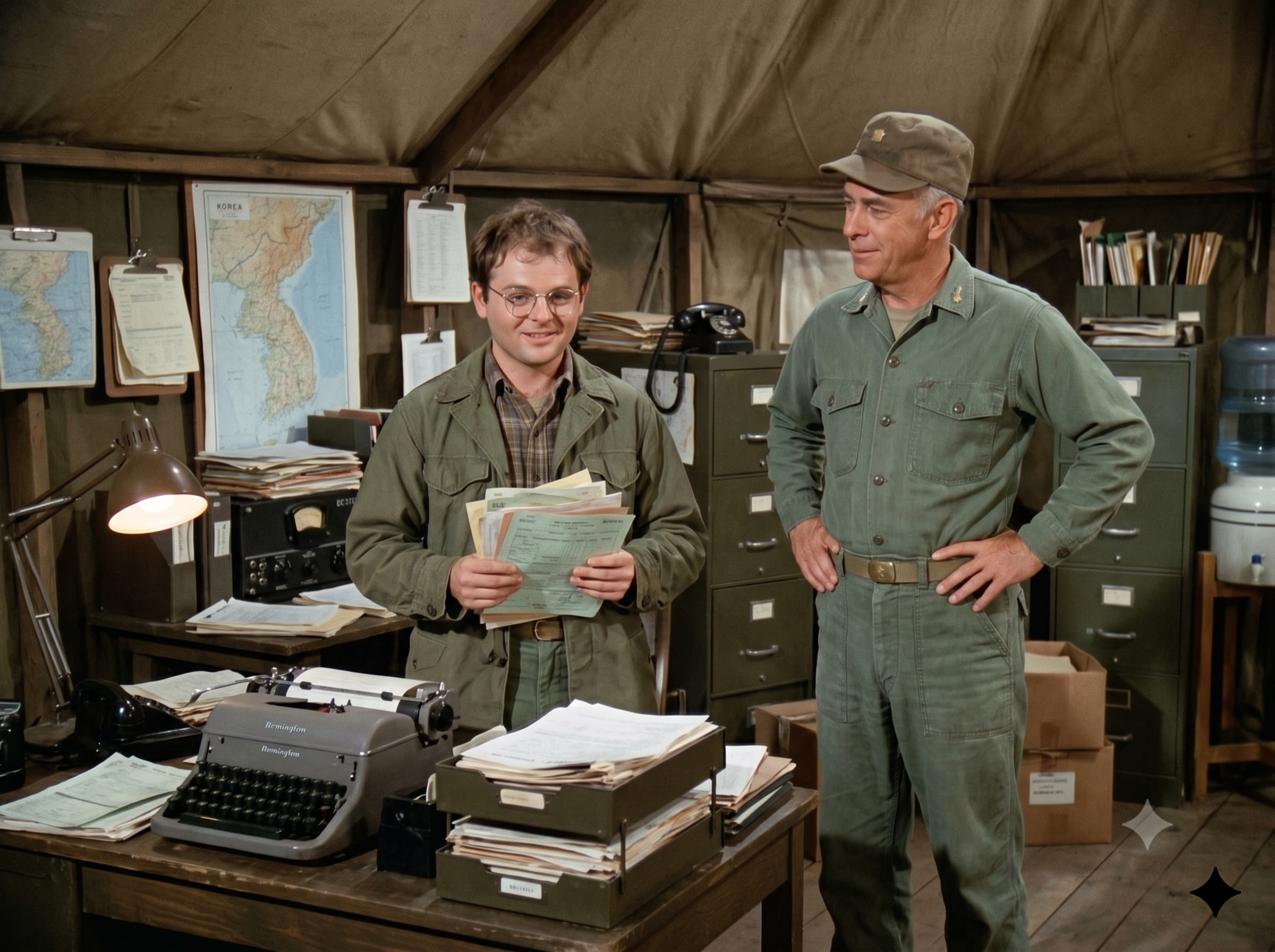
It was a quiet Tuesday afternoon in the clerk’s office of the 4077th MAS*H, or at least as quiet as things ever got in a war zone. The steady, rhythmic clatter of the Remington typewriter echoed off the faded canvas walls. The air smelled of hot dust, stale coffee, and mimeograph ink.
Sitting behind his cluttered desk, surrounded by olive-drab filing cabinets and overflowing file trays, was Corporal Walter “Radar” O’Reilly. He was deep in the trenches of military bureaucracy.
Colonel Sherman T. Potter stepped out of his adjoining office, expecting a simple transaction. He needed the weekly motor pool manifest. Just one standard Army-issued form, printed in triplicate, requiring one swift signature.
“Afternoon, Radar,” Potter said, coming to a halt in front of the desk. “You got that form for the spark plugs? My jeep is starting to sound like a percolator with a chest cold.”
Radar stopped typing abruptly. The carriage bell dinged, loud in the small space. He looked up through his round, wire-rimmed glasses, blinking with a sudden, nervous energy.
“Uh, yes, sir. And no, sir. But mostly yes, sir,” Radar stammered, his voice jumping an octave.
Potter planted his feet firmly on the wooden floorboards. He rested his hands on his hips, his compact frame settling into a stance of patient authority. He knew that tone. He had commanded regular Army troops for decades, but commanding Radar was an entirely different kind of cavalry charge.
“Translate that into Missourian for me, son,” Potter said gently, his face already projecting a dry, fatherly amusement.
Radar stood up from his chair. He reached into a chaotic pile of paperwork and pulled out a thick, messy stack of mismatched forms. There were green requisition slips, pink carbon copies, and yellow transfer orders, all hastily clipped together.
He held the chaotic bundle close to his chest. A shy, earnest smile of innocent confusion spread across his face, as if he were holding a bouquet of flowers rather than a dozen violations of military protocol.
“Well, sir,” Radar began, adjusting his grip on the papers. “Seoul didn’t have any spark plugs in the motor pool sector. So, I had to route a request through the quartermaster at I-Corps.”
Potter’s eyes narrowed slightly, though the warm crinkle at the corners remained. “I-Corps? For spark plugs?”
“Yes, sir. But I-Corps would only release them if we had priority status for winterization equipment. Which we don’t.” Radar took a breath, his smile growing a little more apologetic. “So I had to trade two cases of canned peaches to the 8063rd for a signature that said we needed snow tires.”
Potter didn’t move. He just watched the boy work. “Go on.”
“But the 8063rd didn’t want the peaches unless we could get them a projector bulb for their movie night,” Radar continued, shuffling the green and pink forms. “And the only people who had a projector bulb was a Navy supply depot in Inchon.”
The silence in the modest clerk station stretched out. The practical, soft light from the desk lamp illuminated the map of Korea tacked to the wall behind them.
Radar swallowed hard, looking down at the bottom form in his messy stack.
“Colonel,” Radar said softly, his voice trembling just a bit. “In order to get the bulb, to get the tires, to get the spark plugs… I had to fill out a Form 409-B.”
Potter’s hands tightened on his hips. “What is a Form 409-B, Corporal?”
Radar looked up, his innocent smile now masking pure administrative terror. “Well, sir. Technically speaking… as of oh-eight-hundred this morning, the United States Army officially recognizes the 4077th as a deep-water submarine.”
Potter stared at his company clerk. For a long moment, the only sound in the office was the distant hum of the camp generator and the bubbling of the water cooler in the corner.
Potter didn’t yell. He didn’t turn red in the face. Instead, a slow, dryly amused smile tugged at the corners of his mouth.
He looked at Radar standing there in his practical, worn, olive-drab jacket. The kid looked like he should be back in Ottumwa, Iowa, sweeping the floor of a feed store or taking a girl to a picture show. Instead, he was standing in the middle of a war in Korea, out-maneuvering generals and admirals with nothing but a typewriter and a telephone.
“A submarine, Corporal,” Potter said flatly.
“Yes, sir,” Radar nodded rapidly, holding the mismatched forms even tighter. “A nuclear one, I think. It was the only way the Navy would authorize the transfer of the bulb.”
“I see.” Potter let out a long, slow breath. “And tell me, Radar. Where exactly are we keeping this submarine? In the swamp with Pierce and Hunnicutt? Or did you manage to parallel park it behind the mess tent?”
Radar’s face relaxed just a fraction. He caught the gentle tease in the Colonel’s voice. “Oh, no, sir. It’s strictly on paper. Just a phantom vessel. To balance the books.”
Potter shifted his weight, though his hands remained firmly on his hips. “And the spark plugs? Did we at least get the spark plugs out of this deep-sea adventure?”
“Yes, sir!” Radar beamed, the nervous energy giving way to quiet pride. “They arrived on the morning chopper. But that’s not all, Colonel.”
Radar stepped around the desk, pointing to a set of boxes stacked near the filing cabinets.
“While I had the Navy on the line, I noticed they had a surplus of medical supplies,” Radar explained, his voice dropping to a conspiratorial whisper. “Hawkeye was complaining yesterday that we were running dangerously low on surgical silk. And B.J. said the O.R. was down to its last three bottles of iodine.”
Potter followed Radar’s gaze to the boxes.
“So,” Radar continued, looking back at Potter with absolute earnestness. “Since we were already requisitioning the bulb as a submarine… I went ahead and ordered fifty spools of surgical silk and two cases of iodine. For the, uh, the ship’s infirmary.”
The dry amusement on Potter’s face softened into something much deeper. He looked away from the boxes and back to the boy with the messy stack of papers.
Beneath the comical web of trades, beneath the ridiculous paperwork and the fabricated naval vessels, was the simple, beating heart of the 4077th. Radar hadn’t broken a dozen Army regulations just to fix a jeep. He had done it because his doctors needed supplies to save lives, and the regular Army was too slow to help them.
He had done it because this camp was his family. And Radar took care of his family.
Potter felt a sudden, heavy wave of affection for the young clerk. It was the kind of fatherly pride that often caught the Colonel off guard in this dusty, forgotten corner of the world.
“Put the papers down, son,” Potter said quietly.
Radar quickly laid the colorful, messy stack onto his desk, right next to the heavy typewriter.
Potter stepped forward. He reached into the breast pocket of his well-worn green shirt and pulled out his reading glasses and a fountain pen. He didn’t ask to read the forms. He didn’t try to untangle the bureaucratic knot Radar had tied.
He simply flipped to the bottom of the pink carbon copy and signed his name with a fluid, practiced motion.
“There,” Potter said, capping his pen. “The captain of the submarine has officially signed off.”
Radar’s shoulders dropped in a massive sigh of relief. His shy smile returned, bright and genuine. “Thank you, sir. I really appreciate it. And I’m sure the doctors will, too.”
“You did good, Radar,” Potter said, his voice warm and steady. “But do me a favor. If the Navy calls looking for their boat, tell them it sank. I don’t want to have to start wearing a sailor hat to morning roll call.”
“Yes, sir,” Radar chuckled softly. “It hit an iceberg, sir. Went down with all hands.”
“Tragic,” Potter deadpanned.
The Colonel turned and walked back toward his office. Just before he opened the door, he paused and looked back over his shoulder. The soft, practical lighting of the clerk’s station framed Radar perfectly as the boy happily began sorting his papers back into their proper trays.
It was a small, quiet moment. There were no bombs falling, no choppers landing, no loud announcements over the P.A. system. It was just an old cavalryman and a farm boy from Iowa, quietly keeping the war at bay with a typewriter and a little bit of grace.
Potter smiled to himself, shook his head, and stepped into his office, closing the door behind him.
Some heroes wear silver stars and carry rifles, but the most important one at the 4077th wore wire-rimmed glasses and carried a clipboard.