The Toledo Loophole
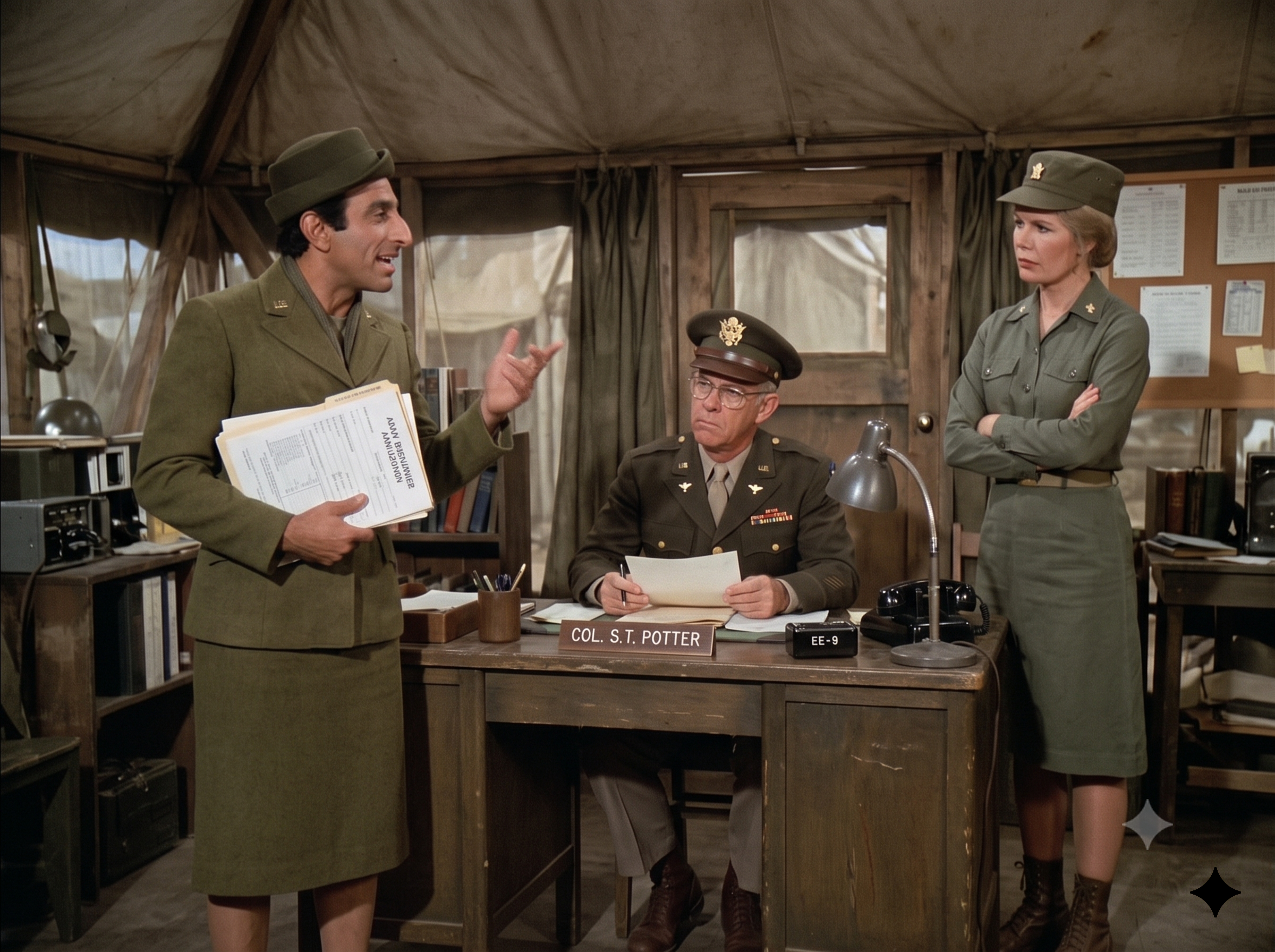
In a war measured in blood, mud, and the endless roar of incoming choppers, sometimes the most intense standoffs happened entirely on paper. The late afternoon sun filtered through the faded canvas walls of Colonel Sherman T. Potter’s office, casting a warm, dusty glow over his modest wooden desk. For a brief, precious moment, the compound was quiet. The old EE-8 field phone sat silent on the desk, offering a rare reprieve from the madness of the Korean War.
But at the 4077th, peace was always a temporary condition.
Corporal Maxwell Klinger stood before the Colonel’s desk, vibrating with a theatrical, expressive comic pride. He was immaculately dressed in a tailored, olive-drab Women’s Army Corps uniform. The green skirt suit was pressed to perfection, paired with sensible regulation shoes and a WAC cap perched flawlessly on his head.
In his arms, Klinger clutched a massive stack of official Army requisition forms. The pile was so thick it could have stopped a piece of flying shrapnel. He held it to his chest like a priceless artifact, his face beaming with the triumph of a man who had finally cracked the code to his own salvation.
Behind the desk, Colonel Potter sat with compact, stable posture. He held Klinger’s top summary sheet in his hands. Potter didn’t yell. He didn’t explode. Instead, his face was a masterpiece of dry, fatherly exasperation and weary wisdom. He stared at the paperwork through his reading glasses, letting the sheer absurdity of the moment wash over his tired shoulders.
Beside the desk stood Major Margaret Houlihan. She was a picture of rigid military discipline. Her arms were folded tightly across her chest in an impenetrable fortress of regulation. Her posture was rigidly controlled, her face a mask of skeptical, professional frustration. She glared at Klinger, utterly unamused by his latest performance.
“It is an airtight, ironclad, undeniable legal reality, Colonel,” Klinger beamed, gesturing grandly with his free hand to emphasize his point. “According to Army Regulation 41-B, subsection C, paragraph 9, regarding the accidental deployment of specialized clerical staff.”
Margaret let out a sharp breath that sounded like a tire rapidly losing air. “Corporal, the only thing accidental in this camp is your continued refusal to wear trousers.”
Klinger ignored the jab entirely. He was too close to the finish line to be deterred by a mere Major. He leaned closer to Potter’s desk, his eyes shining with desperate hope.
“As I was explaining to the Major, sir,” Klinger continued, his voice dropping to a conspiratorial whisper. “This specific loophole clearly states that any enlisted personnel who mistakenly receives deployment papers meant for a female officer of the administrative division must be immediately discharged. It’s right there in black and white. They have to send me home to Toledo for processing.”
Potter didn’t look up right away. He just continued to stare at the single sheet of paper in his hands. The silence in the canvas tent stretched out, heavy with the humid, stale air of the camp.
Klinger’s smile widened. He was waiting for the golden words. He could almost smell the hot dogs at Mud Hens stadium. He could almost taste the cold beer at Tony Packo’s.
Finally, Potter slowly lowered the paper to the desk. He took off his glasses, folded them neatly, and looked Klinger dead in the eye. The Colonel’s voice was dangerously quiet, laced with a terrifying calm.
“Son,” Potter said slowly, leaning forward over his desk. “Where exactly did you get the authorized signature of General Douglas MacArthur?”
Klinger swallowed hard. His theatrical smile faltered just a fraction, the grand illusion cracking at the edges. He shifted his weight nervously, the heavy fabric of his WAC skirt rustling against his hairy knees.
“Well, Colonel, sir,” Klinger stammered, frantically trying to recover his bravado. “I have contacts. High-ranking contacts in very important places. A man in dresses makes friends in the most unusual administrative circles.”
Margaret’s crossed arms tightened until her knuckles turned white. She leaned forward, her professional frustration finally boiling over into outrage.
“You forged a five-star general’s signature, Klinger?” Margaret demanded, her voice rising in pitch. “That’s not a Section 8. That’s a court-martial. You’ll be making little rocks out of big rocks in Leavenworth until the year 1990.”
Potter raised a single, commanding finger. Margaret instantly fell silent, her posture snapping back to attention, though her eyes continued to shoot daggers at the corporal.
The Colonel picked up his coffee mug, took a slow, deliberate sip of the lukewarm, bitter liquid, and set it down with a muted thud on the wooden desk. He looked at Klinger again, truly looking at him this time.
Beneath the ridiculous uniform, the meticulous makeup, and the comic pride, Potter saw the deep, aching exhaustion. He saw a young man from Ohio who was terrified of dying in a muddy ditch halfway across the world. He saw the exact same homesickness that kept Potter awake at night, staring at faded photographs of his beloved Mildred.
The anger drained out of Potter, replaced by a profound, weary tenderness.
“It’s a beautiful forgery, Klinger,” Potter said softly, his voice devoid of anger. “Truly a magnificent work of art. The loops on the ‘M’ are confident. You even spelled ‘Philippines’ correctly, which is more than I can say for most of my command staff.”
Klinger’s chest puffed out just a bit. He accepted the compliment gracefully, despite the impending doom he could feel creeping into the room. “Thank you, sir. I practiced behind the mess tent for three weeks.”
“However,” Potter continued, his tone dry as dust, “General MacArthur was relieved of his command by President Truman months ago. So unless he signed this official transfer order from a hotel room in New York City, I’m afraid your luxury cruise back to Toledo just bounced.”
The air left Klinger’s sails entirely. His shoulders slumped in defeat. The heavy stack of forms in his arms suddenly seemed to weigh a thousand pounds. He looked down at his perfectly polished, sensible WAC shoes, the grand escape plan turning to ash in his hands.
Margaret watched him deflate. For a brief second, the strict, unyielding head nurse disappeared. She uncrossed her arms and let out a very quiet, almost imperceptible sigh.
The frustration in Margaret’s eyes melted into a reluctant, hidden sympathy. She knew that feeling too. They all did. Every single person in the 4077th was just looking for a way out of the nightmare, even if they had to build the door themselves.
“Corporal,” Margaret said, her voice unexpectedly stripped of its usual bark. “Your hem is crooked. If you’re going to insist on impersonating a female officer of the United States Army, at least have the dignity to find a decent tailor.”
Klinger looked up at her, genuinely surprised. A small, sad smile tugged at the corner of his mouth. “Yes, Major. Thank you, Major.”
Potter stood up slowly, feeling the ache in his knees that reminded him he was too old for this war. He reached across the desk and gently tapped Klinger’s massive stack of forms, aligning the edges perfectly.
“Keep these, son,” Potter said gently, his eyes filled with quiet compassion. “Use the blank sides for scratch paper. Heaven knows we’re desperately short on office supplies.”
Klinger adjusted his grip on the heavy papers. “Yes, Colonel.”
“And Klinger?” Potter asked, sitting back down and reaching for his real paperwork.
“Sir?”
“Next time you spend three weeks forging a document to escape a combat zone,” Potter said, not looking up, “try picking a general who is currently employed by the military. Dismissed.”
Klinger snapped to attention. He delivered a crisp, dignified salute, a perfect military movement despite the ridiculous skirt and cap. He turned on his heel and marched out of the canvas door, stepping back out into the muddy, relentless reality of the camp.
The tent flap fell shut behind him. The silence returned to Potter’s office, heavier now, filled with the unspoken weight of being thousands of miles away from everything they loved.
Margaret looked at Potter. Potter looked at his desk. Neither of them smiled, but the bond of shared endurance between them was unmistakable. They were just a family trying to hold the pieces together until the shooting stopped.
“He’s relentless, Colonel,” Margaret said quietly, her voice tinged with a strange kind of respect.
“That he is, Major,” Potter replied softly, signing a requisition for more bandages. “That he is.”
In a place where tomorrow was never promised, the greatest comfort was knowing you didn’t have to carry the madness alone.