A Toledo Breeze in the Dusty Yard
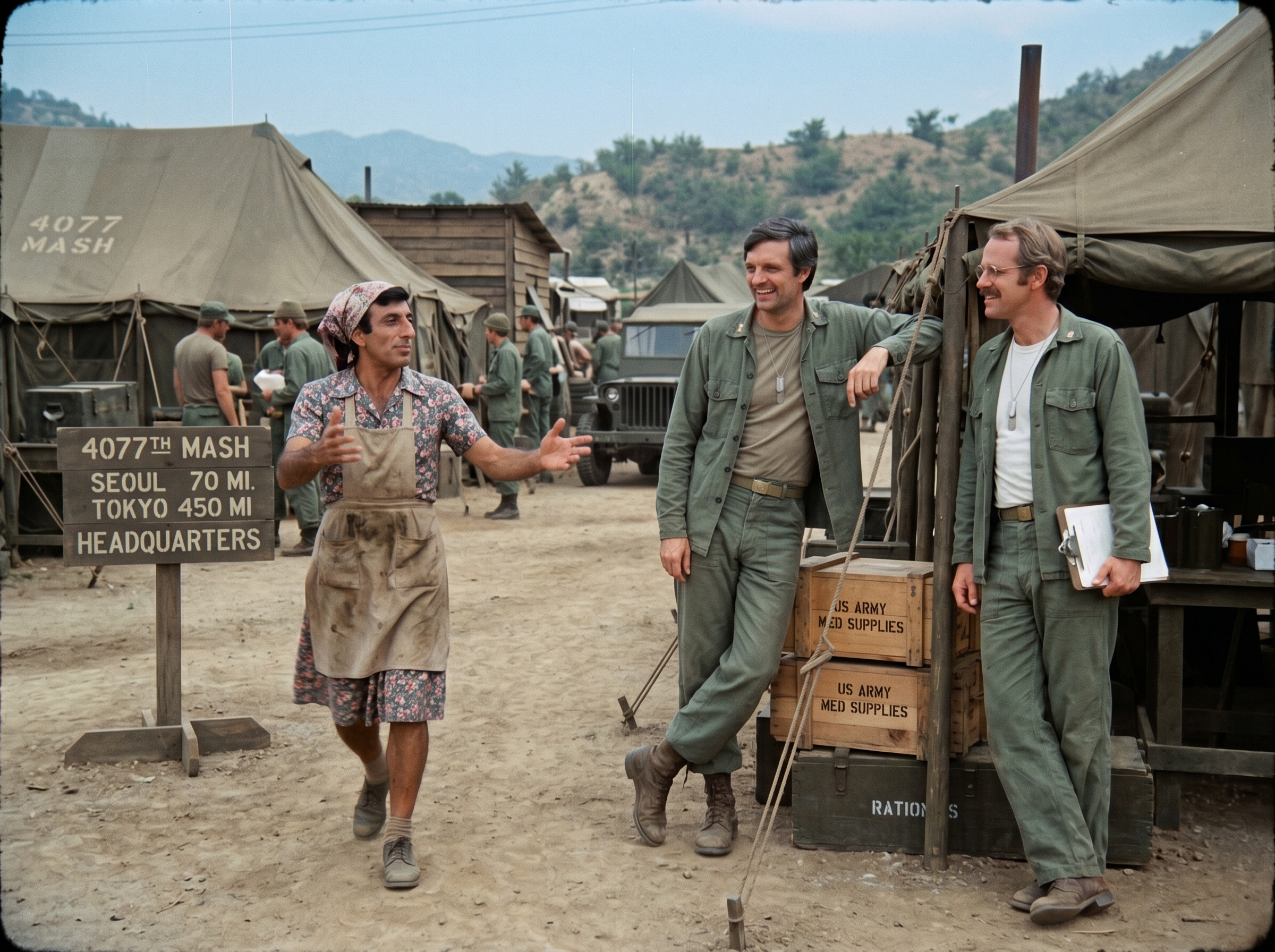
The war had a way of pausing just long enough to let you remember exactly how tired you were.
It was mid-afternoon in the outdoor compound of the 4077th, and the relentless Korean sun had finally begun to soften into a dusty, pale haze. The camp was suspended in a rare, quiet lull between the endless waves of wounded. There were no choppers in the sky, no sirens wailing through the valley, and no urgent shouts echoing from the O.R.
There was only the dry wind blowing past the canvas tents and the familiar, lived-in exhaustion of people who hadn’t slept a full night in months.
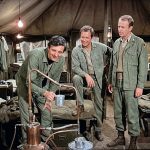
Captain Benjamin Franklin “Hawkeye” Pierce stood leaning heavily against a stack of wooden crates stenciled with US ARMY MED SUPPLIES. He wore his standard-issue green fatigue shirt open over a sweaty olive t-shirt, his dog tags catching the dull daylight. His posture was totally relaxed, a man practiced at finding comfort on jagged edges.
Beside him stood Captain B.J. Hunnicutt. B.J. looked steady and grounded, a clipboard tucked loosely against his side. He wasn’t reading it; he was just holding it the way a man holds a prop to look busy when he has absolutely no intention of doing any work.
They were simply standing there, soaking in the quiet, watching the dust settle around the familiar wooden signpost that pointed the way to Seoul, Tokyo, and a dozen other places they couldn’t go.
Then, marching down the dirt path with all the theatrical dignity of a Broadway star on opening night, came Corporal Maxwell Q. Klinger.
He was a vision in a floral print dress. He wore a sturdy, sensible working woman’s apron, a brightly patterned babushka tied securely beneath his chin, and a pair of scuffed army-issue boots that completely ruined the illusion.
Klinger stopped right in front of the two doctors, throwing his hands wide in a grand, sweeping gesture. His face held a slyly hopeful expression, the look of a man about to pitch the greatest sale of his life.
“Gentlemen!” Klinger announced, his voice carrying the distinct, nasal twang of Ohio. “I ask you to open your hearts to the tragic plight of Madame Rosa, a simple, heartbroken peasant woman from the old country, cruelly swept up in a geopolitical conflict she cannot possibly comprehend!”
Hawkeye didn’t move from his slouch against the crate. A spontaneous, clever smile broke across his face, washing away the deep lines of fatigue around his eyes.
“I don’t know, Madame Rosa,” Hawkeye fired back smoothly, his tone dripping with playful sarcasm. “The floral print says ‘domestic goddess,’ but the hairy shins scream ‘starting linebacker for the Mud Hens.’ It’s a very confusing aesthetic.”
B.J. chuckled softly, his mustache twitching. He offered Klinger a knowing, understated smile, perfectly content to let Hawkeye handle the front lines of the banter.
“Ah, but Captain,” Klinger pressed on, stepping closer and waving his hands for emphasis. “That is the tragedy! The war has hardened my delicate feminine features. Surely, Colonel Potter will take one look at this shattered, displaced mother of three and sign my Section 8 discharge with tears in his eyes!”
Hawkeye laughed, a dry, tired sound. “Klinger, the only thing Potter is going to discharge is his breakfast when he sees that apron clashing with those boots.”
Klinger kept his arms raised for another second, ready with a comeback. But then, right in the middle of the performance, the grand energy suddenly drained out of him.
His hands dropped slowly to his sides. The sly, hopeful grin faded from his face, replaced by a look of profound, quiet defeat. He looked down at his muddy boots, the heavy reality of the dusty compound crashing down on his shoulders.
“It’s just…” Klinger started, his voice suddenly very small, stripped of all its theatrical bombast. “I got a letter from my mother today.”
He swallowed hard, staring at the dirt. “The bakery on the corner of our street in Toledo. The one Mr. Giallanza ran since I was a kid. It closed down. He passed away.”
Hawkeye’s smile vanished. B.J.’s grip on the clipboard tightened.
“And I just realized,” Klinger whispered, looking up at them with eyes that were suddenly wet and terrified. “My whole world back home is disappearing. And I’m stuck here in a dress, freezing in the dirt, missing it all.”
The silence that followed was heavier than the humid Korean air. The dry wind rustled the canvas of the nearby tents, but the three men stood entirely still.
The comedy of the moment evaporated, leaving only the raw, bleeding edge of homesickness. It was the one disease they all shared, and the one wound the surgeons of the 4077th could never seem to stitch closed.
Hawkeye pushed himself slowly off the wooden medical crates. The sharp, wisecracking camp clown was gone in an instant. In his place was the Chief Surgeon—the man who knew exactly when to stop joking and start treating the patient.
“Max,” Hawkeye said quietly.
He didn’t call him Klinger. He used his real name. In the unspoken language of their bizarre, makeshift family, that single word was a lifeline thrown into deep water.
Klinger quickly brought a hand up to his face, swiping a smudge of dirt from his cheek and subtly wiping his eye in the process. He tried to straighten his shoulders, desperately attempting to pull the armor of Madame Rosa back around himself.
“I know, I know,” Klinger mumbled, his voice wavering. “It’s stupid. I’m a grown man in a babushka crying over bread. I’ll just go press the apron and try the pitch on the Colonel later.”
“It’s not stupid, Max,” B.J. said gently.
B.J. stepped forward, closing the distance between them. His voice was incredibly warm, anchored by the steady, fatherly grace that made him the moral compass of the swamp. He looked at Klinger not as a soldier trying to desert, but as a frightened kid missing his family.
“Things change back home,” B.J. continued, his eyes reflecting his own quiet fears about his wife and daughter halfway across the world. “It’s the hardest part about being here. We’re frozen in time, and they just keep living without us.”
Hawkeye crossed his arms, leaning back against the crates, his face full of immense, quiet empathy. “You know, my dad wrote me last month. Said they finally cut down that old oak tree in front of the clinic in Crabapple Cove. The one I used to crash my bicycle into.”
Hawkeye offered a small, bittersweet smile. “Felt like I lost a relative. A really splintery, unforgiving relative.”
Klinger looked between the two doctors. The desperate, lonely panic in his chest began to slowly loosen. They weren’t laughing at him. They weren’t reporting him. They were just standing with him in the dust.
“Tell us about the bakery, Max,” B.J. asked softly. “Tell us about Mr. Giallanza.”
Klinger hesitated. He looked down at his floral dress, then up at the barren, rolling hills of Korea that surrounded them like prison walls. He took a deep breath.
“He made this bread,” Klinger started, his voice gaining a little strength. “It was… incredible. It had this thick, dark crust. You really had to fight it a little bit to break it open. But the inside was as soft as a cloud. And the smell…”
Klinger closed his eyes for a second, lost in a memory thousands of miles away.
“You could smell it three streets over,” he whispered. “Every morning, before the sun even came up. It smelled like… it smelled like you belonged somewhere. Like no matter what happened, there would always be fresh bread and a guy behind the counter who knew your name.”
Hawkeye nodded slowly, letting Klinger’s words hang in the quiet air. He knew what Klinger was doing. He was bringing Toledo to Korea, just for a minute, because he couldn’t bring himself to Toledo.
“Sounds like a beautiful place, Klinger,” Hawkeye said warmly. “A hell of a lot better than the Mess Tent, anyway. If Igor ever tries to bake bread, I’m fairly certain it could be used as anti-tank ammunition.”
B.J. let out a short, appreciative laugh. “I think they actually used Igor’s biscuits to reinforce the sandbags near the latrine last week.”
Klinger opened his eyes. The heavy sorrow in his gaze hadn’t completely vanished, but the immediate terror of it was gone. The familiar rhythm of the banter, the gentle ribbing, the shared misery—it grounded him. It reminded him that while his family in Ohio was far away, the family he had bled and frozen with in this valley was standing right in front of him.
A small, genuine smile touched the corners of Klinger’s mouth. He reached up and adjusted his babushka with a renewed sense of dignity.
“You’re right, Captains,” Klinger said, his voice finding its familiar, theatrical pitch once more. “Madame Rosa would not weep in the dirt. She is a survivor! She will bake a conceptual strudel of such magnificent sorrow that Colonel Potter will personally drive her to the airport!”
Hawkeye pushed off the crate again, a bright, familiar gleam returning to his eyes. “That’s the spirit, Rosa. Just remember to use plenty of flour on your face. Make yourself look appropriately malnourished. You currently have the healthy glow of a man who’s been stealing extra Spam rations.”
“I’ll have you know this is a natural Toledo complexion, sir,” Klinger shot back, throwing his hands up in mock offense.
“Noted,” B.J. smiled, tapping his clipboard with his pen. “Patient exhibits symptoms of deep homesickness, cured only by delusions of culinary grandeur and questionable fashion choices.”
Klinger gave them a crisp, absurd salute, the floral dress swishing around his combat boots as he turned on his heel. He marched off down the dirt path, heading toward the commanding officer’s tent with his head held high.
Hawkeye and B.J. watched him go. The dust settled over Klinger’s footprints.
From somewhere over the distant hills, the faint, rhythmic chopping of helicopter blades began to pulse in the air. The lull was over. The war was coming back.
Hawkeye sighed, the deep exhaustion returning to his face as he looked at B.J.
“You think he’ll ever get out of here, Beej?” Hawkeye asked quietly.
B.J. looked out toward the horizon, his steady eyes filled with a quiet, enduring hope.
“I think,” B.J. said softly, “that as long as he remembers the smell of that bread, they can’t keep him here forever.”
Hawkeye nodded, and together, the two men turned away from the crates and walked back toward the surgical tents to face the incoming storm.
In a place designed to break them, survival meant holding tight to the memories of home, and even tighter to the friends standing right beside you in the dust.