The Daily Ration of Grace
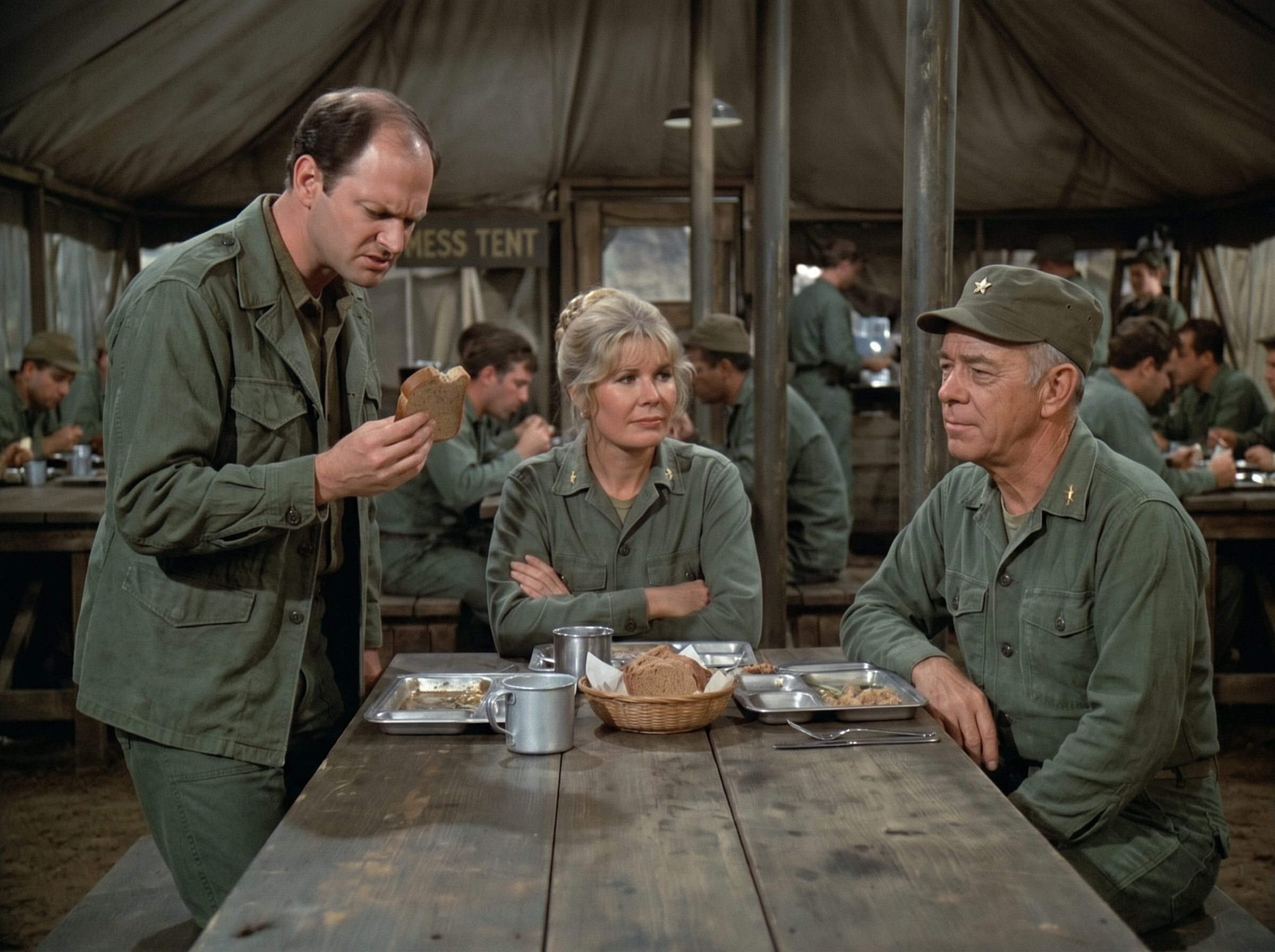
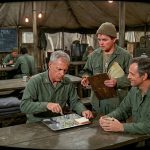
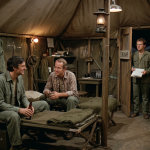
The mess tent of the 4077th Mobile Army Surgical Hospital was never a place of culinary delight, but on this particular Tuesday, it had become the stage for a theatrical tragedy.
The air was thick with the smell of strong coffee, boiled canvas, and whatever mystery meat Igor had aggressively ladled onto the dull metal trays.
It was a quiet afternoon, the kind of rare, fragile stillness that only descended upon the camp after a punishing three-day session in the operating room.
The background noise was nothing more than the hum of a distant generator and the clatter of tin cups.
But at the officers’ table, a storm was brewing.
Major Charles Emerson Winchester III refused to sit.
He stood upright at the far end of the long wooden table, his posture as rigid as a marble column in a Boston museum.
In his right hand, pinched delicately between his thumb and forefinger with a look of supreme, restrained irritation, was a single, tragic piece of army-issue bread.
Charles raised one thick eyebrow, his eyes locked onto the baked good as if it had personally insulted his ancestors.
Sitting directly across from him, Colonel Sherman T. Potter leaned slightly forward over his tray.
Potter’s weathered face was a map of weary wisdom, his eyes crinkling at the corners with a dry, fatherly exasperation.
He had commanded men in two previous wars, but nothing had quite prepared him for a Harvard-educated surgeon confronting a slice of wheat like it was a hostile combatant.
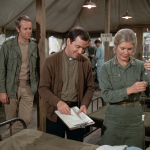
A few feet away, Major Margaret Houlihan sat perfectly upright, her arms folded tightly across her chest.
She was projecting every ounce of her composed, professional military pride.
She was the head nurse; she did not engage in mess hall mutinies.
And yet, watching Charles examine the bread with such profound aristocratic sorrow, a subtle, undeniable warmth was breaking through her sharp presence.
Her lips were pressed tightly together, fighting a losing battle against a genuine smile.
“Colonel,” Charles began, his voice dropping into a low, resonant baritone that commanded the entire tent.
“I am a man of science. I understand the basic principles of chemistry, physics, and biology.”
He held the bread slightly higher, the flat studio lighting of the tent catching the pale, dusty surface of the crust.
“But I must confess, the molecular structure of what the United States Army refers to as ‘bread’ entirely eludes me.”
Potter took a slow, deliberate sip from his metal mug, not breaking eye contact with his pompous but brilliant surgeon.
“Looks like bread to me, Major,” Potter said, his voice grounded with quiet authority. “Chews like bread. Ergo, bread.”
“With all due respect, sir,” Charles countered smoothly, his dry superiority radiating through the damp tent.
“This is not bread. This is a geological formation.”
Margaret shifted in her seat, her folded arms tightening as she let out a sharp, quickly stifled huff of amusement.
Charles ignored her, tapping his knuckles lightly against the crust.
It made a dull, hollow thud against the metal tray.
“If I were to drop this from an altitude of ten feet, Colonel, I am fully convinced it would shatter the floorboards and fracture the earth’s crust.”
Potter leaned back slightly, resting his elbows on the table, letting the exhausted silence stretch between them.
“Eat your rations, Winchester,” Potter said softly, the amusement still dancing in his tired eyes.
“I cannot, sir,” Charles replied, his voice suddenly losing its theatrical edge, revealing the raw, frayed nerves underneath.
He looked around the dim, olive-drab room, his shoulders dropping just a fraction of an inch as the weight of the war seemed to press down on him.
“I simply cannot swallow another piece of this miserable, godforsaken place.”
He dropped the bread onto the tray with a loud, final clatter, the sharp sound echoing through the suddenly silent tent, leaving Potter and Margaret staring at a man who was dangerously close to his breaking point.
The clatter of the rock-hard bread on the metal tray seemed to echo for a long time.
Nobody moved.
The dry comedy of the moment evaporated, leaving behind the heavy, familiar ache of exhaustion that draped over the 4077th like a wet blanket.
Margaret’s quiet amusement faded into something much softer and deeply observant.
She uncrossed her arms, leaning forward slightly, her professional facade melting away.
She knew exactly why Charles was snapping over a piece of baked dough.
They had all been on their feet for thirty-six hours straight.
Charles had spent the last twelve of those hours performing miracles on boys who were barely old enough to shave, standing in a freezing OR with blood on his boots and a relentless cramp in his back.
He wasn’t angry at the bread.
He was angry at the mud, the cold, the senselessness of the war, and the profound, isolating homesickness that he tried so desperately to hide behind his Boston Brahmin arrogance.
Colonel Potter understood it, too.
The older man didn’t pull rank. He didn’t raise his voice.
Instead, Potter reached into his breast pocket and slowly pulled out his spectacles, cleaning them deliberately with a rumpled handkerchief.
“It’s a hard place, Charles,” Potter said gently, his voice carrying the steady, grounding warmth of a grandfather who had seen too many winters.
“The food is hard. The beds are hard. The work is harder than a man ought to bear.”
Potter put his glasses on and looked up at the standing major.
“But you’re still standing. And those kids in post-op are still breathing because you were standing over them.”
Charles looked down at the tray, his jaw tight.
He didn’t want to be comforted. He wanted to be furious. It was easier to be furious.
But the quiet tenderness in Potter’s voice was impossible to fight.
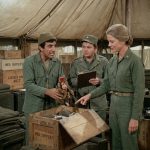
Margaret reached into the deep pocket of her olive-drab fatigues.
She looked around the mostly empty mess tent, ensuring no enlisted personnel were watching, and pulled out a small, glass jar with a handwritten label.
“My aunt in Honolulu sent this last week,” Margaret said quietly, sliding the jar across the rough wooden table toward Charles.
Charles looked down.
It was a jar of real, homemade strawberry preserves.
A tiny, glowing beacon of civilization, color, and sweetness in a world completely suffocated by khaki and mud.
“I was saving it for a special occasion,” Margaret continued, her voice remarkably soft, a gentle smile finally breaking completely across her face.
“But I think saving you from breaking a tooth qualifies as a medical emergency.”
Charles stared at the jar.
He slowly lowered himself onto the wooden bench, his posture finally relaxing, the stiff, upright aristocratic shell cracking just enough to let the humanity in.
He looked at Margaret, his eyes shining with a silent, profound gratitude that he would never, ever vocalize.
“Margaret,” Charles said, his voice thick but remarkably gentle. “You are an oasis of mercy in a vast, culinary desert.”
“Just put it on the bread, Charles,” she replied warmly, leaning her chin on her hand.
Potter chuckled, a low, rumbling sound of genuine affection, and pushed his own metal mug of coffee slightly closer to the center of the table.
“Dunk it first,” Potter advised with a wink. “Softens up the shrapnel.”
Charles carefully unscrewed the lid of the preserves, the sweet smell of strawberries cutting through the heavy smell of the tent.
For a moment, he wasn’t a drafted surgeon trapped in a war zone.
He was just a tired man sitting at a table with two people who understood exactly how heavy his heart was.
He dipped his knife into the jar, spreading the bright red jam over the terrible army bread.
They sat together in the dim, fading light of the mess tent, the canvas walls shifting in the wind.
They didn’t talk about the war, or the wounded waiting in the ward, or the thousands of miles between them and their homes.
They just shared a quiet, unremarkable moment, anchored by the unexpected sweetness of the jam and the unbreakable bonds they had forged in the darkest of places.
It wasn’t home, and it wasn’t fine dining, but in that small pocket of peace, it was exactly what they needed to survive another day.
In a place where everything was broken, the simplest moments of kindness were the only medicine that truly healed.