The Quietest Frequency in the 4077th
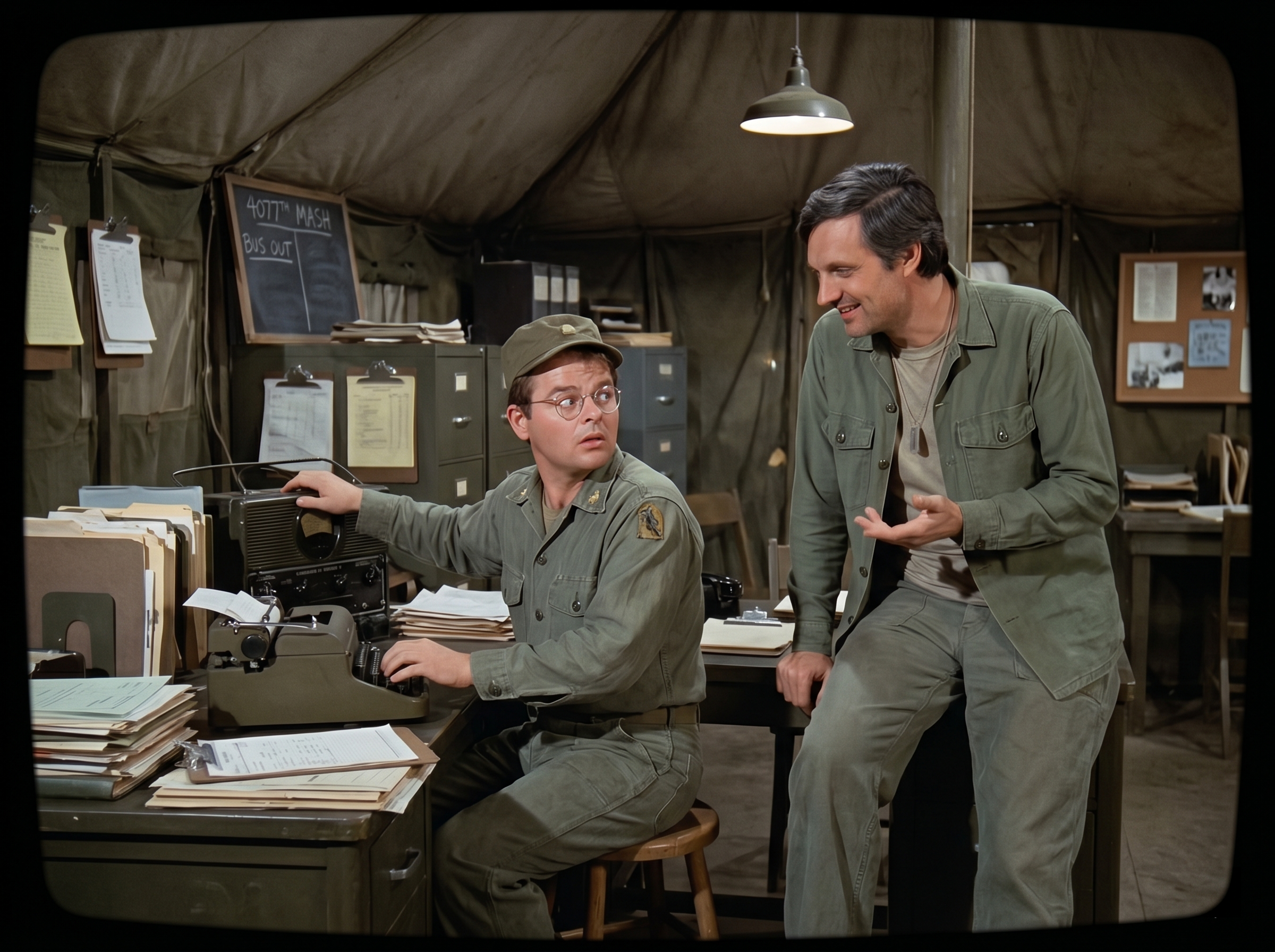
The rain had finally stopped, leaving the 4077th submerged in that heavy, suffocating silence that only follows a long night in the OR. Inside the Company Clerk’s office, the air was thick with the smell of damp canvas, old paper, and the lingering scent of stale coffee.
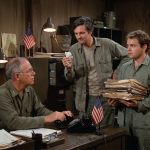
Radar O’Reilly sat hunched over his desk, his fingers hovering hesitantly over the typewriter keys. He looked like a man trying to solve a puzzle where the pieces kept changing shapes. His glasses were slightly askew, and his brow was furrowed in that familiar, frantic way that meant something important—or perhaps something utterly trivial—was driving him to the brink of exhaustion.
Hawkeye Pierce leaned against the desk, his body language effortlessly relaxed in sharp contrast to the tension vibrating off the clerk. Hawkeye had his hands outstretched, his expression caught somewhere between amused curiosity and genuine concern. He watched Radar toggle a switch on the nearby radio, his eyes tracking every nervous movement the young corporal made.
“Radar,” Hawkeye began, his voice a low, raspy velvet that barely cut through the quiet. “Whatever you’re listening for, it isn’t going to come through on that frequency. You’re scanning static, my friend. Beautiful, rhythmic, brain-numbing static.”
Radar didn’t look up, his jaw set firm. He adjusted the dial a fraction of an inch, his eyes wide and unblinking behind his spectacles. “It’s not just noise, Captain. It’s… well, it’s not *just* noise. I heard a signal earlier. A faint one. Someone calling out. I think—I think it might be something from home.”
Hawkeye sighed, a sound that carried the weight of a thousand surgeries, but his eyes softened. He reached out to gently steady the radio, his hand brushing near Radar’s.
“Radar, look at me,” Hawkeye said, his tone shifting from playful to something much deeper. “We’ve been awake for thirty-six hours. The war isn’t broadcast on AM radio, and your mother isn’t calling you on a shortwave set in the middle of a Korean mud-pit. You’re chasing ghosts in the machine, and they’re going to break your heart if you let them.”
Radar finally looked up, his gaze meeting Hawkeye’s with a startling, raw vulnerability. “But what if it’s not a ghost?” he whispered. “What if it’s the only thing that’s real right now?”
The silence that followed was absolute, heavy with the unspoken fear that for all of them, the only thing that felt real was the fatigue, the distance, and the terrifying hope that they might one day wake up somewhere else.
Hawkeye pulled his hand back, his lighthearted facade crumbling to reveal the tired, aching human underneath. He looked at Radar—really looked at him—and saw not just the company clerk, but a boy carrying the crushing weight of every message, every casualty report, and every missed homecoming of the entire camp.
“Alright,” Hawkeye said, his voice softer, devoid of its usual sharp edge. “If it’s real, then we’ll hear it together. But you have to promise me one thing: if it’s just the wind in the wires, we’re going to the mess tent, and we’re going to eat whatever Potter is calling stew today. Deal?”
Radar nodded slowly, a small, tentative smile touching the corners of his mouth. He turned back to the radio, his touch lighter now. He didn’t crank the dial in desperation; he began to tune it with the patience of a watchmaker.
They sat there for a long time. The only sounds were the soft *click-clack* of the typewriter keys Radar had bumped, the distant groan of a truck engine starting up outside, and the persistent hiss of the radio.
Hawkeye stopped leaning and pulled up a wooden crate, sitting down so he was level with the corporal. He didn’t speak. He simply existed in that space with Radar, a silent anchor in a world that felt like it was constantly drifting away.
Then, through the wall of white noise, a sound emerged.
It wasn’t a voice. It wasn’t a broadcast from home. It was a melody—a distorted, warbling, beautiful snatch of a big band tune, barely audible, struggling to survive the atmospheric interference. It lasted for perhaps ten seconds, a tiny, golden thread of music woven into the fabric of the war.
Radar froze, his breath catching in his throat. Hawkeye leaned in, his head tilted, a look of profound, quiet awe crossing his face.
The music faded back into the static, but the tension in the room had vanished, replaced by a strange, lingering warmth. Radar let out a long, shaky breath and reached up to adjust his glasses.
“Did you hear that?” Radar asked, his voice barely a whisper.
“I heard it,” Hawkeye replied, clapping a hand firmly on Radar’s shoulder. “I heard it loud and clear.”
They sat in the dim light of the tent for a while longer, not needing to speak. The radio was still hissing, but the sound no longer felt like a void. It felt like a tether. They were exhausted, they were thousands of miles from anywhere they wanted to be, and they were trapped in a place that defied all logic.
But for a moment, they weren’t just a surgeon and a clerk. They were two friends who had found a fleeting piece of beauty in the middle of the mess, and that was enough to get them through to the next shift, the next meal, and the next day.
Hawkeye stood up, his knees popping, and gave Radar’s shoulder one final squeeze. “Come on, Corporal. Let’s go see if we can find something to eat that isn’t made of mystery.”
Radar turned off the radio, the silence of the tent now feeling peaceful rather than heavy. He stood up, gathered his papers, and followed Hawkeye out into the bright, harsh Korean sunlight, leaving the office behind but carrying the echo of that music with them.
It wasn’t much, but in the 4077th, a little bit of harmony was sometimes all you needed to keep the world turning.