A Moment of Grace in the Mess Tent
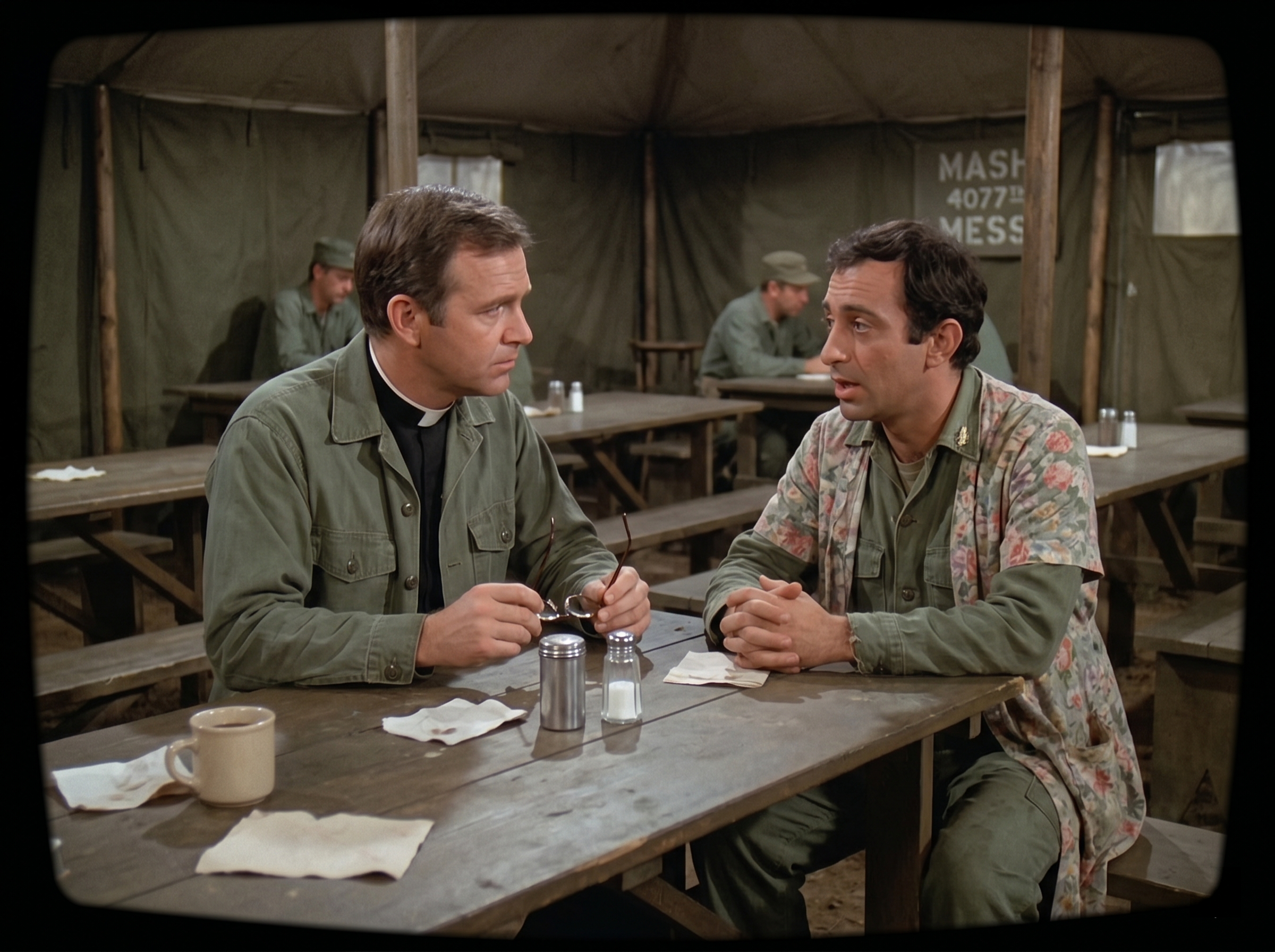
The coffee was, as usual, a chemical concoction that tasted vaguely of burnt rubber and desperation. It was 03:00 hours, or maybe 14:00—time had a way of losing its shape at the 4077th, thinning out like the mountain air until all that remained was the hum of the generator and the weight of the day’s work.
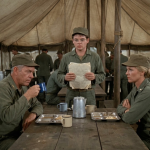
Father Mulcahy sat opposite Klinger at the scarred wooden table in the mess tent. The rest of the camp was strangely quiet, a rare lull that felt more like a held breath than a true reprieve. The Father’s fingers were loosely laced around his spectacles, his expression contemplative, eyes fixed on the man across from him with a gentle, searching kindness.
Across the table, Klinger looked uncharacteristically subdued. He was dressed in a flowered housecoat layered over his fatigues, a sartorial protest that usually demanded a laugh or a double-take. But today, the humor didn’t seem to reach his eyes. His shoulders were slumped, and he sat with his hands clasped tightly together, his posture radiating a profound, quiet exhaustion that went deeper than just physical fatigue.
“You haven’t touched your beans, Maxwell,” the Father noted softly, his voice cutting through the stillness.
Klinger shifted, the floral fabric of his housecoat rustling loudly in the quiet tent. He looked up, his trademark theatrical bravado missing, replaced by a raw, flicker of vulnerability.
“I don’t think I have the stomach for the culinary delights of the Army today, Father,” he replied, his voice rough.
He hesitated, then leaned in, his knuckles turning white from the pressure of his grip.
“I got a letter today,” he whispered, his eyes suddenly glistening. “And for the first time in three years, I’m not sure if I want to go home, or if I’m just afraid that home isn’t there anymore.”
The silence that followed felt heavy, pulling at the very foundations of the tent. Father Mulcahy didn’t rush to fill it with platitudes. He simply set his glasses down on the table, placed his hands flat on the wood, and waited. He knew the weight of a soldier’s doubt; he carried enough of it in his own heart to recognize the shape of it in others.
“Fear is a heavy thing to carry alone, Klinger,” the Father said, his tone steady and devoid of judgment. “It’s often heavier than the actual burden itself. Is it the uncertainty of the change, or is it the fear that you’ve changed too much to fit back into the life you left behind?”
Klinger let out a jagged breath, a sound that started as a laugh and ended as something much more fragile. He looked down at the table, tracing the deep gouges in the wood left by years of cutlery and frustrated soldiers.
“I’ve spent so much time trying to be the guy who doesn’t belong here, that I’m starting to wonder if I’ve forgotten how to be the guy who belongs anywhere,” Klinger admitted. He gestured vaguely at his housecoat. “This? It started as a joke, a way to keep my sanity. But now, it feels like it’s the only thing that proves I’m still me. If I take it off, who is standing there?”
Father Mulcahy reached across the table, his hand covering Klinger’s briefly—a gesture of grounding, of human connection that bridged the gap between the man of the cloth and the man of the front lines.
“You are the man who has kept his humor in a place that tries to drain it away,” Mulcahy said firmly. “You are the man who looks out for the others, even when you’re the one feeling most lost. The clothes don’t make you, Klinger. The compassion you show, the way you refuse to let this war strip you of your personality—that is who you are.”
Klinger looked up, a small, tired smile finally touching his lips. It wasn’t his usual mischievous grin, but something softer, something real. He pulled his hands apart and slumped back against the bench, the tension in his shoulders beginning to bleed away.
“I suppose,” Klinger murmured, looking at the Father with genuine gratitude. “Maybe I just needed to hear someone else say it so it wouldn’t sound like a lie in my own head.”
The mess tent felt a little warmer, a little less like a waiting room for the next crisis. They sat together for a long time, not saying much more, just two men sharing a quiet corner of a world gone mad. They were miles from home, surrounded by the debris of a conflict that made little sense, yet in that small, shared space, they found a moment of profound peace.
It wasn’t a victory in the way the generals measured it, but it was a victory nonetheless—a testament to the fact that, at the 4077th, no one was truly meant to walk through the fire alone. As the distant rumble of a truck echoed outside, they stood up together, ready to face whatever the next hour might bring, fortified by the simple act of having been heard.
In the heart of the 4077th, the most vital medicine was always the grace we found in each other.