A Patchwork Family in the Mud
You never knew what would crack the silence first. The endless shelling from the hills was the soundtrack, but inside, the silence held its own special power.
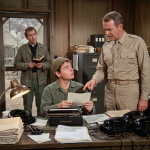
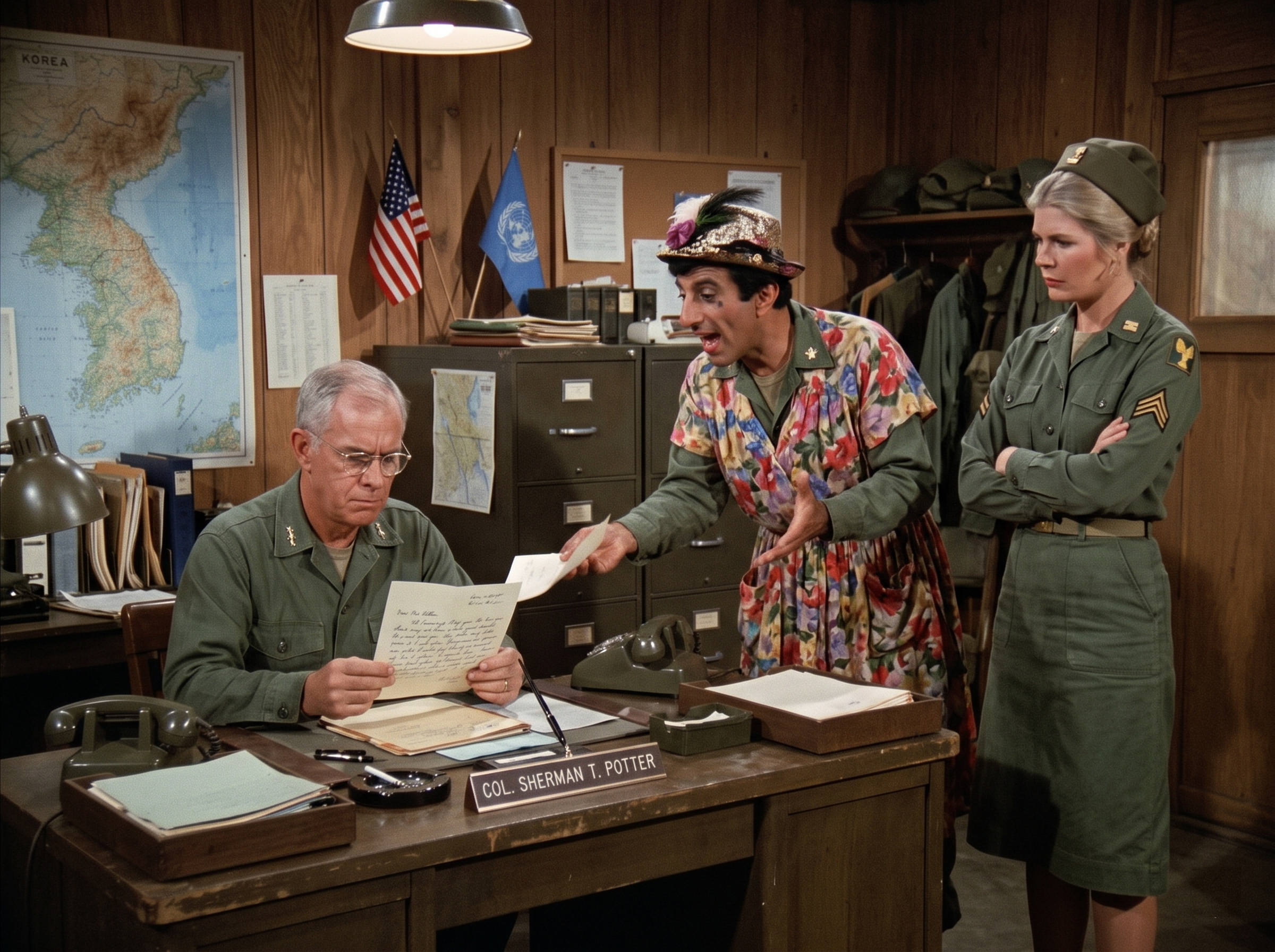
Colonel Sherman Potter’s office was a small fortress. The wood-paneled walls absorbed the cigarette smoke and the anxiety, and the glow of the desk lamp painted a steady circle of light over a mountain of paperwork. The nameplate was simple: “COL. SHERMAN T. POTTER.”
Across the desk, Major Margaret Houlihan was a study in controlled tension. Her arms were crossed, her green uniform crisp and her blonde hair pinned back with military precision. She stared at the closed door, but the lines on her forehead showed the fatigue that none of them could escape. They were waiting.
The door burst open not with a bang, but with a rush of floral energy.
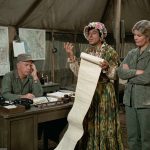
Maxwell Klinger didn’t just enter a room; he performed. He looked less like an orderly and more like a very determined extra who had lost his way from a Gilbert and Sullivan production, having only found a particularly dramatic floral housecoat and a feathered hat. The pattern was a dizzying mix of petunias and something that might have been a carnation, cinched tightly with his fatigue belt.
“Colonel, Major,” Klinger announced, his hand sweeping wide in a classic theatrical bow. His voice was a perfect balance of desperation and earnest conviction. The feathered hat wobbled, adding an absurd exclamation point to his arrival.
Potter didn’t even look up at first. He adjusted his glasses, picked up the next file, and casually placed it down. “Well, look who it is. Miss Toledo, 1952.“
Klinger didn’t let the dry humor slow him down. He marched to the desk, his boots making a mismatched thumping sound. He slapped a single sheet of paper down in the ‘IN’ tray with the authority of a general signing an armistice. Potter calmly removed it and placed it on the desk blotter, the nameplate just visible beneath the edge of the paper.
“It’s not for me, Colonel,” Klinger said, gesturing wildly with his other hand, which held a matching floral handkerchief. “It’s a petition. For sanity.“
Potter’s fatherly exasperation was already on his face as he picked up the paper. “A petition for sanity. Signed, I assume, exclusively by you?“
“And fifteen other good men!” Klinger retorted, placing his hand dramatically over his heart. “Men who are suffering. We need change. We need hope. We need…“
“You need a transfer home,” Margaret finished dryly, her eyes narrowing as she shifted her weight. She glared at Klinger’s hat as if she could make it disappear with sheer force of will. “I’m sure you’re very passionate, but the Colonel has real work to do.“
“A petition signed by fifteen men,” Potter said, reading the paper thoroughly. He didn’t immediately dismiss it. That was his gift. He listened. “Klinger, it’s addressed to… the President.“
“Yes, sir!” Klinger said, standing at what could best be described as flamboyant attention. “President Eisenhower. He loves a strong, united message. This is democracy at its finest, right here in the mud!“
Potter looked up, his expression a complicated map of weariness, amusement, and a quiet, profound understanding. ” Democracy at its finest,” he repeated. He picked up the paper again. “It seems to be mostly about… petunias.“
Klinger’s dramatic facade slipped for a microsecond, his shoulders slumping. He caught his breath, his mouth slightly open, before recovering and striking a new pose. “The petunia is a simple, hardworking flower, sir! A symbol of home. A reminder that life continues in colors other than… this!” He gestured wildly, his floral dress sweeping over the desk phones.
Potter set the paper down and looked directly at Klinger, no longer seeing Miss Toledo, but a soldier drowning in the endless green and gray. “Klinger, you’re trying to build a garden on a swamp,” Potter said, his voice soft, almost conversational. He leaned back in his chair, the spring groaning softly.
He didn’t make it a joke. He made it about the loneliness they all carried. Potter reached into a side drawer, pulling out a faded photograph of Mildred, placed it on top of Klinger’s petition. “Last letter I got from Mildred, she wrote three pages about her geraniums. One of them had a spot. She was very upset. Spent two hundred words on a mildew stain.“
Klinger listened, the energy draining out of his performance. He looked at the photograph, then at the petition on the desk, then at the map of Korea on the wall, marked with pins of previous battles.
Margaret took a half-step forward, relaxing her arms. Her command presence didn’t vanish, but it softened, revealing the woman beneath the rank. She touched the back of her head, adjusting a pin, a simple, human gesture. “The garden. That’s what we’re missing, Klinger. A garden.“
The humor was gone, replaced by a raw, fragile moment of shared humanity. For a few seconds, the three of them—the fatherly commander, the stern nurse, the desperate performer—were just three people, far from home, looking at the same map, smelling the same stale coffee, holding onto the same desperate need for something green and alive in the endless brown mud.
Klinger looked at his own floral dress. “I thought… I thought maybe the colors would help,” he admitted, his voice a genuine whisper. “I missed the sight of them.“
Potter didn’t offer a Section 8 discharge. He didn’t offer a promotion. He looked at the desk phones, at the filing cabinets, at the simple, sturdy objects that were the tools of their survival. He looked back at Klinger and offered the only thing he could.
“The best I can do, Klinger,” Potter said, picking up the petition, folding it gently, and handing it back. “Is a fresh ration of chocolate for your entire platoon, directly from me. And I’ll let you keep the dress. But please… the hat only in the latrine. It scares the horses.“
Klinger didn’t make a joke. He didn’t gesture. He took the paper, clutched it to his chest, and gave a small, genuine nod of gratitude that was more meaningful than any theatrical bow. He looked at Potter, then at Margaret, a quick, silent acknowledging glance that said thank you for seeing me, not the clown, not the scheme, but the person.
“Thank you, sir,” Klinger whispered. “Major.“
He saluted with simplicity, the dress swishing softly as he turned and walked out, closing the door behind him with a quiet click.
The silence that returned was different. It wasn’t full of anxiety. It was full of shared endurance. Potter picked up the next file, the desk lamp glowing steadily. He adjusted his glasses and looked at Margaret.
She met his gaze, her expression softer, her hands clasped loosely in front of her. She didn’t say a word. She didn’t need to. They understood.
Potter’s gaze lingered on the closed door, then down at the map of Korea on his wall. He picked up the file, but before he started to read, he took a quiet, deep breath, holding the thought of home, a single, tiny, precious seed of normalcy that kept him going in the mud. He knew Klinger was doing the same thing.
They were a patchwork family in a broken world, but in that office, for one small moment, they were all home.