A Splash of Color in the Supply Tent
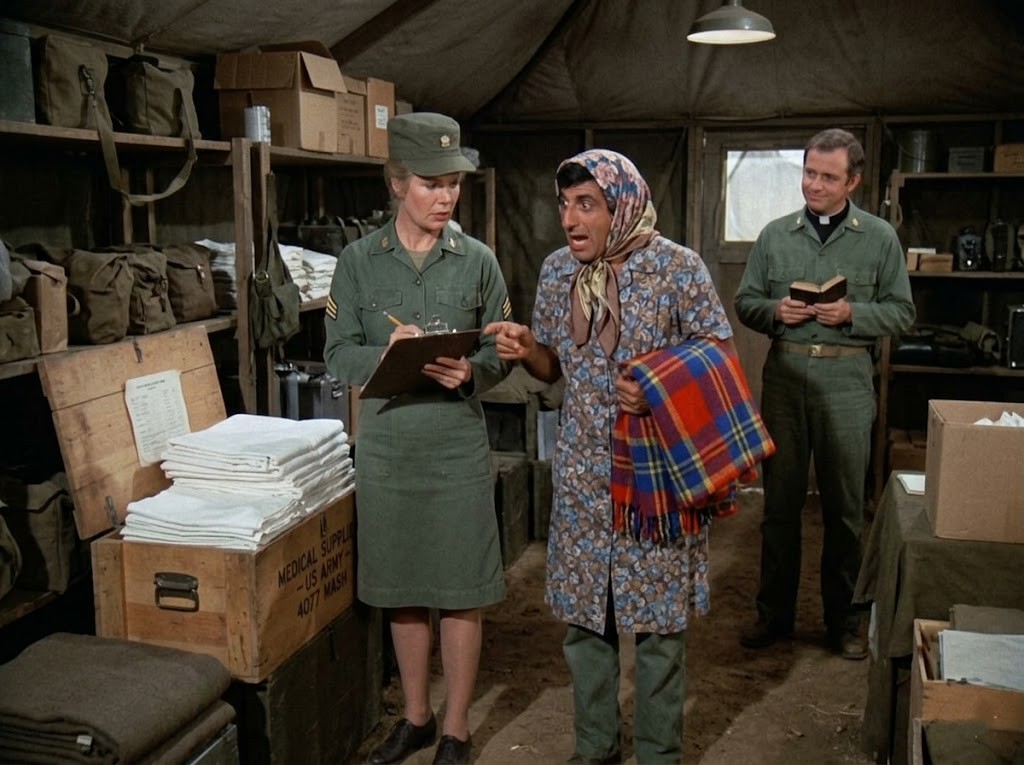
In the freezing, mud-soaked reality of the 4077th, color was a rare luxury.
Everything in their world was painted in the same exhausted shades of olive drab, faded khaki, and the dull, endless brown of the Korean dirt.
But inside the main supply tent, a standoff was brewing over something entirely out of place.
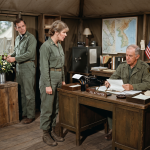
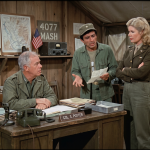
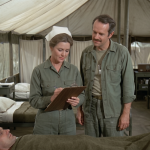
Major Margaret Houlihan stood tall in her crisp green fatigues, a wooden clipboard pressed firmly against her side.
She was in the middle of a brutal inventory count, trying to make sense of the meager supplies the Army had seen fit to send them.
Beside her, a large wooden crate sat open, clearly stamped with bold black letters: *MEDICAL SUPPLIES – US ARMY – 4077 MASH.* Neat stacks of stark white towels and folded linens sat on top of the crate, organized with Margaret’s signature precision.
Father Mulcahy stood quietly in the background, a small prayer book held gently in his hands.
He had come looking for a quiet place to read, but he found himself an amused spectator to the latest clash of wills.
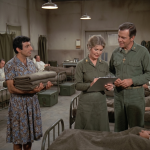
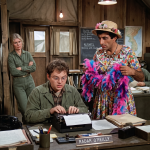
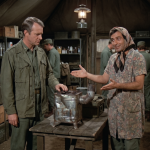
Standing in front of the stern Head Nurse was Corporal Maxwell Klinger, looking as absurd and deeply earnest as ever.
He was wearing a light blue floral dress that hung loosely around his knees, paired with a patterned babushka tied snugly under his chin.
But it wasn’t the dress that had brought the supply tent to a tense standstill.
It was what Klinger had draped over his arm.
It was a brilliant, thick, beautifully woven plaid blanket, glowing with deep reds, bright yellows, and rich blues.
It looked incredibly soft, entirely civilian, and wonderfully warm.
Margaret’s eyes had locked onto the blanket the second Klinger walked through the canvas flaps.
“I don’t care what your latest excuse is, Corporal,” Margaret said, her voice sharp and uncompromising. “We are desperately short on bedding. I am requisitioning that fabric for the post-op ward immediately.”
Klinger took a step back, his eyes going wide with defensive outrage.
He raised a finger, pointing it directly at Margaret as his voice hit that familiar, desperate pitch.
“Hold it right there, Major!” Klinger barked. “This is private property! An irreplaceable heirloom straight from the heart of Toledo!”
“It’s a blanket, Klinger,” Margaret countered, tapping her yellow pencil against her clipboard. “And the United States Army needs it. Hand it over.”
“You can’t have it!” Klinger insisted, clutching the bright plaid fabric tighter to his chest. “It’s vital to my new persona! How can I be a grieving Scottish widow without my ancestral tartan? The psychiatrists will never believe me!”
“I am not interested in your Section 8 theatricals,” Margaret said, taking a step forward, her military posture stiffening.
The wind howled outside the tent, a bitter reminder of the dropping temperatures.
“I have boys shivering in the recovery room right now,” Margaret continued, her tone losing its patience. “That scratchy olive-drab wool the Army provides isn’t enough. That blanket is going on a patient’s bed.”
Father Mulcahy watched the exchange, his gentle smile faltering just a bit as he sensed the shifting mood in the room.
This wasn’t just the usual banter anymore.
Margaret extended her hand, palm up, silently demanding the blanket.
But Klinger didn’t move.
The manic energy suddenly drained from his face, replaced by a stubborn, deeply quiet defiance that took Margaret entirely by surprise.
His raised finger lowered, but his grip on the colorful wool only tightened.
“I said no, Major,” Klinger said, his voice dropping to a low, serious register. “You’re not taking this one. Not for your inventory.”
Margaret’s eyes flashed with anger, her authority openly challenged, and the air in the supply tent grew dangerously cold.
The silence that followed was heavy and thick.
Margaret’s jaw set tightly, her grip on the clipboard turning her knuckles white.
“Corporal,” she said, her voice dropping to a dangerous whisper. “You are bordering on direct insubordination. I could have you written up and scrubbing latrines until the armistice.”
Before Klinger could fire back, a soft, measured voice broke the tension.
“Now, now, let’s not be hasty,” Father Mulcahy said, stepping forward from the shadows of the wooden supply shelves.
He kept his small book clasped in his hands, his kind eyes moving between the rigid Major and the defensive Corporal.
“Major, perhaps there is a misunderstanding,” Mulcahy suggested mildly, his calming presence acting as a sudden buffer.
He turned his gentle gaze to Klinger.
“Max,” the priest said softly. “The Major is right about the cold. The boys in post-op are truly suffering today. Is this ‘ancestral tartan’ really so important for a trip to the psychiatrist?”
Klinger looked at Father Mulcahy, and the last of his theatrical bravado completely melted away.
His shoulders slumped beneath the thin floral fabric of his dress.
He looked tired. Not just physically exhausted, but bone-weary in the way that only the 4077th could make a man feel.
He looked down at the bright red and yellow plaid draped over his arm, running a rough hand over the soft fabric.
“It’s not for a scam, Father,” Klinger admitted, his voice barely above a whisper.
Margaret frowned, slightly lowering her clipboard. “Then what is it for?”
Klinger sighed, looking up at the canvas ceiling for a moment before meeting Margaret’s eyes.
“My Uncle Habib sent it to me in a care package,” Klinger explained. “Said it was to keep my spirits warm. But… I wasn’t keeping it.”
He gestured vaguely toward the door of the tent, in the direction of the hospital compound.
“There’s a kid over in bed number four,” Klinger said quietly. “Private Miller. He’s nineteen. Got a belly full of shrapnel and he hasn’t stopped shaking since Hawkeye pulled him off the table.”
Margaret’s expression shifted. The rigid lines of her face began to soften.
As Head Nurse, she knew every patient by name. She knew exactly the boy Klinger was talking about.
“He was crying for his mother last night,” Klinger continued, his voice tight. “He kept talking about the quilt on his bed back home in Michigan. That Army wool is just making his skin raw. It’s too heavy, and it’s too rough.”
Klinger looked down at the vibrant blanket again.
“I was on my way to give him this,” Klinger confessed. “But I know how things work around here, Major. If I hand it over to supply, it gets logged in. It gets thrown into the general pile. It might go to the wrong guy, or get covered in mud, or get traded for gin.”
He looked back at Margaret, his dark eyes pleading.
“I just wanted this specific kid to have it,” Klinger said. “I wanted him to have something that felt like home. That’s all.”
The tension in the dusty supply tent completely vanished, replaced by a profound, aching tenderness.
Father Mulcahy smiled, a true, beaming smile, his faith in humanity reaffirmed in the most unlikely of packages.
He looked at Margaret, waiting to see what the strict, rule-abiding officer would do.
Margaret stood perfectly still.
She looked at the stacks of pristine white towels on the crate.
She looked at the scratchy, miserable brown blankets on the lower shelf.
And then she looked at Klinger, standing there in a floral babushka, holding a piece of civilian comfort in a world of military misery.
Beneath all her brass, beneath all her regulations, Margaret Houlihan was a nurse first.
She cared for her wounded boys more than she cared for breathing.
Slowly, Margaret raised her clipboard.
She picked up her yellow pencil and flipped to a fresh sheet of paper.
She made a loud, deliberate scratching sound as she wrote something down.
“Corporal,” Margaret said, her voice returning to its official, authoritative tone, but entirely missing its usual sharp bite.
Klinger braced himself. “Yes, ma’am?”
“I am logging the receipt of one non-regulation thermal covering,” Margaret announced to the room, not looking up from her paper.
“Furthermore,” she continued, her voice remarkably steady, “I am officially assigning this item to post-op bed number four, for the exclusive medical use of Private Miller. Until such time as he is discharged.”
Klinger blinked, stunned.
Margaret finally looked up, meeting his gaze.
There was a profound, quiet respect in her eyes.
“It is Army property now, Klinger,” Margaret said softly. “But it is assigned exactly where it belongs. I expect you to deliver it immediately. And see that it stays clean.”
A slow, brilliant smile spread across Klinger’s face.
He snapped off a surprisingly crisp salute, despite the dress.
“Yes, Major. Right away, Major.”
He turned and practically floated out of the supply tent, the bright plaid blanket held carefully in his arms like a treasure.
The tent was quiet again, save for the wind rattling the canvas.
Father Mulcahy stepped forward, standing beside Margaret.
“That was a very beautiful piece of administrative work, Margaret,” he said gently.
Margaret kept her eyes on the clipboard, adjusting the perfectly stacked white towels with her free hand.
“I have no idea what you’re talking about, Father,” she replied, though a small, undeniable smile tugged at the corner of her mouth. “Just doing inventory.”
She turned and walked deeper into the supply tent, leaving the priest to his quiet prayers.
In a place defined by endless gray, the 4077th survived because they always found a way to share the warmth.