The Silence After the Strom in the 4077th Post-Op
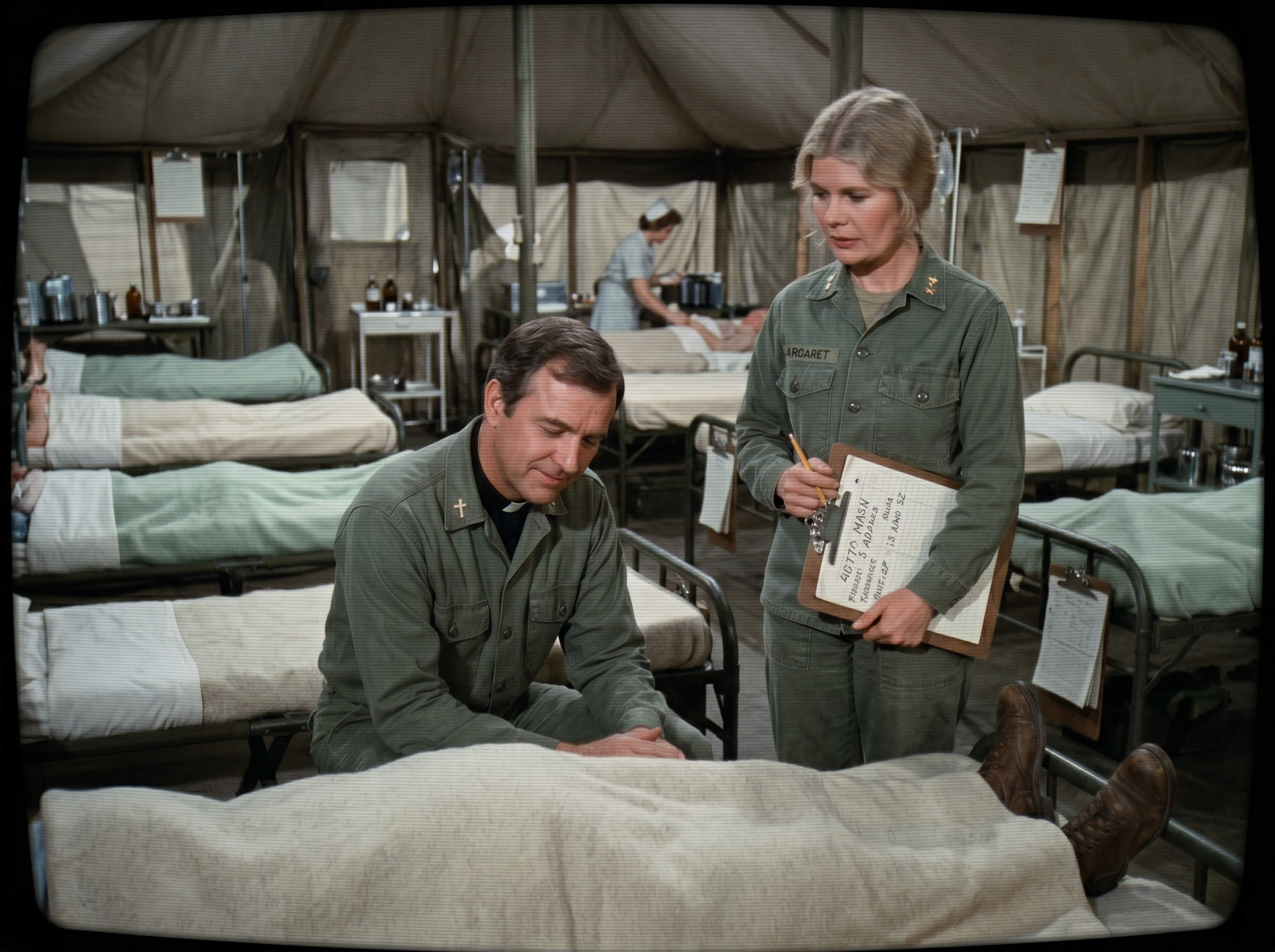
It’s the boots that get you. Those heavy, scuffed leather boots sticking out from under the scratchy wool blanket. Life, paused at the ankles.
Inside the olive-drab Post-Op ward, the noise of triage has finally been replaced by a heavy, thick silence, broken only by the rhythmic squeak of a nurse’s rubber-soled shoes on the dirt floor. The worst is over, for some.
Father John Mulcahy sits on a low metal stool beside one of the quiet cots. His shoulders are slumped under the weight of the last twenty-four hours. He has seen enough tragedy to last multiple lifetimes.
He leans in, his folded hands resting on the rough blanket, close to where the patient’s shoulder should be. He is looking down at the shrouded figure with an expression that says everything: deep, quiet sadness and a desperate, hopeful warmth. He is praying, not for a recovery, but for peace.
Standing beside him, Major Margaret Houlihan looks equally fatigued. She holds a wooden clipboard tight against her chest, her fingers clutching a pencil. The chart is full of notations and vitals—or lack thereof. Her professional mask is perfectly in place, her expression one of composed, steely strength, looking down at the cot with a critical, medical focus.
But if you look closer, past the starched collar, you can see the slight tremble in her jaw. You can see the quiet emotion pool in her eyes. The vulnerability beneath her legendary armor.
Another nurse works silently further down the row of beds. The whole ward is a sea of cots covered in muted white and pale green wool. The smell of ether and antiseptic hangs in the air, a reminder of the battle against mortality that never truly ends here.
Margaret hasn’t spoken a word since she arrived. She just watched Mulcahy sit, and then took her place next to him. Now, as Mulcahy completes his silent vigil and looks up, his eyes meet hers.
The silence stretches. Finally, it’s Mulcahy who breaks it. His voice is a gentle, almost timid whisper. “It was the boots, wasn’t it, Major?”
Margaret flinches, just a tiny bit, the comment striking a direct hit. She takes a deep, shaky breath, her gaze dropping to the floor. The professional composure cracks, just for an instant.
“They’re just leather, Father. Part of the uniform.” Her voice is controlled, but there’s a distinct wobble in it. “He was supposed to wear them on his victory walk.”
She stares down at the chart in her hands. The pencil’s point is pressed dangerously hard against the paper. She tries to lift it to make one final notation, but her hand won’t obey.
“You’ve been standing here for twenty minutes,” Mulcahy says, his tone softening with concern. “You should sit, Major.”
Margaret looks at the empty stool across the cot. The thought of collapsing onto it is almost too tempting to bear. She shakes her head. “There are still cots to check. Rounds.”
She tries to turn away, but her feet feel leaden, anchored to the dirt floor. She grips the clipboard tighter. A single, silent tear finally escapes the corner of her eye, tracking a lonely path down her cheek.
Mulcahy sees it. Without a word, he stands up from his stool. He reaches out a steadying hand and places it gently on her forearm. The touch, unexpected and tender, is enough.
Margaret looks up at him, the mask dissolving into sheer, human fatigue and grief. For one raw second, she’s not Major Houlihan, Chief Nurse of the 4077th. She’s just Margaret, tired and heartbroken.
“Just for a minute, Father,” she says, her voice breaking.
She slowly lets herself sit on the stool Mulcahy vacated. He doesn’t sit opposite her, but just stands, a quiet presence of support. She places the clipboard on her lap, hands covering the chart, looking down at the cot not as a case file, but as a person.
“Potter will be looking for this,” she says after another long minute, her voice returning to its normal, controlled cadence.
“He will understand,” Mulcahy assures her gently.
She gives the blanket one last, lingering look, her gaze resting finally on the boots. Then she nods, straightens her jacket, and picks up her pencil.
She makes the final notation. Case Closed. 12 Nov 1952. J. Adams.
She stands up, all professionalMajor again. Mulcahy gives her a small, respectful nod, and she begins the walk down the row of beds to the next patient, head held high.
Mulcahy waits until her silhouette disappears into the far end of the tent. He turns back to the cot, adjusted the blanket, and whispered a final blessing, his own tired heart a little lighter for the moment of shared vulnerability. He knows that here, the only thing thicker than the mud is the friendship that keeps them all from truly shattering.
In the 4077th, even the quietest silence tells a story.