The Plaid Petticoat and the Padre’s Prayer
Sometimes, the only thing keeping the 4077th from sliding completely into the mud of Korea was a healthy dose of pure, unadulterated absurdity.
The sound of artillery had finally faded into the hills, leaving behind a heavy, exhausted silence in the swamp. After a grueling thirty-six-hour shift in the Operating Room, the surgeons had collapsed into their cots, but for the administrative heart of the camp, the paperwork never slept.
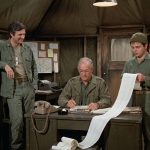
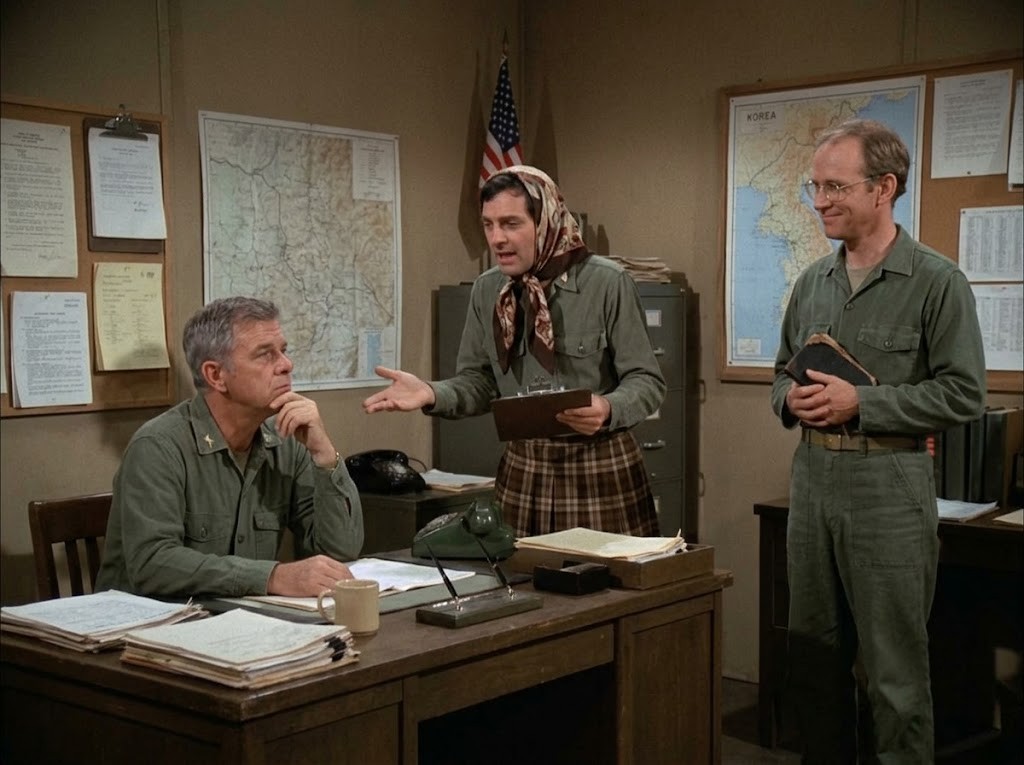
Inside Colonel Potter’s office, the air smelled faintly of stale coffee, old ink, and the damp wool of a very particular outfit.
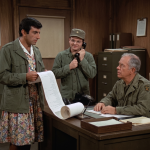
Colonel Sherman Potter sat heavily at his desk, his chin resting in his hand, staring blankly at a stack of requisition forms that seemed to multiply whenever he blinked. His face was a roadmap of fatigue, etched with the deep lines of a man carrying the weight of two hundred souls on his shoulders.
To his right stood Corporal Max Klinger, though today he looked less like an infantryman from Toledo and more like a displaced schoolmarm. He was wearing his standard olive-drab utility shirt, but it was paired with a brown plaid skirt and a matching patterned headscarf tied neatly beneath his chin.
Klinger held a clipboard tightly in one hand, his other arm extended wide in an impassioned, theatrical gesture as he pleaded his case to the exhausted commander.
“Colonel, I am begging you on behalf of my fragile psyche and my impending Section Eight,” Klinger insisted, his voice a dramatic mix of desperation and flair. “This isn’t just about a dress anymore; it’s about a man’s right to a breath of fresh air in a war zone!”
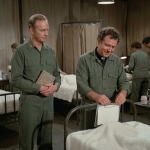
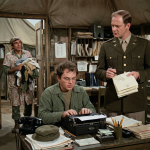
Standing just a few feet away, Father John Mulcahy watched the scene unfold with a gentle, patient smile playing on his lips. Clutching his small, weathered Bible closely to his chest, the padre looked on with the quiet, understanding indulgence of a man who had seen every kind of human coping mechanism the army could produce.
“Now, Klinger,” Colonel Potter sighed, not even shifting his gaze from the young corporal. “I’ve tolerated the chiffon, I’ve looked the other way on the taffeta, and I didn’t say a word about the yellow sundress with the matching parasol. But a plaid skirt during a supply shortage is pushing it.”
“But it’s a winter weight, Colonel!” Klinger argued, tapping the clipboard for emphasis. “And it matches the autumn foliage perfectly. If the North Koreans come over that hill, I’ll blend right into the shrubbery!”
Potter finally rubbed his eyes, letting out a long, weary breath. “Max, I don’t care if it makes you look like a Scotch thistle. I have a report here from Seoul stating that our entire shipment of winter blankets has been diverted to a division in the south. We have a cold front moving in tonight, and my people are already freezing.”
The humor in the room evaporated instantly, replaced by the stark, chilly reality of their situation.
Father Mulcahy’s smile faded, his fingers tightening slightly around the edges of his Bible. He stepped forward, his eyes filled with a sudden, deep concern for the patients resting in the post-op tent.
“No blankets, Colonel?” Mulcahy asked softly. “The boys in the wards… some of them are so weak. Without heat or extra covers, a simple chill could be disastrous.”
Klinger lowered his clipboard, the theatricality draining from his posture as he looked between the priest and the old cavalry officer. The silence in the office grew suffocatingly heavy, punctuated only by the distant, lonely bark of a stray dog outside in the compound.
Potter looked up, his eyes old and heavy with defeat. “We’re completely on our own for this one, Father. And God help us, I don’t know what I’m going to tell the doctors.”
—
The weight of the news hung in the air like a heavy fog. In the 4077th, a lack of medical supplies was a daily battle, but a lack of basic warmth felt like a cruel joke from the universe.
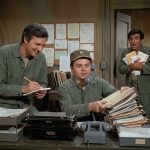
Colonel Potter stared at the papers on his desk, the lines on his forehead deepening. “I’ve got Radar trying to crack open a line to supply corps, but you know how they are. If it isn’t signed in triplicate by a general, we don’t exist.”
Father Mulcahy stepped closer to the desk, his voice steady but carrying a profound weight. “There must be something we can do, Colonel. The human body can only endure so much before the spirit gives way. I’ve been with those boys in the ward all morning. They are fighting so hard just to breathe.”
Klinger stood perfectly still, his eyes darting from the map of Korea on the wall back to the exhausted face of his commanding officer. The plaid headscarf, which had seemed so comical just moments before, now framed a face filled with intense, quiet calculation.
Slowly, Klinger lowered his arm, adjusting the clipboard against his chest. The dramatic soldier looking for a ticket home was gone; in his place stood the kid from Toledo who knew exactly how to survive when the world stripped everything away.
“Colonel,” Klinger said, his voice dropping its usual theatrical pitch, becoming surprisingly quiet and grounded. “What exactly did that supply sergeant in Seoul say?”
Potter looked up, a bit surprised by the change in tone. “He said the trucks were rerouted to the 8063rd. Said they had high-priority clearance and we were at the bottom of the totem pole.”
“The 8063rd,” Klinger muttered, a slow, knowing smile beginning to creep onto his face. “Sergeant Baker runs the supply depot over there. We used to trade silk stockings for canned peaches back in ’51.”
Father Mulcahy looked at Klinger, his brow furrowing with a mix of hope and mild moral anxiety. “Max, what are you thinking?”
“I’m thinking, Father, that Sergeant Baker has a profound weakness for authentic, homemade Lebanese baklava,” Klinger said, his eyes lighting up with a familiar, manic spark. “And I happen to have a tin of it that my mother sent me last week. It was supposed to be my victory dessert when my discharge papers finally came through.”
Potter raised an eyebrow, a tiny glimmer of interest breaking through his fatigue. “Baklava, Klinger? You think you can trade a pastry for US Army issue winter blankets?”
“Not just the baklava, Colonel,” Klinger said proudly, gesturing down at his outfit. “Baker’s camp is entirely made up of regular infantry guys. They haven’t seen a piece of civilian clothing—or anything resembling a woman—in six months. If I march over there in this plaid ensemble, carrying a tray of sweets, I’ll have those blankets loaded into the back of a jeep before the captain even knows I’m on the base.”
Mulcahy let out a soft, breathy chuckle, shaking his head. “Max, that sounds highly unorthodox. And perhaps slightly manipulative.”
“It’s a cold world, Father,” Klinger replied with a wink, turning back to the Colonel. “Permission to borrow the jeep, sir? For a diplomatic mission?”
Sherman Potter looked at his clerk. He looked at the plaid skirt, the matching headscarf, and the undeniable devotion hiding behind the ridiculous costume. A warm, fatherly smile finally broke through the Colonel’s tired demeanor, shaking his head in sheer admiration.
“Klinger, if you bring back those blankets, you can wear a wedding gown to formation every day for a month,” Potter said, his voice thick with affection. “Just get those boys warm.”
“Consider it done, Colonel,” Klinger said. He gave a crisp, surprisingly dignified salute, turned on his heel, and hurried out the door, his plaid skirt swirling behind him.
The office fell quiet again, but the heavy, suffocating despair was gone, replaced by the lingering warmth of friendship and the resilient spirit of the camp.
Father Mulcahy looked down at his Bible, a look of quiet peace on his face. “You know, Colonel, the Lord certainly works in mysterious ways.”
“He sure does, Father,” Potter agreed, picking up his coffee mug and taking a slow sip. “And sometimes, He works in a brown plaid skirt.”
—
In the heart of the forgotten war, it was the beautiful, stubborn eccentricities of humanity that kept the cold away.